The Old Country
Cover of the McNally Surname Report
Free to read · McNally and McAnally, one name with three Gaelic roots: the poor man of Mayo, the hound of Ulidia in east Ulster, and a Tyrone name. Antrim, Monaghan, Armagh and Dublin

McNallySurname meaning, origin and history

This report tells the story of the name McNally, and its longer spelling McAnally: what it means, where it lived, the people who carried it, and how it crossed to America.

Get my report · $14.99

43 pages, 15 named sources, in your inbox within a minute.

Read it. If it is not the best account of your name you have seen, reply to your receipt within 14 days and we refund you.

“I have been tracing my family tree for some time, but there were certain stories that even our closest relatives never knew about. This surname report is a true deep dive. Thank you.”Susan D., reader

Not today? Read the McNally chapter free. We will email it to you.Rather read it later? We will email you the McNally chapter.

One email: the link to this page and the free Sept Sheet, every Irish name on the shelf, its spellings and its families, county by county, on two printable pages. Nothing else unless you tick the box.

The McNally name at a glance

Meaning
Three roots: the poor man, the hound of Ulidia, and a Tyrone name
Irish forms
Mac an Fhailghigh; Mac Con Uladh; Mac Con Allaidh, reported for Tyrone
McNally or McAnally
One name in two spellings, counted as one by Matheson in 1890
Earliest dated mention
Woulfe: common in many parts of Ulster and Leinster in the 1500s; no first record
Homeland
East Ulster for most; Mayo and the midlands for Nally
Most in one county
Antrim, 573 people in 1901, once every spelling is joined
In Ireland, 1901
4,832 people across 15 spellings; McNally alone 3,369
In America
McNally 15,658 and McAnally 3,831 at the 2020 US Census
Arms
One coat, registered for a Mac Nally family Burke does not name
Chapter four, free to read in full

Armagh, Monaghan and east Ulster

Most McNallys lived in Ulster, the northern province of Ireland. In 1901, 55.2 per cent of the family lived there. Leinster, the eastern province around Dublin, held 29.1 per cent, and Connacht in the west 14.0 per cent. Munster, in the south, had only 1.7 per cent.

Within Ulster the name sat thickest in four counties. In 1901, counting every spelling, Antrim held 573 people of the name, Monaghan 550, Armagh 525 and Tyrone 516. Dublin, the capital, had 512.

"In the seventeenth century, as now, this is where the name was most common."

Matheson found the same counties from the births of 1890. He counted 101 birth entries for McNally and its spellings, 59 of them in Ulster. He named the counties where it was "principally found": "Antrim, Armagh, Monaghan, and Dublin". Those are entries in a birth index, not people.

Bell found the name strongest in Armagh and Monaghan. Taken together, he writes, McNally and McAnally were "the nineteenth most common name in Monaghan in 1970". It was to the town of Monaghan that a McNally bishop moved his see, as a later chapter tells.

One county needs a warning. In Tyrone in 1901, 308 of its 483 McNallys were written "Mc Nally", with a space. That was a clerk's or a transcriber's habit. Search the online census for McNally alone, and you will find only about a third of Tyrone's.
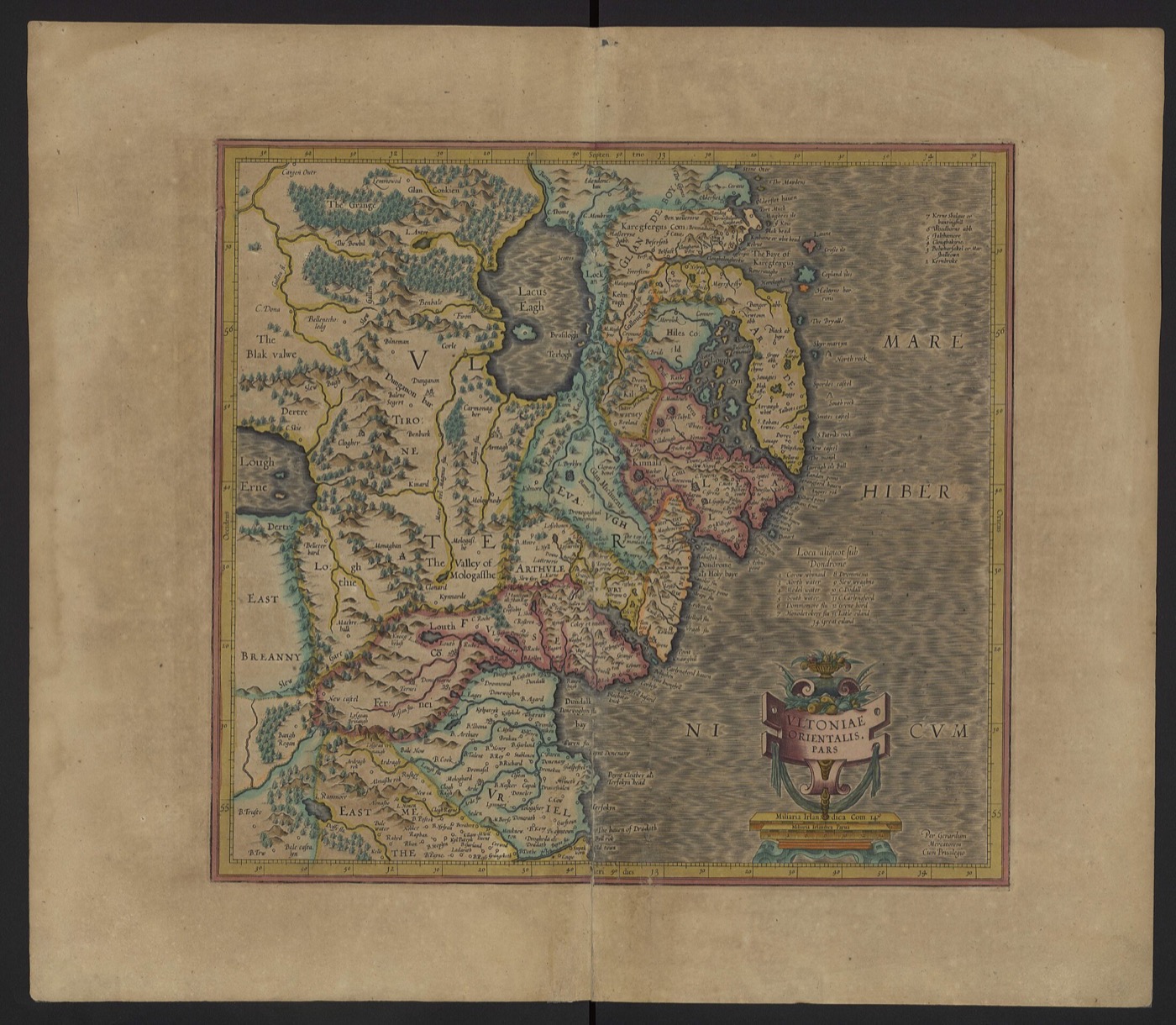
Eastern Ulster as Gerard Mercator drew it, in the Hondius atlas edition of 1628, with Lough Neagh near the top and Armagh and Tyrone to its west and south: the
Eastern Ulster as Gerard Mercator drew it, in the Hondius atlas edition of 1628, with Lough Neagh near the top and Armagh and Tyrone to its west and south: the east Ulster country where Bell finds the McNally name most common. North is at the top. Bibliotheque municipale de Bordeaux; public domain.
McNally and McAnally, one name with three Gaelic roots: the poor man of Mayo, the hound of Ulidia in east Ulster, and a Tyrone name. Antrim, Monaghan, Armagh and Dublin · 43 pages

The full McNally surname report

That was one chapter. The report carries the rest: where the name comes from, the family and its chiefs, heraldry, the stories, a timeline, migration, the name today, notable bearers, and a page on tracing your own line. Every claim sourced the same way as the chapter above.

Get my report · $14.99

Instant download, yours to keep and print

Read it. If it is not the best account of your name you have seen, reply to your receipt within 14 days and we refund you.

Not your name? Search yours, or read another name's free chapter.

The editions

Read it, watch it, or keep it on the shelf.

One piece of research, three more ways to have it. Every edition includes the McNally report itself.

Watch itin five days$39.99

The McNally report and a five and a half minute film of the name, your spelling on the title.

Get the film · $39.99
Keep itin two weeks$79

The McNally report as a hardback, posted free to your door.

Get the book · $79
All three Best valuesaves $19.99$99

The report, the film and the hardback. Bought apart they are $118.99.

Get all three · $99

For the wall. The McNally record on one framed sheet, 16 by 12 inches, $89 posted free. See the framed plate.

A gift? Send the McNally report on a day you choose, with a card.

The sources page, in fullWhere every claim on this page comes from.
Where the record is uncertainWhere tradition and record disagree in these pages, we have said so in the text rather than choosing quietly. Where one writer is the only authority for a statement, the report says whose it is. No commercial surname site was used.
  • Patrick Woulfe, Irish Names and Surnames (Sloinnte Gaedheal is Gall), Dublin, 1923: the entries Mac an Fhailghigh, Mac Conuladh, Mac Conallta and Mac an Ultaigh, and the Irish-English index.
  • Robert Bell, The Book of Ulster Surnames (Belfast, 1988), the entry MacNally.
  • Sloinnte Gaelacha in Ultaibh, O Duibhin's guide to Ulster surnames (teanga.info), the entries Mac Con Allaidh and Mac Con Uladh, reporting Seamus O Ceallaigh in the Journal of the Royal Society of Antiquaries of Ireland, volume 81 (1951), page 39.
  • Robert E. Matheson, Special Report on Surnames in Ireland (Dublin, 1909 edition), the births of 1890; and his Varieties and Synonymes of Surnames and Christian Names in Ireland (Dublin, 1901).
  • Annals of the Four Masters, in John O'Donovan's edition, Annals of the Kingdom of Ireland, under 1178; read in the CELT edition, University College Cork.
  • Dictionary of National Biography, volume 35 (London, 1893), "MacNally, Leonard", by J. M. Rigg.
  • Alfred Webb, A Compendium of Irish Biography (Dublin, 1878), the entry for Leonard McNally.
  • Andrew McNally, 1836-1904: Memorials, Messages of Condolence, and Press Notices (Chicago, 1904), with the press notices it reprints.
  • Diocese of Clogher, the history of St Macartan's Cathedral, Monaghan (clogherdiocese.ie).
  • Sir Bernard Burke, The General Armory of England, Scotland, Ireland, and Wales (London, 1884), under Mac Nally.
  • James Fairbairn, Fairbairn's Book of Crests of the Families of Great Britain and Ireland, fourth edition (London, 1905), volume 1, under MacNally.
  • National Archives of Ireland, Census of Ireland 1901 and 1911, online index, counts by spelling, county and religion.
  • US Census Bureau, surnames from the 2010 and 2020 censuses.
  • National Records of Scotland, surnames in the registers of births, marriages and deaths, 1975 to 2025.
  • Cover: "View of College-street, Armagh, taken from the road leading to the Observatory", The Dublin Penny Journal, 1835, public domain. Armagh, the city where Andrew McNally was born the year after this view was printed.

This history is written from public-domain sources and the family's own published records, every one of them listed. Where tradition and record disagree the text says so rather than choosing quietly. No image on this page is AI-generated.

First edition · last revised

More surname histories, free to read

Every surname we have written →