The Old Country
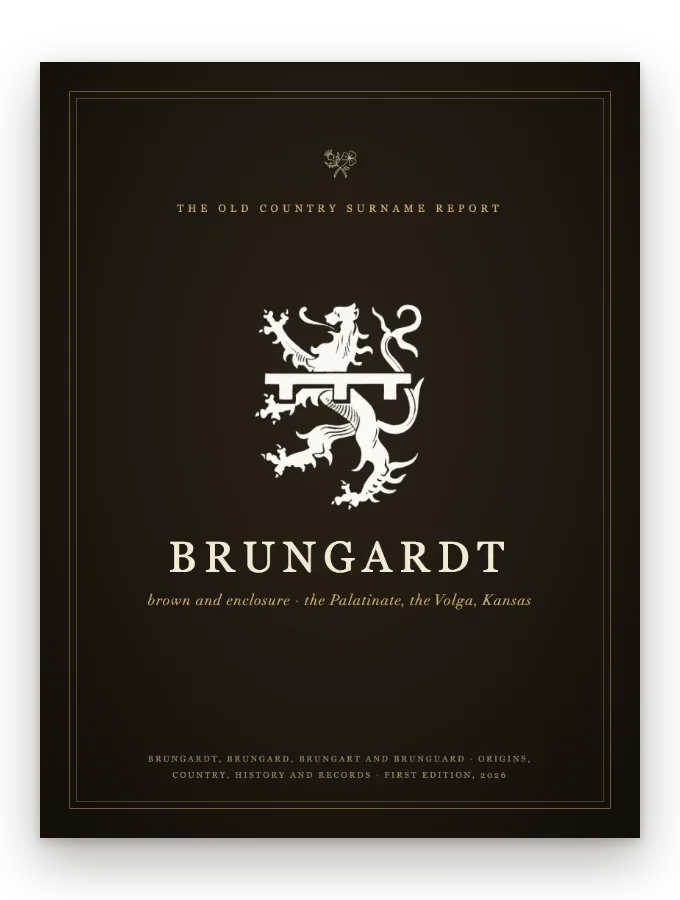
Cover of the Brungardt Surname Report
Free to read · a Palatinate name that went to the Volga, then to Kansas

BrungardtSurname meaning, origin and history

Brungardt is a small name with a long paper trail, and the trail runs in a straight line. It starts in the Catholic register of Contwig, near Zweibrücken in the Palatinate, where a Franciscus Brunguard was baptised in 1709. It crosses to Russia in 1766, when his son Franz Peter reached the Volga and was put down on a list of colonists bound for the village of Rohleder. It moves a few miles up the meadow side of the river to Herzog in 1791 and 1795. And in the summer of 1876 it leaves Herzog in a body: seven Brungardt entries on one party's list, bound for a new Herzog on the prairie of Ellis County, Kansas, a village that took the name Victoria in 1913.

Get my report · $14.99

44 pages, 20 named sources, in your inbox within a minute.

Read it. If it is not the best account of your name you have seen, reply to your receipt within 14 days and we refund you.

“I have been tracing my family tree for some time, but there were certain stories that even our closest relatives never knew about. This surname report is a true deep dive. Thank you.”Susan D., reader

Not today? Read the Brungardt chapter free. We will email it to you.Rather read it later? We will email you the Brungardt chapter.

One email: the link to this page and the free Name Atlas, ten German names and the region each spelling belongs to, on two printable pages. Nothing else unless you tick the box.

The Brungardt name at a glance

Meaning
From an early medieval personal name, presumably Brungard, made of Old High German and Old Saxon brun, brown, and gart, a fence or enclosure, as the Dictionary of American Family Names gives it
Name type
A German name from a personal name, not a trade, an office or a place. The family's own record writes it Brunguard, Brungart, Brungard and Brungardt
Heimat
Stambach, in the Catholic parish of Contwig near Zweibrücken in the Palatinate. On the Volga, Rohleder from 1766 and Herzog from 1791
Earliest documented bearer
Franciscus Brunguard, baptised in the Catholic register of Contwig on 17 February 1709, father of the emigrant Franz Peter
Heraldry
None for the name. The cover carries the arms of the town of Zweibrücken, the district the 1767 census names: the town's, not this name's
Recorded surname ranks
United States: 1,386 bearers at joint rank 19,489 in 2010, and 1,316 in 2020. Germany: 29 telephone entries in 2002, rank 100,584, as Geogen maps them
The crossing
Seven Brungardt entries of Herzog on the list of the party that took the Mosel in 1876, 39 people at most, at Victoria, Kansas, on 3 August
The informant
B. Brungardt, named in eleven of the notes to Francis Laing's 1910 history of the German-Russian settlements of Ellis County
Chapter four, free to read in full

Stambach, by Contwig: the Palatinate home

The Brungardt Heimat is a village of a few hundred people in the hills of the western Palatinate. Meyers Gazetteer, the gazetteer of the German Empire of about 1912, enters Stambach as a village of the Bavarian Palatinate in the district office of Zweibrücken, with its civil registry at Contwig and a population of 525. Today it is part of the municipality of Contwig, in the Landkreis Südwestpfalz of Rhineland-Palatinate, a few miles east of Zweibrücken. It is not a famous place, and this report does not dress it up as one. What makes it the family's is a register.

Catholics and Lutherans shared one church at Contwig from 1684 until 1903 to 1905, and the Brunguards are in its Catholic books.

The Brunguards of Stambach were Catholics, and their baptisms, marriages and burials were written in the Catholic books of Contwig. The parish was an unusual one: from 1684, under French control of the district, Catholics and Lutherans shared its one church, St Thomas, and they went on sharing it until the Catholic church of St Laurentius was built in 1903 to 1905, as the Center for Volga German Studies at Concordia University prints the parish history. In those books Franciscus Brunguard was baptised on 17 February 1709, son of Mathias Brunguard and Anna Margaretha Guiot. On 20 November 1731 he married Anna Magdalena Schoenberger of Stambach, and the register then follows their eight children one by one.

It is a hard register to read. Five of the eight died young, among them four girls given the same name, Maria Barbara, one after another. Anna Magdalena died at Stambach on 19 May 1760, aged 58. The 1767 census on the Volga, as the Volga German Institute prints it, gives her son Franz Peter's origin only as the German region of Zweibrücken; the Contwig books name the village. The family also kept a tradition of its own, which B. Brungardt gave to Laing in Kansas: that its maternal ancestors came from Ornbau in Bavaria. It is a tradition of the mother's side, from one informant, and Laing himself added that such details are rare.
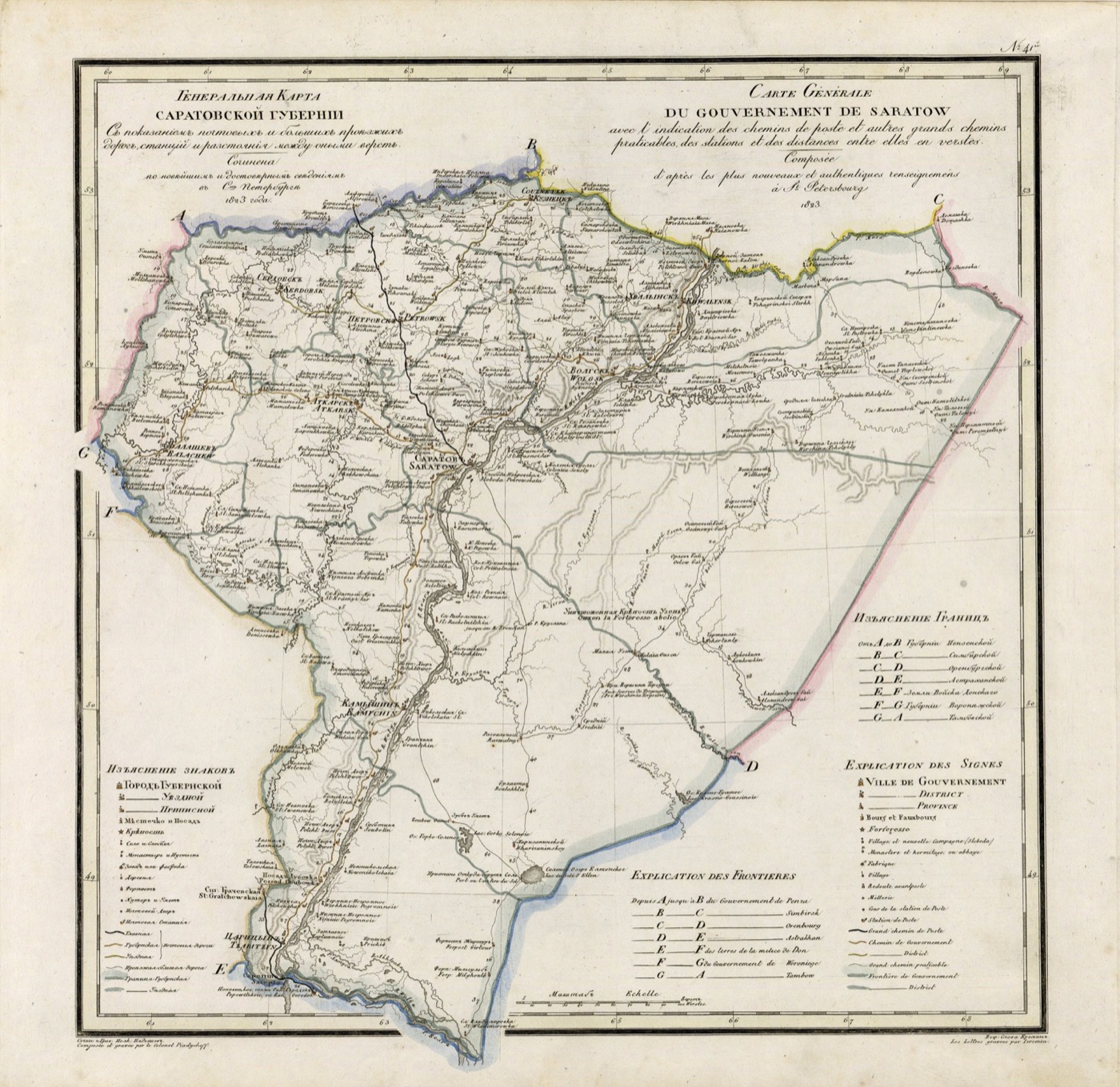
Saratov province on Colonel Vasily Pyadyshev's map of 1823, with Herzog on the meadow side of the Volga printed by its Russian name as Colonie Sously, the villa
Saratov province on Colonel Vasily Pyadyshev's map of 1823, with Herzog on the meadow side of the Volga printed by its Russian name as Colonie Sously, the village where Balthasar Brungardt was secretary for nine years - engraved map, St Petersburg, 1823. Public domain.
a Palatinate name that went to the Volga, then to Kansas · 44 pages

The full Brungardt surname report

That was one chapter. The report carries the rest: where the name comes from, the region and its records, arms, seals and marks, the stories, a timeline, migration, the name today, notable bearers, and a page on tracing your own line. Every claim sourced the same way as the chapter above.

Get my report · $14.99

Instant download, yours to keep and print

Read it. If it is not the best account of your name you have seen, reply to your receipt within 14 days and we refund you.

Not your name? Search yours, or read another name's free chapter.

The editions

Read it, watch it, or keep it on the shelf.

One piece of research, three more ways to have it. Every edition includes the Brungardt report itself.

Watch itin five days$39.99

The Brungardt report and a five and a half minute film of the name, your spelling on the title.

Get the film · $39.99
Keep itin two weeks$79

The Brungardt report as a hardback, posted free to your door.

Get the book · $79
All three Best valuesaves $19.99$99

The report, the film and the hardback. Bought apart they are $118.99.

Get all three · $99

For the wall. The Brungardt record on one framed sheet, 16 by 12 inches, $89 posted free. See the framed plate.

A gift? Send the Brungardt report on a day you choose, with a card.

The sources page, in fullWhere every claim on this page comes from.
Where the record is uncertainWhere this report prints a number it comes from a file or page that publishes it, and where two authorities disagree it prints both and says whose each is. Much of the 1870s rests on one family's memory as Laing took it down: those passages name his informant. Any statement that something does not exist, arms for the name above all, and any date attached to a named person, is given only where a published record carries it. Counts from Laing's lists are counts of entries and of the household sizes he prints.
  • Hanks and Lenarčič, with McClure (eds.), Dictionary of American Family Names, 2nd edition (Oxford University Press, 2022), entries Brungardt and Brungard, for the meaning and the 2010 frequencies.
  • Hans Bahlow, Deutsches Namenlexikon (1972), for the absence of the name from a German surname dictionary.
  • Rev. Francis S. Laing, O.M.Cap., German-Russian Settlements in Ellis County, Kansas, Collections of the Kansas State Historical Society, vol. 11 (1909-1910), pages 489 to 528, for the manifesto as the settlers knew it, the law of 1874, Balthasar Brungardt, the 1876 party and its list, and the first years at Herzog, Kansas; the informants are named in its notes.
  • Golden Jubilee of the German-Russian Settlements of Ellis and Rush Counties, Kansas (1926), KSGenWeb transcription, for the 286 persons, the St Fidelis family list, the county officers and the sisters of the parish.
  • Volga German Institute, Fort Hays State University, surname page Brungardt (Rohleder), colony pages Herzog and Rohleder, surname page Brungardt (Merkel), biographies of Rev. Andreas and Rev. Michael Brungardt and the Volga German Clergy list, for the first settlers, the moves of 1791 and 1795, the population tables and the priests and sisters of the name.
  • Center for Volga German Studies, Concordia University (volgagermans.org), Surnames with Confirmed Pre-Volga Origins: Brungardt (citing the Contwig and Wiesbach parish registers, FHL films 489413 and 247677, the Kuhlberg lists and Pleve), and Brungardt (the Büdesheim family), for Stambach, the family's baptisms and marriages and the second family of the name.
  • Center for Volga German Studies, pages on Victoria, St Fidelis Catholic Church, Brush and the Autonomous Republic, for Herzog's change of name in 1913, the church of 1911, the basilica of 2014, Brush in 1906 and the decree of 28 August 1941.
  • Meyers Gazetteer (meyersgaz.org), from Meyers Orts- und Verkehrs-Lexikon des Deutschen Reichs, entry Stambach, for the village, its district office and its population.
  • The Manifesto of Catherine II, 22 July 1763, in the English translation published by the German Historical Institute, German History Intersections, document 59, for article six.
  • E. V. Erokhina, Military Reform and German Colonists: Expectations and Reality, RUDN Journal of Russian History 24, no. 3 (2025), for the law of 1 January 1874.
  • Patricia Michaelis, Crisis of Loyalty: Examples of Anti-German Sentiment from Kansas Memory, Kansas History (Spring 2017), for Kansas in the First World War.
  • National Register of Historic Places nomination, Brungardt-Dreiling Farmstead, Ellis County, Kansas (2016), for Andrew Peter and Michael J. Brungardt.
  • Diocese of Dodge City, Remembering Uncle Father Al (2015), for Rev. Aloysius Balthasar Brungardt.
  • Pennsylvania House of Representatives Archives, member biography of Aaron W. Brungard, for the Pennsylvania family.
  • United States Census Bureau, surname files of 2000, 2010 and 2020, for every American count, rank and share.
  • Geogen (Christoph Stöpel), surname rank and state distribution for Brungardt, Brungart, Brungard, Brunkhardt and Brungert, each spelling queried separately, from the German telephone subscribers of 31 December 2002.
  • Rietstap, Armorial general, 2nd edition (1884-1887); Burke, The General Armory (1884); Fairbairn's Book of Crests (1905); and the Tiroler Landesarchiv's guidance on family arms, for the absence of arms for the name and the rule that arms belong to a person, not a surname.
  • The cover device is the arms of the town of Zweibrücken, the district the 1767 census names, a red lion on gold with a blue bridge, rendered as a single white device from the Wikimedia Commons file supplied by the town's administration: the town's arms, not this name's, public domain as the official arms of a German municipality.
  • Plates: Laing (1910) for the Herzog churches, pastors, first settlers, map and list; Colonel Vasily Pyadyshev's map of Saratov province (1823); N. N. Popov's plan of Saratov (1870); Carl Justus Fedeler's engraving of the Mosel in Die Gartenlaube (1876); photographs by HodgesMark (CC BY-SA 3.0) and Nheyob (CC BY-SA 4.0) via Wikimedia Commons.
  • Map coastlines: Natural Earth, public domain. Rivers: (c) OpenStreetMap contributors, Open Database Licence.

This history is written from public-domain sources and the family's own published records, every one of them listed. Where tradition and record disagree the text says so rather than choosing quietly. No image on this page is AI-generated.

First edition · last revised

More surname histories, free to read

Every surname we have written →