 The Old Country
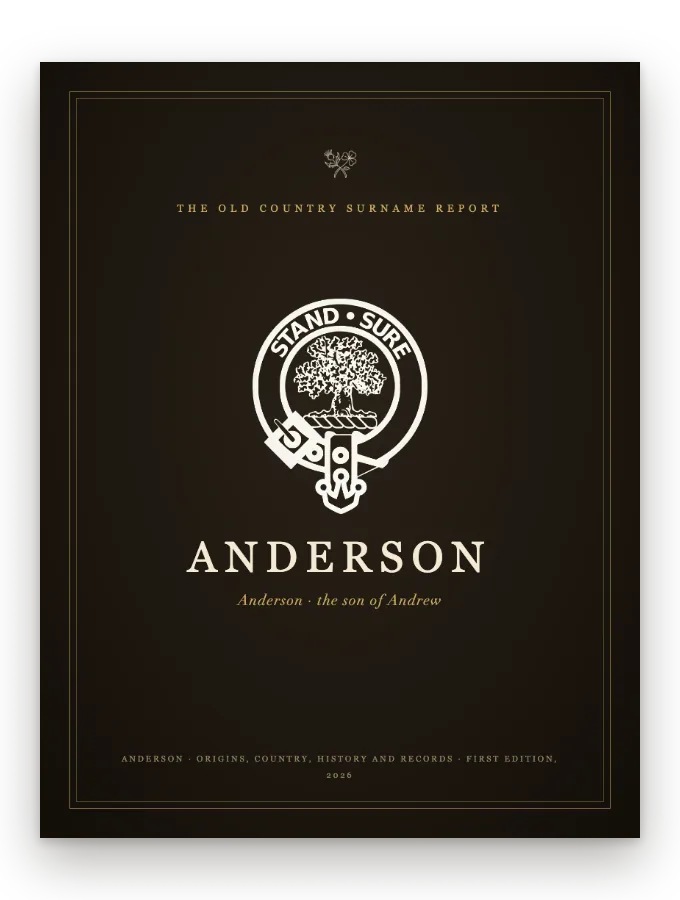
This report is about a name that was made many times over. Anderson means the son of Andrew, and Andrew was a common Christian name across Scotland, England and Scandinavia, so the surname arose independently wherever a son was called after a father of that name. The record shows it in a Yorkshire tax roll of 1379, in the town register of Aberdeen from 1448, in Highland names built on Saint Andrew, in the Ulster counties of the Irish census, and in the Swedish Andersson and the Danish and Norwegian Andersen. No authority makes the Andersons one family, and this report does not pretend that they are.
No email needed. It starts just below.
39 pages, 32 named sources, in your inbox within a minute.
The next page asks where to post it.
The hardback could not be added just now. Get your report here, and the hardback is offered on the next page for the same $79 in all.
Read it. If it is not the best account of your name you have seen, reply to your receipt within 14 days and we refund you.
“I have been tracing my family tree for some time, but there were certain stories that even our closest relatives never knew about. This surname report is a true deep dive. Thank you.”Susan D., reader
In Scotland the record puts the name first on the north-east coast. Aberdeen, a port on Scotland's north-east coast, is where the burgh register names Andersons from 1448, and the Aberdeen and Banff sheet that Robert Gordon of Straloch drew for Joan Blaeu's atlas of 1654 shows the country around it. Burke records arms for an Anderson of Aberdeen with a cross staff for its crest and the motto Per mare, and for Sir Alexander Anderson, Lord Provost of the city in 1872. West Airderbreck in Banffshire carries the oak tree and Stand sure. Glasgow and Edinburgh have their own Anderson coats, and the Glasgow professor John Anderson was a minister's son from Roseneath in Dunbartonshire.
In England the earliest form is in Yorkshire, in the district of Kirkby Malzeard and Nidderdale, in 1379. Further north, Burke records a grant to Henry Anderson of Newcastle upon Tyne on 3 November 1547, and Anderson families at Little Harle Tower and at Jesmond House in Northumberland, one of them "long settled at Newcastle-on-Tyne". The English line of baronets of Penley in Hertfordshire, created 1643, ended in 1699.
In Ireland the name is an Ulster one. Matheson's report on the births registered in 1890 counted 175 Anderson entries in Ireland, 120 of them in Ulster. The census of 1901 counts 1,703 Andersons in Antrim, 1,219 in Down and 675 in Londonderry, and 513 in Dublin, the largest group outside Ulster. In America the first census of 1790 carries Anderson lines in every one of the twelve state returns printed, with the most in Pennsylvania, 266, Virginia and South Carolina, 182 each, and North Carolina, 165. Those are lines in a printed list, one for each head of household, and they show a name already spread from Maine to Carolina.
That was one chapter. The report carries the rest: where the name comes from, the clan and its chiefs, heraldry, the stories, a timeline, migration, the name today, notable bearers, and a page on tracing your own line. Every claim sourced the same way as the chapter above.
Get my report · $14.99Instant download, yours to keep and print
Read it. If it is not the best account of your name you have seen, reply to your receipt within 14 days and we refund you.
Not your name? Search yours, or read another name's free chapter.
One piece of research, three more ways to have it. Every edition includes the Anderson report itself.
The Anderson report and a five and a half minute film of the name, your spelling on the title.
Get the film · $39.99The Anderson report as a hardback, posted free to your door.
Get the book · $79The report, the film and the hardback. Bought apart they are $118.99.
Get all three · $99For the wall. The Anderson record on one framed sheet, 16 by 12 inches, $89 posted free. See the framed plate.
A gift? Send the Anderson report on a day you choose, with a card.
This history is written from public-domain sources and the family's own published records, every one of them listed. Where tradition and record disagree the text says so rather than choosing quietly. No image on this page is AI-generated.
First edition · last revised