The Old Country
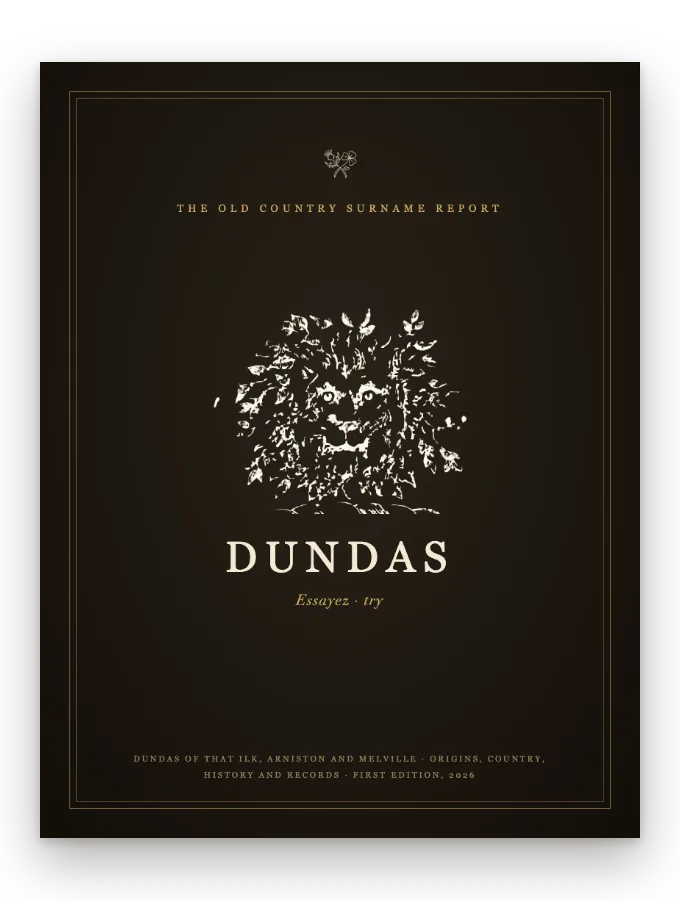
Cover of the Dundas Surname Report
Free to read · Dundas of that Ilk, Arniston and Melville

DundasSurname meaning, origin and history

Dundas is a territorial surname, carried first by a place: the lands of Dundas in West Lothian, on the south shore of the Firth of Forth a few miles west of Edinburgh. The place is on record under that name by 1180, and the family that held it took its name from it in the Scots style 'of that Ilk.' Its founding document survives in the family's own papers: an undated charter by which Waldeve, son of Gospatric, Earl of Dunbar, granted Dundas to Helias, son of Huctred, before Waldeve's death in 1182. Helias de Dundas witnesses a charter at Edinburgh about 1202, and on 28 August 1296 a later Serle de Dundas swore fealty to Edward I at Berwick among the landholders of Linlithgowshire, and sealed his oath with a stag's head.

Get my report · $14.99

39 pages, 23 named sources, in your inbox within a minute.

Read it. If it is not the best account of your name you have seen, reply to your receipt within 14 days and we refund you.

“I have been tracing my family tree for some time, but there were certain stories that even our closest relatives never knew about. This surname report is a true deep dive. Thank you.”Susan D., reader

Not today? Read the Dundas chapter free. We will email it to you.Rather read it later? We will email you the Dundas chapter.

One email: the link to this page and the free Clan Finder, eighteen clans and every surname recorded as belonging to them, on two printable pages. Nothing else unless you tick the box.

The Dundas name at a glance

Meaning
Territorial, from the lands of Dundas in West Lothian. Wilkinson's study of West Lothian place-names reads the name as Gaelic dun deas, 'southern fort'; Anderson's Scottish Nation of 1863 gave 'the hill of the fallow deer'
Language of origin
Scottish Gaelic place-name, carried into Scots and English as a surname and hardly respelled since
Earliest record
The place as Dundas by 1180; Helias de Dundas, a witness at Edinburgh about 1202; Serle de Dundas, who swore fealty to Edward I at Berwick on 28 August 1296
Recorded heartland
West Lothian for the senior line, Midlothian for the Arniston judges, and in Ireland, County Fermanagh
Clan status
A chief recognised by the Lord Lyon King of Arms: David Duncan Dundas of Dundas, who died in August 2024
Motto
Essayez, French for 'try'
Best-known bearer
Henry Dundas, 1st Viscount Melville (1742-1811), Home Secretary, Secretary of State for War and First Lord of the Admiralty
Recorded today
15 in Scotland (2024, rank 1,402); 1,405 in the United States (2020, rank 19,300); 260 in Ireland (1911)
Chapter four, free to read in full

The Firth of Forth and Edinburgh's New Town

The lands of Dundas lie in the parish of Dalmeny, on the south shore of the Firth of Forth a few miles west of Edinburgh, and Dundas Castle stands on them still. Historic Environment Scotland dates its four-storey L-plan tower to about 1416 and a new wing to the years after the great-seal licence of 1424, and beside the old tower William Burn built a Tudor-Gothic mansion in 1818. Out in the firth lies Inchgarvie, the rock James IV granted to John Dundas of that Ilk in 1491 to fortify as a refuge for ships chased there by the enemy.

Two Dundas buildings share St Andrew Square: a bank's head office built for Sir Lawrence, and a column raised for Henry by officers and men of the navy.

The Arniston branch's houses stand on the other side of the city. Arniston House, in Midlothian, was built by William Adam between 1726 and 1733, with a west wing and orangery added by his son John in the 1750s, and the initials RD are carved over its porch; Omond gives it as Henry Dundas's birthplace. Melville Castle, at Lasswade, was built by James Playfair for Henry Dundas between 1786 and 1791.

The name's most visible address is Edinburgh's New Town, where two Dundas buildings stand within sight of each other in St Andrew Square. Dundas House was designed by William Chambers in 1771 for Sir Lawrence Dundas; the Excise Office bought it in 1794 and the Royal Bank of Scotland in 1825, and John Dick Peddie altered it in 1857. In the middle of the square stands the Melville Monument, a column of over 150 feet designed by William Burn and raised in 1821 to 1823, with a statue of Henry Dundas designed by Francis Chantrey and carved by Robert Forrest, set on top in 1827.
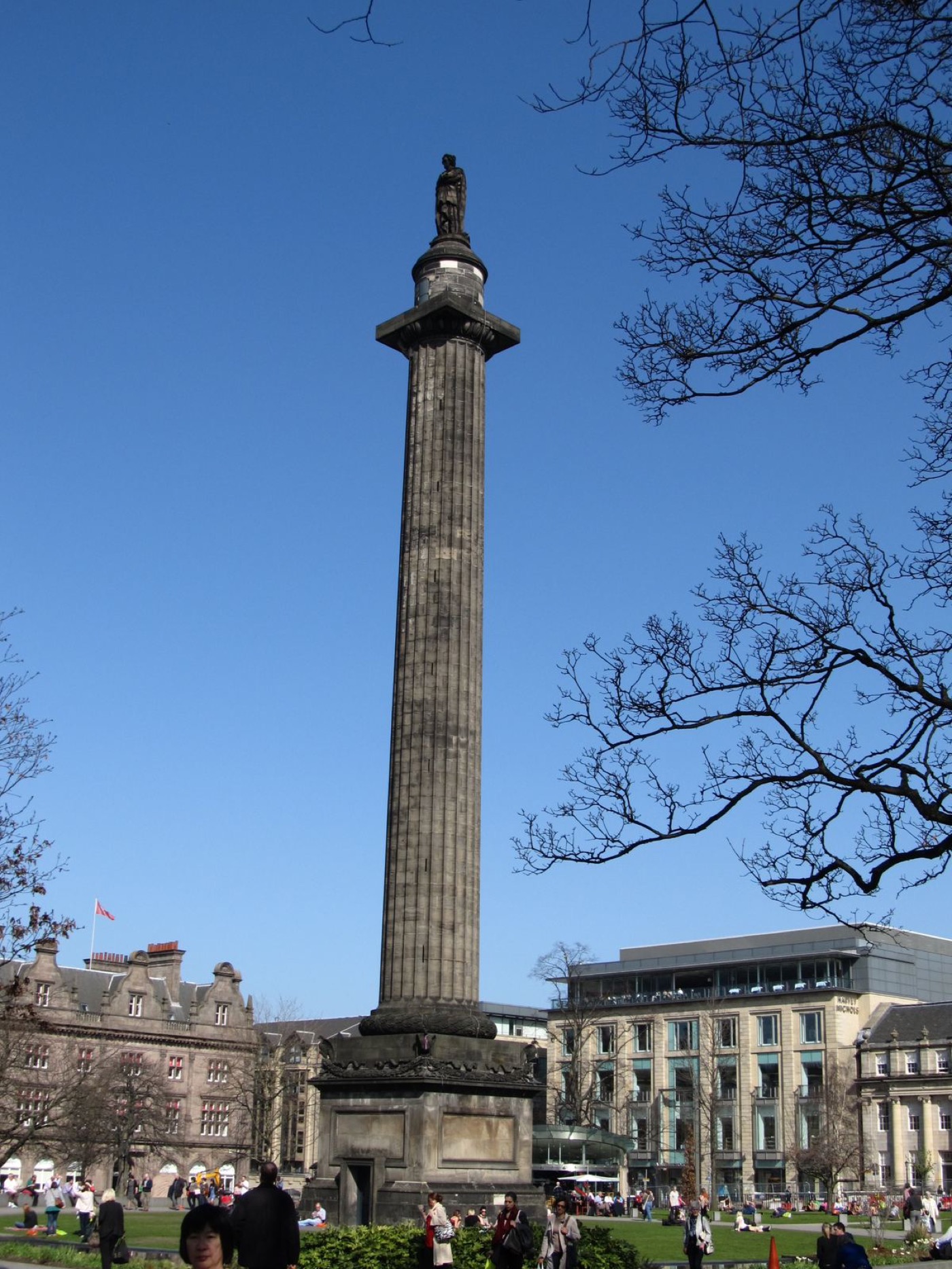
The Melville Monument, St Andrew Square, Edinburgh: William Burn's column of 1821 to 1823, paid for by a subscription raised mainly among navy officers, with th
The Melville Monument, St Andrew Square, Edinburgh: William Burn's column of 1821 to 1823, paid for by a subscription raised mainly among navy officers, with the statue of Henry Dundas set on top in 1827. Photograph by Richard Rogerson, CC BY-SA 2.0.
Dundas of that Ilk, Arniston and Melville · 39 pages

The full Dundas surname report

That was one chapter. The report carries the rest: where the name comes from, the clan and its chiefs, heraldry, the stories, a timeline, migration, the name today, notable bearers, and a page on tracing your own line. Every claim sourced the same way as the chapter above.

Get my report · $14.99

Instant download, yours to keep and print

Read it. If it is not the best account of your name you have seen, reply to your receipt within 14 days and we refund you.

Not your name? Search yours, or read another name's free chapter.

The editions

Read it, watch it, or keep it on the shelf.

One piece of research, three more ways to have it. Every edition includes the Dundas report itself.

Watch itin five days$39.99

The Dundas report and a five and a half minute film of the name, your spelling on the title.

Get the film · $39.99
Keep itin two weeks$79

The Dundas report as a hardback, posted free to your door.

Get the book · $79
All three Best valuesaves $19.99$99

The report, the film and the hardback. Bought apart they are $118.99.

Get all three · $99

For the wall. The Dundas record on one framed sheet, 16 by 12 inches, $89 posted free. See the framed plate.

A gift? Send the Dundas report on a day you choose, with a card.

The sources page, in fullWhere every claim on this page comes from.
Where the record is uncertainWhere the family's own papers, as Macleod edited them in 1897, differ from Anderson's Scottish Nation of 1863, this report gives both and says whose each is. Where a claim rests on tradition rather than record, the text says so.
  • Walter Macleod (ed.), Royal Letters and other Historical Documents selected from the Family Papers of Dundas of Dundas (Edinburgh, 1897), for Waldeve's charter to Helias, son of Huctred, and its date, the early lairds and their witnessing, the 1424 great-seal licence for the tower of Dundas, the Earl of Forth letter and the 1491 Inchgarvie charter.
  • Instrumenta Publica sive Processus super Fidelitatibus et Homagiis Scotorum (Bannatyne Club, 1834), pp. 137, 146 and 167, and Joseph Bain, Calendar of Documents relating to Scotland, vol. II (1884), pp. 202, 205 and 213 and Appendix iii, no. 393, for Serle or Saer de Dundas's homage at Berwick on 28 August 1296 and his seal.
  • John Garth Wilkinson, West Lothian Place Names (1992), s.v. Dundas, for the form of 1180 and the reading dun deas.
  • William Anderson, The Scottish Nation, vol. II (Edinburgh, 1863), s.v. Dundas, for the family's own account of its origin and of its later lairds and branches.
  • George W. T. Omond, The Arniston Memoirs: Three Centuries of a Scottish House, 1571-1838 (Edinburgh, 1887), for the Act of 1663 and Lord Arniston's refusal, the offices and dates of the two Lord Presidents, and Henry Dundas's birth at Arniston and his death in Edinburgh.
  • George Brunton and David Haig, An Historical Account of the Senators of the College of Justice (1832), and the Dictionary of National Biography (1885-1900), entries for Robert Dundas (1685-1753), Robert Dundas (1713-1787), Sir David Dundas, Robert Saunders Dundas and Sir James Whitley Deans Dundas, for their offices and dates.
  • Burke, The General Armory of England, Scotland, Ireland, and Wales (1884), s.v. Dundas, for the arms, crests and mottoes of Dundas of that Ilk and its branches.
  • Fairbairn, Book of Crests of the Families of Great Britain and Ireland (4th ed., 1905), vol. 1 index and vol. 2, Plate 21, crest 9, 'Dundas of Dundas', the source of this report's cover device. No Celtus clan crest badge exists for Clan Dundas.
  • Cobbett, The Parliamentary History of England, vol. 29 (1817), and The Debate on a Motion for the Abolition of the Slave-Trade (1792), for the words, divisions and dates of April and May 1792.
  • Hansard, Commons debates of April to June 1805 and Lords minutes of 12 June 1806; the Diary of Charles Abbot, Lord Colchester; and the index to the reports of the Commissioners of Naval Enquiry, for the impeachment and the verdicts.
  • UK Parliament, Living Heritage, on the last impeachment trials held in the House of Lords.
  • City of Edinburgh Council, 'New wording for plaque at Melville Monument agreed' (11 June 2020) and 'Replacement plaque installed at the Melville Monument' (18 March 2024), for the plaque's text, its theft and its replacement.
  • Historic Environment Scotland, listed-building records LB27816, LB29705, LB45474, LB5512, LB7394 and LB808, and scheduled monument SM6689.
  • History of Parliament, 1754-1790, Dundas, Sir Lawrence (?1710-81); Falkirk Local History Society and the Charlotte Dundas Heritage Trail, for the canal; Glasgow Life, for Port Dundas.
  • University College London, Legacies of British Slavery database, entry for Lawrence Dundas, for the Dominica and Grenada estates.
  • The London Gazette, 26 June 1838 and 23 September 1892, for the earldom and marquessate of Zetland, and 26 March 1807 (issue 16014, p. 393) for the Privy Council entry naming a Robert Dundas.
  • Parks Canada, Dundas Street National Historic Event; The Canadian Encyclopedia, Dundas; the proclamation of 16 July 1792 dividing Upper Canada into counties; Dictionary of Sydney, Dundas; City of Parramatta, Dundas and Dundas Valley: a brief history.
  • P. P. King, Narrative of a Survey of the Intertropical and Western Coasts of Australia (1827); W. E. Parry, Journal of a Voyage for the Discovery of a North-West Passage (1821); Landgate, Western Australia, and the Australian Dictionary of Biography (Henry Dundas), for the Dundas Hills.
  • Dictionary of Canadian Biography, vol. X, Dundas, George; Public Archives and Records Office of Prince Edward Island, Lieutenant Governor fonds.
  • Collins Scottish Clan and Family Encyclopedia (1994), pp. 124-125, for the chiefs, and a death notice of 2024 (Dignity Memorial).
  • National Records of Scotland, Most Common Surnames 2024 and Surnames in Scotland 1975 to 2024; United States Census Bureau, surname files of the 2010 and 2020 censuses; National Archives of Ireland, Census of Ireland 1901 and 1911, surname search (exact match).
  • The catalogues of the archives named in the trace chapter, for the holdings given there.
  • Plate credits, licence templates, the provenance of every image and the cover crest's recipe are set out in assets_dundas/MANIFEST.md.

This history is written from public-domain sources and the family's own published records, every one of them listed. Where tradition and record disagree the text says so rather than choosing quietly. No image on this page is AI-generated.

First edition · last revised

More surname histories, free to read

Every surname we have written →