The Old Country
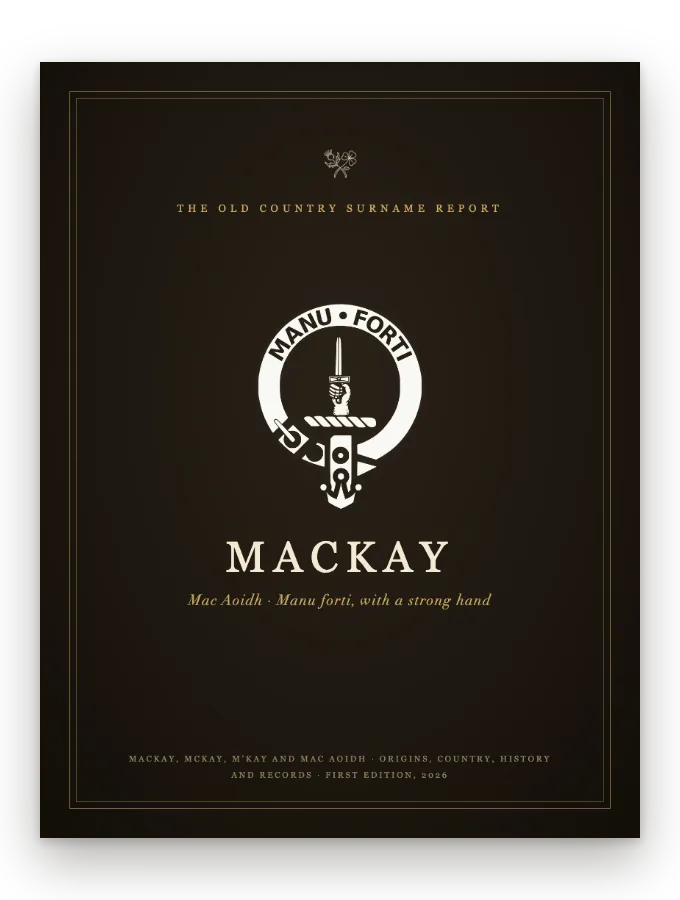
Cover of the MacKay Surname Report
Free to read · Mac Aoidh, son of Aodh: Strathnaver and the Lords Reay, Kintyre, Islay and Ulster

MacKaySurname meaning, origin and history

This report is about a name that is really a man's first name with a Mac in front of it. MacKay is Mac Aoidh in Gaelic, the son of Aodh, and Aodh was a personal name used all over the Gaelic world, in Ireland as much as in Scotland. That is why there was never one original MacKay. The record shows a clan of the name in Strathnaver, on the north coast of Sutherland, and other families of the name with no proven tie to it: crowners of north Kintyre, a Gaelic charter family in Islay, landholders in Bute and in Galloway, and in Ireland the McKays of Antrim and a Mac Aodha of their own.

Get my report · $14.99

40 pages, 20 named sources, in your inbox within a minute.

Read it. If it is not the best account of your name you have seen, reply to your receipt within 14 days and we refund you.

“I have been tracing my family tree for some time, but there were certain stories that even our closest relatives never knew about. This surname report is a true deep dive. Thank you.”Susan D., reader

Not today? Read the MacKay chapter free. We will email it to you.Rather read it later? We will email you the MacKay chapter.

One email: the link to this page and the free Clan Finder, eighteen clans and every surname recorded as belonging to them, on two printable pages. Nothing else unless you tick the box.

The MacKay name at a glance

Meaning
From Gaelic Mac Aoidh, son of Aodh, a personal name. Macbain's Gaelic dictionary traces Aodh to an old word for fire; it is a man's name, not a description of a family.
First on record
31 March 1329: a charter of Robert Bruce confirms land in Kintyre to Gilchrist macYmar M'Cay and his younger son Gilchrist.
Clan country
Strathnaver, on the north coast of Sutherland: Tongue, Durness, Farr and Strath Halladale, called in Gaelic Duthaich Mhic Aoidh, Lord Reay's Country.
Other families
Mackays of Ugadale in Kintyre, of the Rhinns of Islay, of Bute and of Galloway, with no proven tie to Strathnaver; and in Ireland, McKays of Antrim.
Chief
The Lord Reay, as the Standing Council of Scottish Chiefs lists him. The peerage was created on 20 June 1628 for Sir Donald Mackay of Far.
Motto
Manu forti, with a strong hand. The crest is an arm raised from the elbow holding a dagger, the device the clansman wears in the crest badge.
Scotland today
Mackay 353 and McKay 247 register entries in 2024, the 47th and 78th commonest surnames. National Records of Scotland.
The Americas today
McKay 38,681 and Mackay 9,886 in the United States in 2010, ranked 895th and 3,600th. United States Census.
Chapter four, free to read in full

Strathnaver, Kintyre and Antrim

The heart of the name is the north coast of Sutherland. Strathnaver runs south from the sea at Bettyhill into the hills, and the country the Mackays held reached west to Durness and the Kyle of Tongue and east to Strath Halladale. Castle Varrich stands on a rock above the river Verry where it runs into the Kyle of Tongue, and the Lords Reay later lived at the House of Tongue on the shore below. In Gaelic this was Duthaich Mhic Aoidh, and the Dictionary of National Biography, writing of the poet Rob Donn in 1893, still gave it that name and its English one, Lord Reay's Country. Ben Loyal and Ben Hope stand over it.

In 1901 there were 2,020 McKays in Ireland, and more than half of them lived in one county, Antrim.

The second centre is the west. A charter of Robert Bruce confirmed land in Kintyre to Gilchrist macYmar M'Cay on 31 March 1329, and his descendants, the Mackays of Ugadale, were hereditary crowners of north Kintyre, the king's officers in that district, until an heiress carried Ugadale to the MacNeils. Brian Vicar Mackay received a charter of land in Islay from the Lord of the Isles in 1408, written in Gaelic, and a Neil Mcky was crowner of the Rhinns of Islay in 1606. In 1506 four men written Mackaw, Makkcae and Makkay held land of the king in Bute. Further south, Angus Mackay found families of the name in Galloway, holding land in Wigtownshire and Kirkcudbright at places such as Camlodane, Balgarne and Craichlo, whom the clerks wrote Makke and McGhie before they settled, late in the 1500s, on McKie.

The third centre is Ulster. The census of Ireland in 1901 counted 2,020 people named McKay, and 1,801 of them, almost nine in every ten, lived in the nine counties of Ulster. County Antrim alone held 1,124, with Londonderry 261 and Down 247. Ten years later the total had grown to 2,221, and Antrim held 1,180. The spelling Mackay was much rarer in Ireland, 259 in 1901, and scattered: Dublin had the most, 55. It is the McKay spelling, in Antrim, that most American McKays of Irish birth carried.
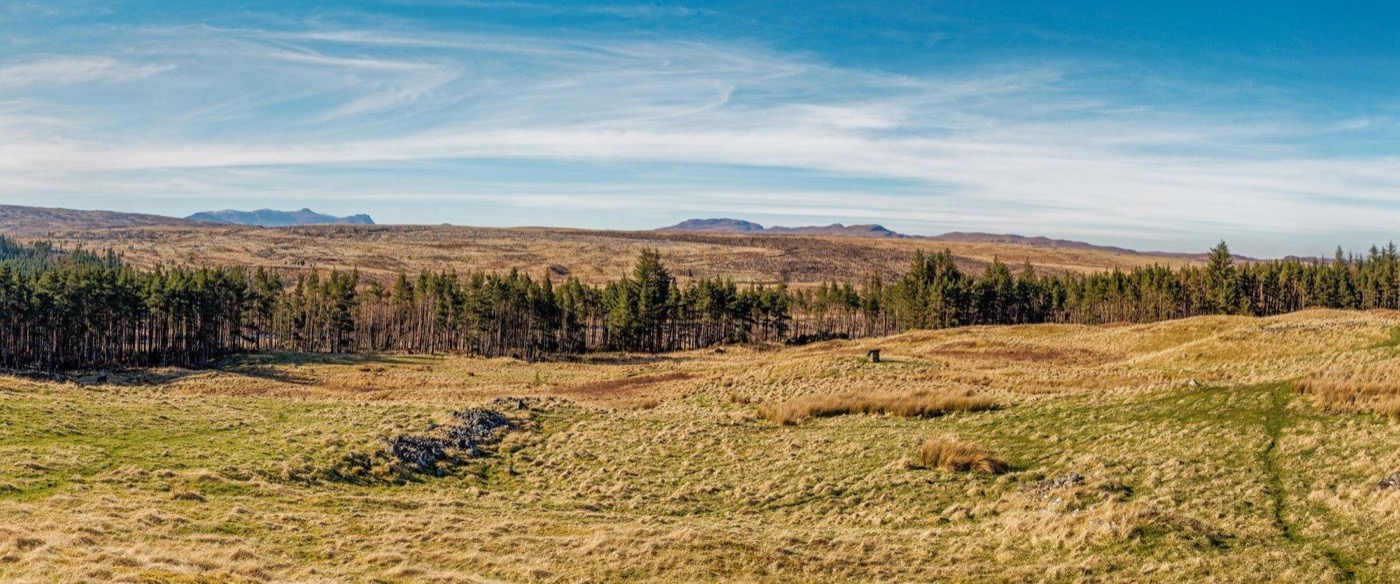
The ruins of Rosal in Strathnaver, the Mackay country's own strath. Donald Macleod, whose Gloomy Memories told the removals from the people's side, was born her
The ruins of Rosal in Strathnaver, the Mackay country's own strath. Donald Macleod, whose Gloomy Memories told the removals from the people's side, was born here; his father's farm went into a sheep run. Photograph by valenta, 2017; geograph.org.uk, CC BY-SA 2.0.
Mac Aoidh, son of Aodh: Strathnaver and the Lords Reay, Kintyre, Islay and Ulster · 40 pages

The full MacKay surname report

That was one chapter. The report carries the rest: where the name comes from, the clan and its chiefs, heraldry, the stories, a timeline, migration, the name today, notable bearers, and a page on tracing your own line. Every claim sourced the same way as the chapter above.

Get my report · $14.99

Instant download, yours to keep and print

Read it. If it is not the best account of your name you have seen, reply to your receipt within 14 days and we refund you.

Not your name? Search yours, or read another name's free chapter.

The editions

Read it, watch it, or keep it on the shelf.

One piece of research, three more ways to have it. Every edition includes the MacKay report itself.

Watch itin five days$39.99

The MacKay report and a five and a half minute film of the name, your spelling on the title.

Get the film · $39.99
Keep itin two weeks$79

The MacKay report as a hardback, posted free to your door.

Get the book · $79
All three Best valuesaves $19.99$99

The report, the film and the hardback. Bought apart they are $118.99.

Get all three · $99

For the wall. The MacKay record on one framed sheet, 16 by 12 inches, $89 posted free. See the framed plate.

A gift? Send the MacKay report on a day you choose, with a card.

The sources page, in fullWhere every claim on this page comes from.
Where the record is uncertainWhere this report cites an early record it cites the printed text of the document: the charters of 1329, 1415 and 1542, the 1746 reports of the Hazard and the prisoner roll come from the volumes that print them, and Monro's words are Monro's own. Where a modern reference work carries a life, it is a national dictionary of biography, and no commercial surname site was used as corroboration for anything printed here.
  • Alexander Macbain, An Etymological Dictionary of the Gaelic Language, 2nd edition (Stirling, 1911), the introduction and the list of personal names and surnames, s.v. Mackay and Hugh
  • Angus Mackay, The Book of Mackay (Edinburgh, 1906), pp. 7-11 (the name and its forms), p. 60, pp. 134, 190-192, 232-233, 278-279, 360-362, and Appendix nos. 1, 4, 5, 34 and 62
  • Patrick Woulfe, Irish Names and Surnames (Dublin, 1923), the Irish-English list, s.v. Mac Aodha, Mac Aoidh and O Macdha
  • Robert Monro, Monro his Expedition with the Worthy Scots Regiment (called Mac-Keyes Regiment) (London, 1637), title page, Part I, the first duty, and the table
  • Dictionary of National Biography, 1885-1900: Mackay, Donald, first Lord Reay (T. F. Henderson); Mackay, Hugh (T. F. Henderson); Mackay, Robert, Rob Donn (Ae. J. G. Mackay); Sellar, Patrick (Andrew Lang)
  • Sir Bernard Burke, The General Armory of England, Scotland, Ireland and Wales (1884), the Mackay (Baron Reay) entry and its differenced coats
  • James Fairbairn, Fairbairn's Book of Crests of the Families of Great Britain and Ireland, 4th edition (1905), the Mackay and Reay index entries
  • Sir Bruce Gordon Seton and Jean Gordon Arnot, The Prisoners of the '45, vol. III (Scottish History Society, 1929), pp. 108-110, nos. 2081 to 2096
  • London Gazette, 15 April 1746, and Gentleman's Magazine, 1746, the taking of the Hazard at Tongue, as printed in The Book of Mackay, pp. 190-191
  • Donald Macleod, Gloomy Memories in the Highlands of Scotland (1857; Glasgow edition, 1892), letters IV to VI
  • A Complete List of Those Who Came on the Hector, Pictou Advocate, 27 July 1923, p. 2, in the collection of the McCulloch Heritage Centre, Pictou
  • Dictionary of Canadian Biography: MacKay, Alexander (d. 1811); Mackay, George Leslie
  • Australian Dictionary of Biography: Mackay, John (1839-1914), by J. A. Nilsson; McKay, Hugh Victor (1865-1926), by John Lack
  • Online Nevada Encyclopedia, Nevada Humanities: John William Mackay
  • Standing Council of Scottish Chiefs, list of members
  • National Records of Scotland, Most Common Surnames 2024, table Surnames TimeSeries 1975to2024
  • United States Census Bureau, 2010 Census surname file, rows MCKAY, MACKAY, MCKEY, MCKEE, MCCOY and MACKEY
  • National Archives of Ireland, Census of Ireland 1901 and 1911, surname search (exact match), national and county counts
  • Clan member crest badge illustration by the Wikimedia Commons contributor Celtus, used under CC BY-SA 3.0.
  • OpenStreetMap contributors (openstreetmap.org), Open Database Licence, for the coastlines and the rivers of the maps.

This history is written from public-domain sources and the family's own published records, every one of them listed. Where tradition and record disagree the text says so rather than choosing quietly. No image on this page is AI-generated.

First edition · Second edition

More surname histories, free to read

Every surname we have written →