 The Old Country
The Old Country
The Old Country
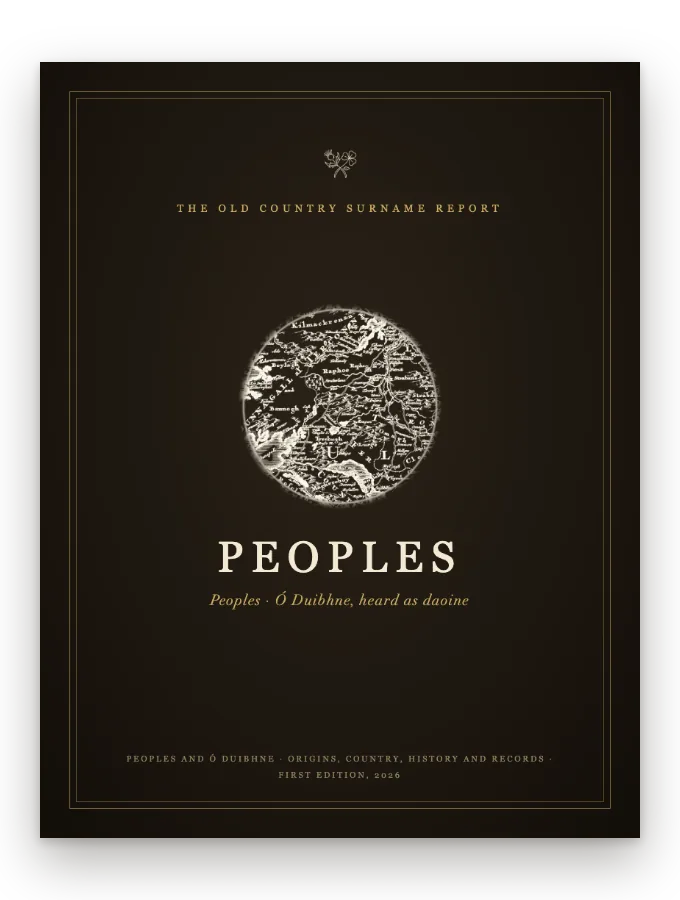
This report tells the story of a surname that is a mistake, and a mistake with a date, a county and a printed source behind it. In east Donegal the Irish surname Ó Duibhne, anglicised in the ordinary way as Deeny or Deeney, sounded to an English ear close enough to daoine, the Irish word for people, that clerks and neighbours began writing the family down as Peoples. Edward MacLysaght, Chief Herald of Ireland from 1943 to 1954 and the standard authority on Irish surnames, calls it flatly an example of the more absurd type of pseudo-translation, and he says so twice, in More Irish Families and again in The Surnames of Ireland.
The country of this name is the north-east corner of County Donegal: the Laggan, the low farmland between the River Foyle and Lough Swilly, and the peninsulas north of it. It is a landscape of small holdings, sea loughs and long parish histories, and it is the country that Ó Duibhne, the Irish name behind Peoples, never left. The 1901 census put 263 of the 382 Peoples in Ireland inside County Donegal. Ten years later it put 272 of 395 there. In 1926, when the Free State counted its own population and the six northern counties were outside the count, 299 of the 303 people named Peoples in the state were in County Donegal, and the other four were single individuals in Kildare, Sligo, Dublin and Roscommon.
Inside the county the name is not evenly spread, and the pattern is worth stating because it corrects a small point in the literature. MacLysaght says Peoples and Deeney are mainly found in the barony of Raphoe. The Raphoe districts do carry the name well: twenty-five at St Johnston, sixteen at Clonleigh North beside Lifford, nine at Convoy. But the largest single concentration in 1901 sits a barony to the north-west, in Fanad West, with thirty-eight, and Kilmacrenan and Milford held nineteen each. Raphoe is the name's country in the sense of where its story starts. Fanad and the Swilly shore are where most of the households actually were when a government last counted them one by one.
The Antrim thread has a geography of its own, and it is a different one: sixty-two bearers in 1901, scattered through Belfast's Dock and Woodvale wards and out into the countryside, with a household of the name at Lisnagreggan near Randalstown. Nothing in the record ties those families to Donegal, and everything about their religion suggests they should not be tied to it. They are treated here as the separate line the evidence makes them.
That was one chapter. The report carries the rest: where the name comes from, the clan and its chiefs, heraldry, the stories, a timeline, migration, the name today, notable bearers, and a page on tracing your own line. Every claim sourced the same way as the chapter above.
Get the Peoples report$14.99 · instant download, yours to keep and print
Not your name? Search yours, or read how we work, with another full chapter.
This history is written by AI from public-domain sources and the family's own published records, every one of them listed above. Where tradition and record disagree the text says so rather than choosing quietly. No image on this page is AI-generated.
First edition · last revised