 The Old Country
The Old Country
The Old Country
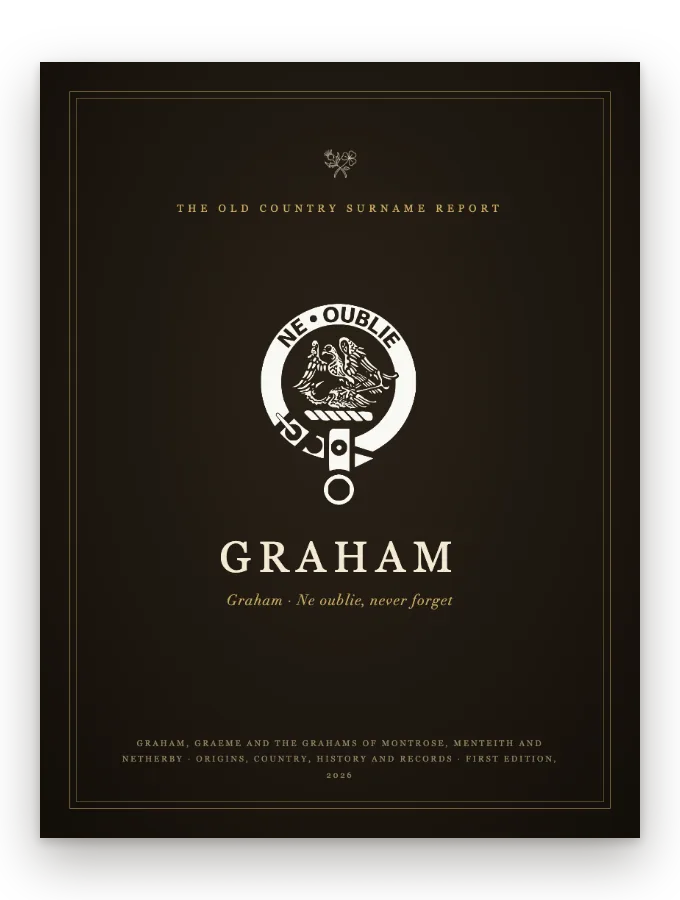
This report tells the story of a name built from an English place, not a Gaelic word: Graham is a contraction of Grantham, the Lincolnshire town Domesday Book itself spells Grantham, Grandham, Granham and Graham within a single 1086 survey. A Norman knight who took his name from that town, William de Graham, is the earliest Graham on record in Scotland: independently attested in a charter of about 1127, and named among the witnesses to Holyrood Abbey's foundation charter, a document recording a foundation begun around 1128 but itself produced about 1141 to 1147. Everything this report tells afterward, a Marquess hanged in Edinburgh, a Viscount killed at Killiecrankie, a Border family banished to Ireland, an American cracker, a Scottish telephone, traces back to that one recorded arrival, even where the family tree in between cannot be drawn.
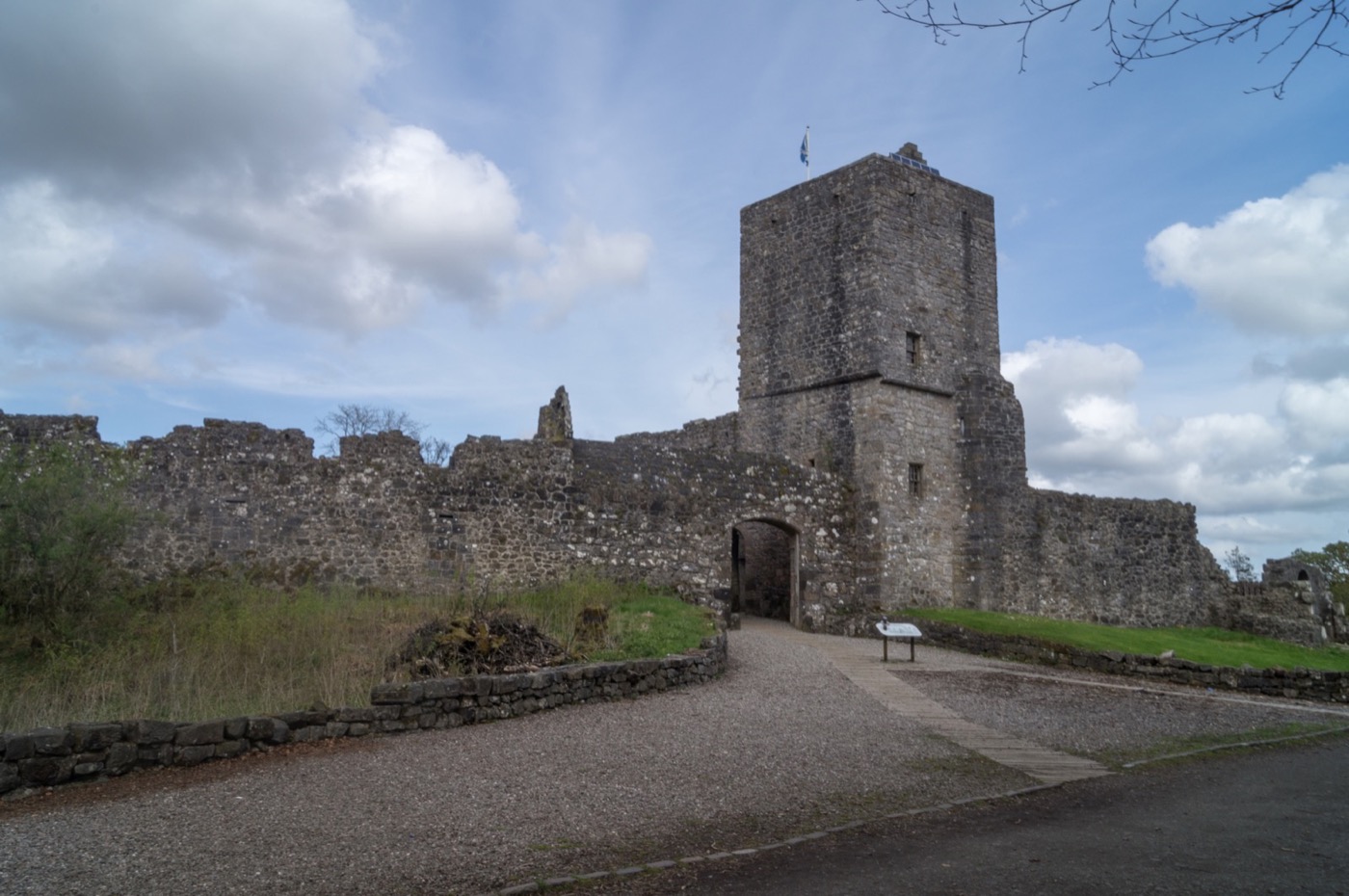
The Montrose line's own country lies either side of the Highland line in Stirlingshire and Perthshire. Mugdock Castle, north of Glasgow and first documented in 1372, was held by the Grahams apart from its forfeiture in 1645-1661; they bought the Buchanan estate, including Auld House, in 1682, though the present Buchanan Castle was not built until the 1850s, and Mugdock itself remained with the family until 1945. The lands were older in the family than the castle: David de Graham of Dundaff acquired Mugdock from the Earl of Lennox in the mid thirteenth century. The ruin now stands in Mugdock Country Park, open at all times, and Falkirk Old Parish Church, also in the historic county of Stirlingshire, still holds the grave of Sir John de Graham.
A second Graham country lies a few miles east, around the Lake of Menteith, Scotland's only body of water called a lake rather than a loch. This was the earldom King James I gave Malise Graham in 1427, in place of the Strathearn he had just confiscated from him, before sending Malise to England as a hostage for his own ransom from November 1427 until 17 June 1453, about twenty-five years and seven months, a strange homeland to inherit.
A third and harder country belongs to the Border Grahams: the Debatable Land between the Esk and the Sark, and Netherby Hall on the Cumberland side of that line, seat of a family that made its living, as the Clan Graham Society's own history of the Border Grahams tells it, from raiding on both sides of an unpoliced frontier. That country cost the Border Grahams their homeland: James VI and I ordered their transplantation in a 1603 proclamation, and the scheme, sending a large number of Border Graham households across the Irish Sea to County Roscommon, was carried out in 1606, a policy this report's next chapter tells in full. The households went by sea from Workington to Dublin, for settlement on Sir Ralph Sidley's lands in Roscommon; yet the largest Irish totals of the name in the 1911 census lie far to the north-east, in Antrim and Down.
That was one chapter. The report carries the rest: where the name comes from, the clan and its chiefs, heraldry, the stories, a timeline, migration, the name today, notable bearers, and a page on tracing your own line. Every claim sourced the same way as the chapter above.
Get the Graham report$14.99 · instant download, yours to keep and print
Not your name? Search yours, or read how we work, with another full chapter.
This history is written by AI from public-domain sources and the family's own published records, every one of them listed above. Where tradition and record disagree the text says so rather than choosing quietly. No image on this page is AI-generated.
First edition · last revised