 The Old Country
The Old Country
The Old Country

This report tells the story of a name that belongs to a village and a family, not to a coat of arms, and says so on its first page rather than its last. Timken is a Low German name from the farming country north-east of Bremen: a diminutive of a diminutive, built from Timm, itself a short pet-form of the old personal name Thiedmar, with the ending -ken doing the same small, affectionate work that -chen does in standard German. It is not a trade name, not a place name, and, whatever a few genealogy websites claim, not a Dutch one. It is simply what one farming family in the villages of Tarmstedt and Wilstedt was called, generations before any of them had reason to think the name would travel.
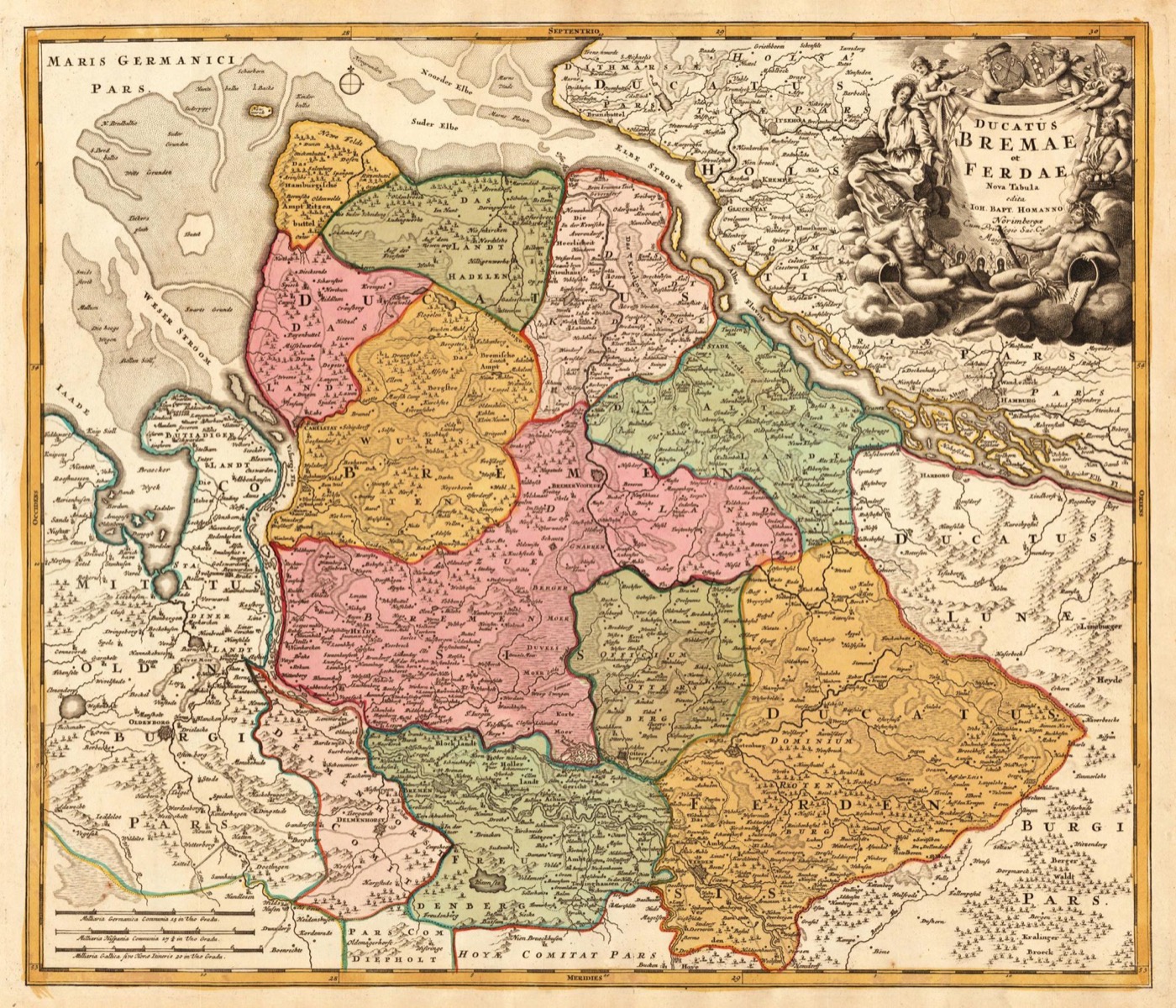
Tarmstedt and Wilstedt sit in the district the Germans call Rotenburg (Wümme), a stretch of the sandy, lightly wooded Geest country that runs north-east from Bremen toward the market town of Zeven, with Wilstedt lying barely four kilometres from Tarmstedt itself. It is quiet farming country, edged on one side by the Teufelsmoor, the Devil's Moor, the peat bog whose reclamation shaped so much of this corner of Lower Saxony through the eighteenth and nineteenth centuries. In 1831, when Henry Timken was born here, the land lay inside the Kingdom of Hanover, a kingdom that would not become part of a unified Germany for another forty years and would cease to exist as an independent state within Henry's own lifetime, absorbed into Prussia in 1866.
This was never grand country, and this report does not dress it up as such. No castle, no manor house and no market square here carries the Timken name; what the record shows is a family that rented or owned a working farm, baptised its children in the parish church, and, when the mother died and the land was sold, walked away from all of it inside a single year. The nearest port, and the gateway every emigrant from this district used, was Bremerhaven, itself a young town: it had been founded by the city-state of Bremen only in 1827, specifically because Bremen's own harbour on the Weser was silting up, and by the 1830s it was already becoming one of the two great German emigration ports, the other being Hamburg.
The record of the crossing itself is thinner than this report would like, and it says so rather than inventing detail. Bremen's port authorities kept meticulous passenger records from 1832 onward, but in 1874 they began destroying everything older than the current year plus the two previous, a practice that continued until 1909; almost the entire original run for 1838, the Timkens' own year, did not survive that purge. What is documented instead comes from a descendant's own compiled family history: the family sold its land, travelled the roughly thirty-one miles to Bremerhaven, and sailed in 1838, reaching New Orleans on 12 November that year and St Louis, by steamboat up the Mississippi, in March 1839.
That was one chapter. The report carries the rest: where the name comes from, the clan and its chiefs, heraldry, the stories, a timeline, migration, the name today, notable bearers, and a page on tracing your own line. Every claim sourced the same way as the chapter above.
Get the Timken report$14.99 · instant download, yours to keep and print
Not your name? Search yours, or read how we work, with another full chapter.
This history is written by AI from public-domain sources and the family's own published records, every one of them listed above. Where tradition and record disagree the text says so rather than choosing quietly. No image on this page is AI-generated.
First edition · last revised