 The Old Country
The Old Country
The Old Country
Wagner is a job. Before it was anyone's surname it was the word for the man who made wagons, and it is one of the plainest names in the German language: Middle High German wagener, Old High German waganari, the wright of the wagon. Duden's dictionary of German family names gives it exactly that way, a trade name from the trade word, and adds the detail that decides everything else in this report. Wagner is the Upper German form. In the Low German country of the north the same trade, and therefore the same name, is written Wegner and Wegener. One word, two halves of a language, and a line across the map that a family can still be placed by.
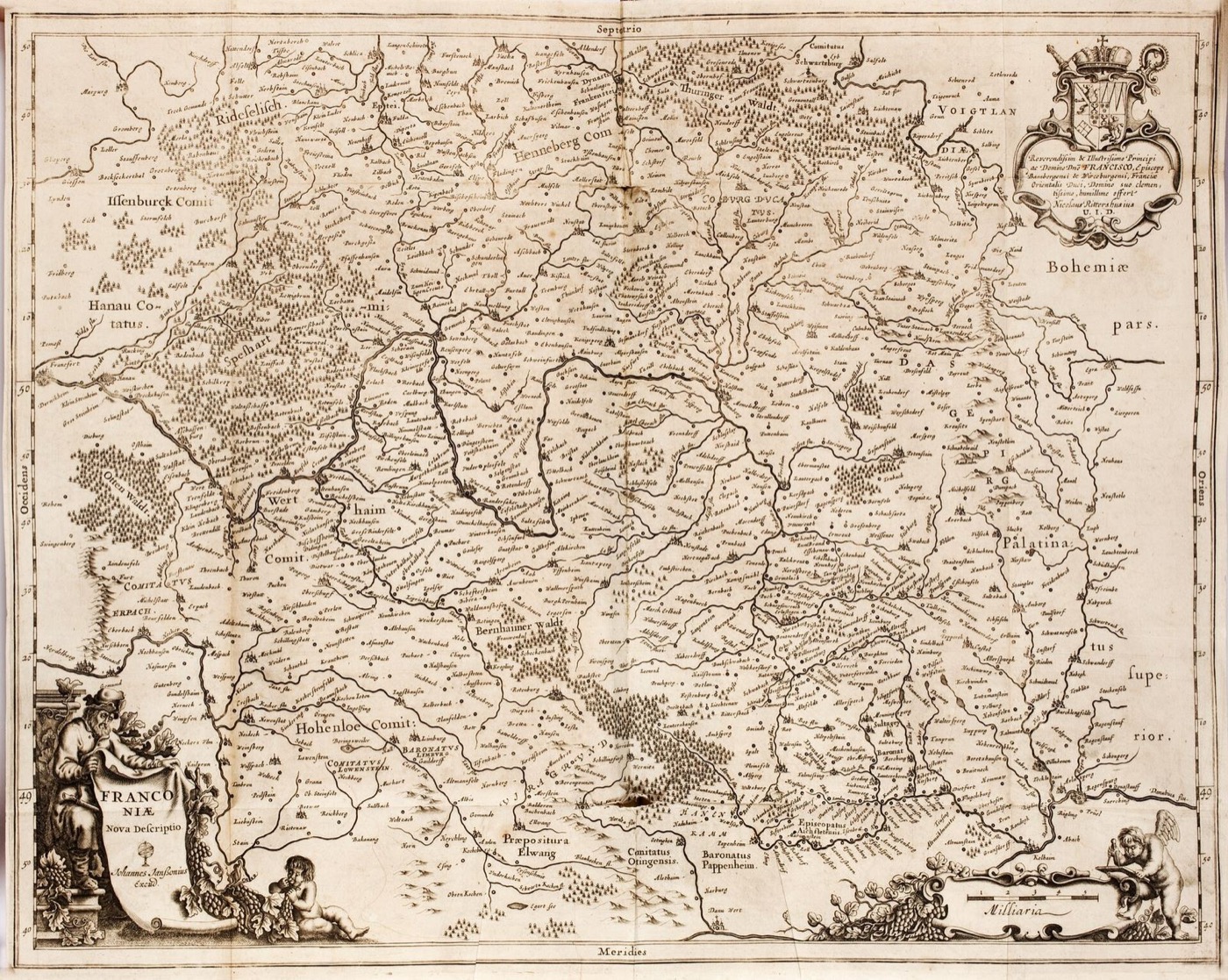
A trade name has a Heimat the way a dialect has one, which is to say it has a region and a boundary rather than a village and a church. Wagner's region is the Upper German south and west: Bavaria and Franconia, Swabia and the Baden lands, Hesse, the Rhineland-Palatinate and the Saarland, the country where a man who worked wood for vehicles was called a Wagner rather than a Stellmacher. Geogen's directory count puts a quarter of all German Wagner listings in Bavaria alone, and adds Baden-Wuerttemberg, North Rhine-Westphalia, Hesse and the Rhineland-Palatinate behind it. Those five states hold 60,257 of the 84,765 listings between them.
That belt is not an accident of language alone. It is also the belt that emigrated. The Palatine country of 1709, the Rhineland and Hesse and the northern Baden lands along the lower Neckar, sent its people down the Rhine to Rotterdam and across to London in the first great German exodus, and the same districts fed the Philadelphia redemptioner trade for the next sixty-five years. Nobody planned that the most Wagner-dense part of Germany would also be the part with the heaviest traffic to Pennsylvania, but it is what happened, and it is the single most useful thing an American Wagner can know before opening an archive catalogue.
Within the belt the name refuses to narrow. Franconia has it, Swabia has it, the Saarland has it out of proportion to its size, and Saxony and Thuringia, further east, carry 5,033 and 3,240 listings of their own. A family story that names a particular village is worth more than any distribution map, and a family story that names only a region is worth exactly what the map is worth, which is a direction rather than an address. The chapters that follow work the other way round, from documents outward, because for this name that is the only direction that leads anywhere.
That was one chapter. The report carries the rest: where the name comes from, the region and its records, arms, seals and marks, the stories, a timeline, migration, the name today, notable bearers, and a page on tracing your own line. Every claim sourced the same way as the chapter above.
Get the Wagner report$14.99 · instant download, yours to keep and print
Not your name? Search yours, or read how we work, with another full chapter.
Also as a film, $39.99, a printed book, $59, or all three, $79, with Wagner on the title.
Buying it for someone? Send it on a day you choose, with a card.
This history is written by AI from public-domain sources and the family's own published records, every one of them listed above. Where tradition and record disagree the text says so rather than choosing quietly. No image on this page is AI-generated.
First edition · last revised