 The Old Country
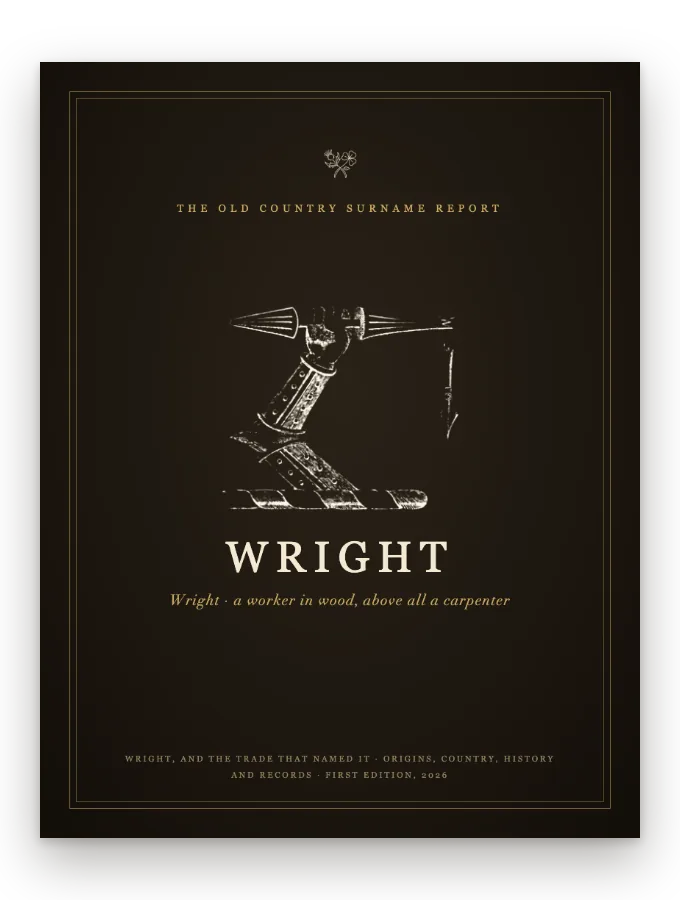
Wright is a big name: 458,980 people at the 2010 US Census, the thirty-fifth most common name in America, and 443,210 at the 2020 count. It is also, like Smith and Taylor before it, a trade name rather than a family name. A wright, in Old English wyrhta, was a maker or worker, above all in wood: a carpenter. In Scotland the same word, wricht, went on naming the carpenter and the joiner for centuries. Every town that needed a carpenter could grow a Wright, and by the time surnames were settling into their modern forms, most of them had.
No email needed. It starts just below.
39 pages, 20 named sources, in your inbox within a minute.
The next page asks where to post it.
The hardback could not be added just now. Get your report here, and the hardback is offered on the next page for the same $79 in all.
Read it. If it is not the best account of your name you have seen, reply to your receipt within 14 days and we refund you.
“I have been tracing my family tree for some time, but there were certain stories that even our closest relatives never knew about. This surname report is a true deep dive. Thank you.”Susan D., reader
This name has no single home because a trade does not need one, but the record is densest in three places. England's begins in Lancashire and the West Riding of Yorkshire. Wrightington, in West Lancashire, was already Wryghtyngton in the thirteenth century, and its early 18th-century hall became part of a hospital opened in 1933, where Sir John Charnley later pioneered hip-replacement surgery. In the poll tax of 1379 the West Riding collectors wrote the word both ways on the same roll: Thomas Wryght and his wife Isabella at Wombwell, and William, John and Johanna Wryght at Dalton, carried it as a surname, while at Darfield and Thurnscoe two men whose own surnames were Annotson and Grymbald were each written down as a wright and each taxed sixpence.
Scotland's record is different in kind: not a place but an institution. From 15 October 1475 the Incorporation of Wrights and Masons of Edinburgh had a limited say over the trade in the city, each craft with its own deacon; it later met in Niddry's Wynd, off the High Street, at the chapel that gave it its common name, Mary's Chapel. Burke records its arms as a gold carpenter's square and compasses on a blue field. The word itself stayed in everyday Scots for a carpenter or joiner.
Ulster is the third country, and the census measures it. Searched in 2026, the 1901 Irish census index holds 4,470 Wrights: 1,254 in Antrim, 767 in Down, 471 in Armagh, 247 in Londonderry, 240 in Tyrone and 217 in Monaghan, against 382 in Dublin and 118 in Cork. Three in every four lived in the nine counties of Ulster, and the pattern held in 1911, when Down had gained and Monaghan had lost. The Gola Wrights of Monaghan, granted their land in 1691, sit inside that map.
From those three countries the name went on to a township on the Ottawa River in 1800, a dune on the Outer Banks of North Carolina in 1903 and a house over a waterfall in Pennsylvania, the places the stories that follow belong to.
That was one chapter. The report carries the rest: where the name comes from, the clan and its chiefs, heraldry, the stories, a timeline, migration, the name today, notable bearers, and a page on tracing your own line. Every claim sourced the same way as the chapter above.
Get my report · $14.99Instant download, yours to keep and print
Read it. If it is not the best account of your name you have seen, reply to your receipt within 14 days and we refund you.
Not your name? Search yours, or read another name's free chapter.
One piece of research, three more ways to have it. Every edition includes the Wright report itself.
The Wright report and a five and a half minute film of the name, your spelling on the title.
Get the film · $39.99The Wright report as a hardback, posted free to your door.
Get the book · $79The report, the film and the hardback. Bought apart they are $118.99.
Get all three · $99For the wall. The Wright record on one framed sheet, 16 by 12 inches, $89 posted free. See the framed plate.
A gift? Send the Wright report on a day you choose, with a card.
This history is written from public-domain sources and the family's own published records, every one of them listed. Where tradition and record disagree the text says so rather than choosing quietly. No image on this page is AI-generated.
First edition · last revised