The Old Country
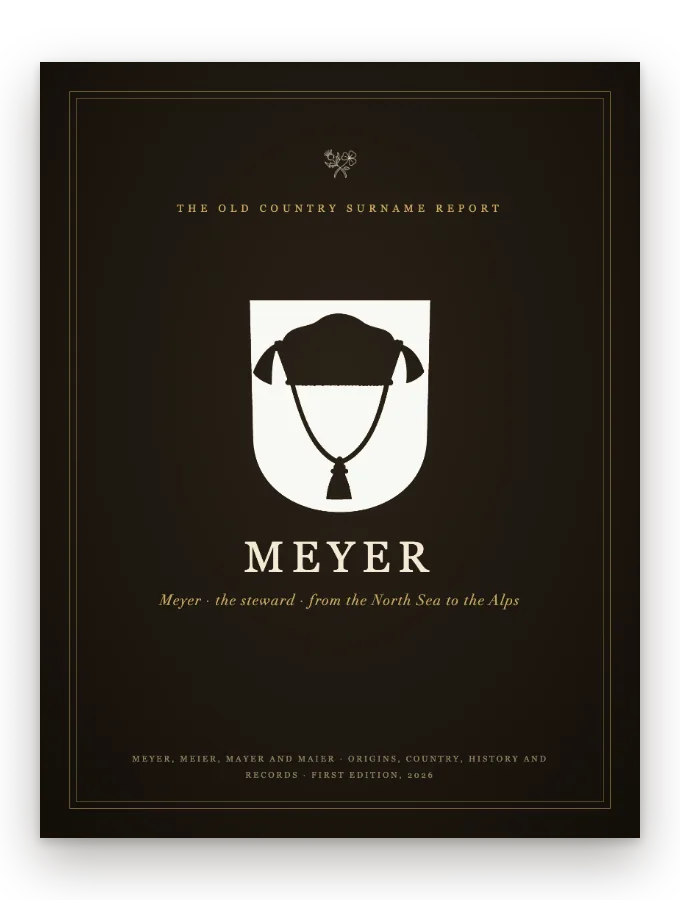
Cover of the Meyer Surname Report
Free to read · the steward's name, from every German-speaking land

MeyerSurname meaning, origin and history

Meyer is an office. Before it was anyone's surname it was the title of the man who ran a landlord's farm for him, and the word came into German from Latin: maior, the greater, by way of Middle High German meier and meiger. Duden's dictionary of German family names gives Meyer as a status name for that man, who oversaw the running of a landowner's estates and held the lower court. The German legal dictionary describes him first as a manorial official at the head of a demesne farm and its court, and later as a farmer holding such a farm on a tenure called Meierrecht. The spelling then tells the region: Meyer in the north-west, Meier north and south and in Switzerland, Mayer and Maier in the south-west, Mayr in Bavaria. One office, four spellings.

Get my report · $14.99

47 pages, 19 named sources, in your inbox within a minute.

Read it. If it is not the best account of your name you have seen, reply to your receipt within 14 days and we refund you.

“I have been tracing my family tree for some time, but there were certain stories that even our closest relatives never knew about. This surname report is a true deep dive. Thank you.”Susan D., reader

Not today? Read the Meyer chapter free. We will email it to you.Rather read it later? We will email you the Meyer chapter.

One email: the link to this page and the free Name Atlas, ten German names and the region each spelling belongs to, on two printable pages. Nothing else unless you tick the box.

The Meyer name at a glance

Meaning
The steward. Middle High German meier, meiger, from Latin maior: the official who ran a landlord's demesne farm and its court, later the tenant of a large farm held on Meierrecht
Name type
A status name for an office, not a trade. Meyer is the north-western spelling; Meier is found north and south and in Switzerland, Mayer and Maier are Upper German, Mayr is Bavarian
Heimat
For an office held everywhere the Heimat is a region. Meyer is north-western: Lower Saxony holds 28,596 of the 89,301 listings Geogen counts, North Rhine-Westphalia 15,800
Earliest documented bearer
No first bearer exists for an office held on every manor. The legal dictionary's earliest dated Meierrecht is of 1290; in Pennsylvania, Christian Meyer owned his Salford farm by 24 December 1719
Heraldry
None for the name. The cover carries the arms of Knonau, canton Zurich, a Meier's hat: the village's arms, not this name's
Recorded surname ranks
United States: 150,895 bearers and rank 183 in 2010, 147,096 and rank 183 in 2020. Germany: rank 6, from Geogen. Switzerland: Meyer rank 8 and Meier rank 2 in 2022
One spelling, two names
Hanks gives Meyer as the German and Swiss steward's name and as a Jewish name from the personal name Meir: records, not the spelling, tell which
Chapter four, free to read in full

Lower Saxony and Westphalia: where the name is thickest

An office name has a Heimat the way a dialect has one, which is to say it has a region and a boundary rather than a village and a church. Meyer's region is the Low German north-west: Lower Saxony and Westphalia, the Osnabrueck country between them, and the Hanseatic ports of Bremen and Hamburg. It is farm country, and for centuries it was farm country of a particular legal shape. Antonius Holtmann of the University of Oldenburg, describing the Osnabrueck district of the Kingdom of Hanover, sets it out: the lords of the manors, noble, clerical, municipal or patrician, owned the soil, and the farmers who cultivated it held their rights by custom and by codified law, and with them the farm's obligations.

Lower Saxony holds 28,596 of Germany's 89,301 Meyer listings: nearly a third of the name in one state.

The farm passed whole. Since 1722, Holtmann writes, the youngest son held preference over his sisters to inherit the undivided farm, and he could not marry without the lord's approval. The dues could reach thirty per cent of the gross harvest. Brothers and sisters who left took a dowry or a cash settlement, which is why so many farms were heavily mortgaged. Juergen Schlumbohm's study of the parish of Belm, which Holtmann cites, found that barely two-thirds of the children of large farmers kept the standing they were born to, and nearly a quarter sank into the class of Heuerleute, the landless day labourers. Around 1800 the old common lands, the Marken of wood, pasture, heath and moor, were parcelled out to the farmers and taken from the labourers' use, and a Hanoverian law of 1827 made a marriage licence depend on proof of sufficient property or secure work and a dwelling.

That is the country the name is thickest in, and a family tradition of a Meyer farm there is worth more than any distribution map. A tradition that names only a region is worth exactly what the map is worth, a direction rather than an address. The chapters that follow work from documents outward, because for a name held on this many farms that is the only direction that leads anywhere.
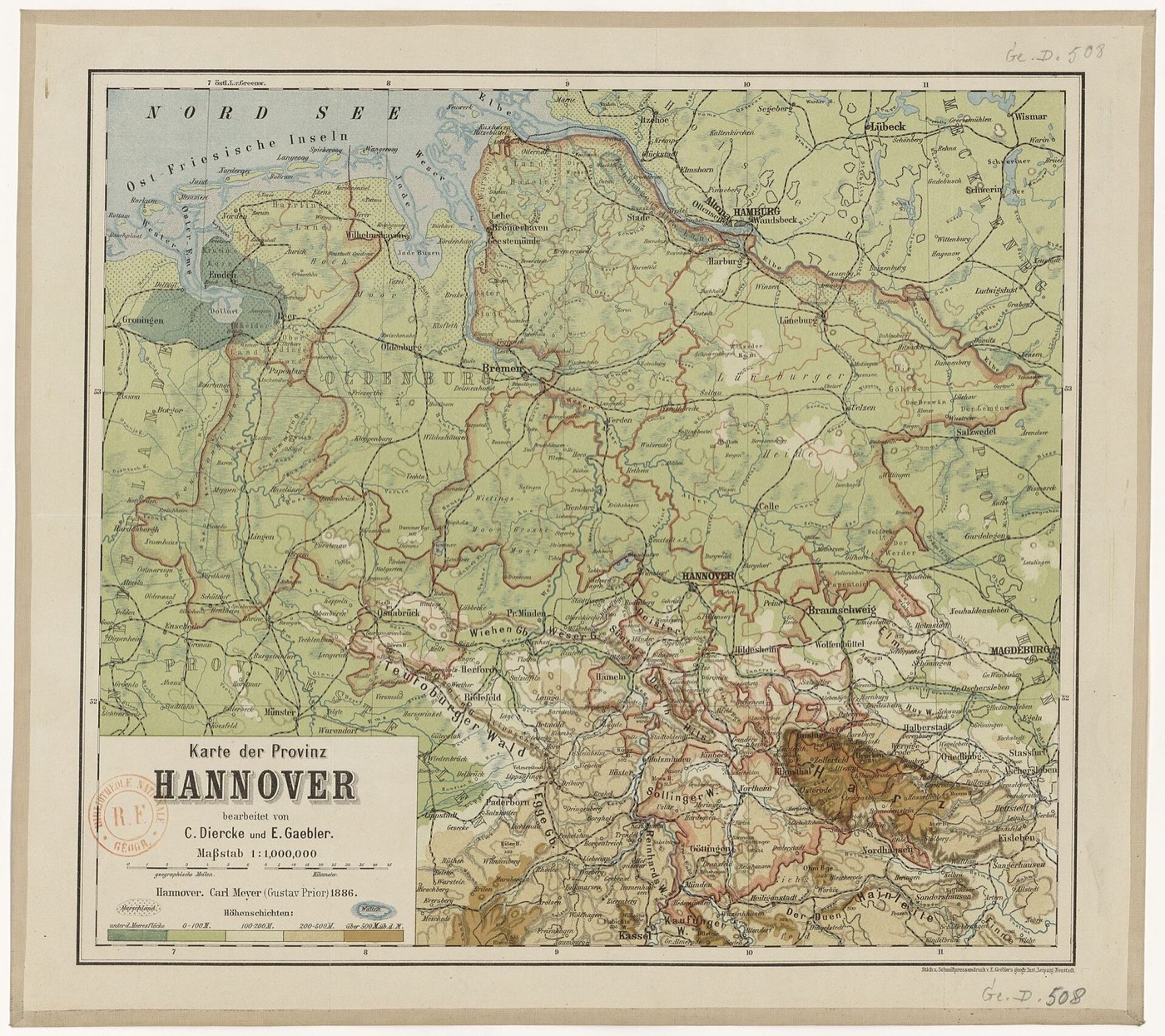
The Prussian province of Hanover in 1886, the Lower Saxon country that holds nearly a third of all Meyer listings in Germany today - Carl Diercke and Eduard Gae
The Prussian province of Hanover in 1886, the Lower Saxon country that holds nearly a third of all Meyer listings in Germany today - Carl Diercke and Eduard Gaebler, engraved map, 1886. Bibliotheque nationale de France; public domain.
the steward's name, from every German-speaking land · 47 pages

The full Meyer surname report

That was one chapter. The report carries the rest: where the name comes from, the region and its records, arms, seals and marks, the stories, a timeline, migration, the name today, notable bearers, and a page on tracing your own line. Every claim sourced the same way as the chapter above.

Get my report · $14.99

Instant download, yours to keep and print

Read it. If it is not the best account of your name you have seen, reply to your receipt within 14 days and we refund you.

Not your name? Search yours, or read another name's free chapter.

The editions

Read it, watch it, or keep it on the shelf.

One piece of research, three more ways to have it. Every edition includes the Meyer report itself.

Watch itin five days$39.99

The Meyer report and a five and a half minute film of the name, your spelling on the title.

Get the film · $39.99
Keep itin two weeks$79

The Meyer report as a hardback, posted free to your door.

Get the book · $79
All three Best valuesaves $19.99$99

The report, the film and the hardback. Bought apart they are $118.99.

Get all three · $99

For the wall. The Meyer record on one framed sheet, 16 by 12 inches, $89 posted free. See the framed plate.

A gift? Send the Meyer report on a day you choose, with a card.

The sources page, in fullWhere every claim on this page comes from.
Where the record is uncertainWhere this report prints a number it comes from a file or page that publishes it, and where two sources disagree it says which one it follows. Two kinds of claim were held to a higher bar: any statement that something does not exist, above all the absence of arms for the surname; and any date attached to a named person, given only where a published record carries it. Counts from the Philadelphia lists are counts of entries, not of passengers.
  • Duden, Familiennamen: Herkunft und Bedeutung (Kohlheim and Kohlheim), 2008 edition, pages 409 to 410, entry Meyer, for the status name from Middle High German meier and meiger, the Middle Low German occupational sense, the Jewish name from Hebrew Meir and the variant spellings; page 412, entry Mayer, for Mayer as the Upper German spelling.
  • Friedrich Kluge, Etymologisches Woerterbuch der deutschen Sprache, 24th edition, page 610, entry Meier, for the derivation from late Latin maior domus through Old High German maior.
  • Max Gottschald, Deutsche Namenkunde, 5th edition (1982), page 346, for English mayor and French maire from the same Latin word.
  • Deutsches Rechtswoerterbuch (Heidelberg Academy of Sciences), entries Meier, Meierhof and Meierrecht, for the manorial official and the farmer on Meierrecht, and for the citation of 1290 from the Calenberg charter book.
  • Niedersaechsische Landeszentrale fuer politische Bildung, Niedersaechsische Geschichte kurz gefasst (2004), page 18, for Meierrecht in Lower Saxony.
  • Patrick Hanks (ed.), Dictionary of American Family Names (Oxford University Press), entries Meyer, Meyers, Myers, Myer, Mayer, Mayers, Meier, Moyer and Moyers.
  • Damaris Nuebling and Konrad Kunze, Familiennamenforschung morgen: Der Deutsche Familiennamenatlas, page 149, for the distribution of the four spellings, the Hoffmann gap and the compounds between Bielefeld and Hanover; Hans Taubken, Niederdeutsches Wort 39 (1999), for the names of the type Meier zu.
  • Geogen (Christoph Stoepel), surname rank and state distribution for Meyer, Meier, Maier, Mayer and Mayr, each spelling queried separately, from German telephone directory data.
  • United States Census Bureau, 2010 and 2020 decennial surname files, for every American count, rank and share in this report; Swiss Federal Statistical Office, last names of the permanent resident population, 2022, for Switzerland and the canton of Zurich.
  • A. J. Fretz, A Genealogical Record of the Descendants of Christian and Hans Meyer and Other Pioneers (1896), pages 17 to 22, for Christian Meyer's land, patent and will; Forrest Moyer, Our Immigrant Heritage: Moyer, and Moyer family inheritance letter, 1752, Mennonite Heritage Center, Harleysville, for the Pennsylvania spellings, the Franconia deacon, Samuel Moyer and the Oblinger letter.
  • Ralph Beaver Strassburger and William John Hinke, Pennsylvania German Pioneers, volume one (Pennsylvania German Society, 1934), for the Philadelphia lists of the William and Sarah, the Samuel, the Francis and Elizabeth, the Halifax and the Neptune, and the spellings of the name through the volume.
  • William Henry Egle, History of the Counties of Dauphin and Lebanon (1883), pages 206 to 207, and the Borough of Myerstown's own history, for Isaac Meier, the founding in 1768, his death and the incorporation of 1912.
  • The Jewish Encyclopedia, article Names, Personal; Historische Kommission fuer Westfalen, HiKo-Materialien 18 (2021); Hochschule fuer Juedische Studien Heidelberg; and Haus der Bayerischen Geschichte, for the surname requirements of 1787 to 1813 and the Alsatian names of 1784.
  • Neue Deutsche Biographie and Allgemeine Deutsche Biographie, entries Joseph Meyer and Herrmann Julius Meyer, for their dates, the Bibliographisches Institut, Meyer's Universum and the New York branch; meyersgaz.org, for the fifth edition of the Orts- und Verkehrs-Lexikon and what its entries give.
  • Antonius Holtmann (University of Oldenburg), Basic, Reliable Information About Early Emigration from the Osnabrueck Area in the Kingdom of Hannover, for the farms, the emigrants of 1832 to 1866 and the Cincinnati letter.
  • Encyclopedia of Chicago, entries Germans and Oscar Mayer and Co.; the Library of Congress record for the Illinois Staats-Zeitung; the town of Neresheim, for Oscar Mayer's birthplace.
  • National Agricultural Library and the Arnold Arboretum, for Frank N. Meyer; USDA Inventory of Seeds and Plants Imported No. 15, number 23028; University of California, Riverside, Citrus Variety Collection.
  • Meyer v. Nebraska, 262 U.S. 390 (1923), and Bartels v. Iowa, 262 U.S. 404 (1923), opinion text; Encyclopedia of the Great Plains, entry Meyer v. Nebraska, for the teacher's name; National Archives, World War II Selective Service Draft Cards: Fourth Registration, 1942.
  • Plate and cover credits are printed with each picture. The cover device is the civic arms of Knonau in the canton of Zurich, a silver Meier's hat on red, rendered as a single line device: the village's arms and not this name's, public domain as the official arms of a Swiss public body. The plates are public domain, their holdings named in the captions.

This history is written from public-domain sources and the family's own published records, every one of them listed. Where tradition and record disagree the text says so rather than choosing quietly. No image on this page is AI-generated.

First edition · Second edition

More surname histories, free to read

Every surname we have written →