The Old Country
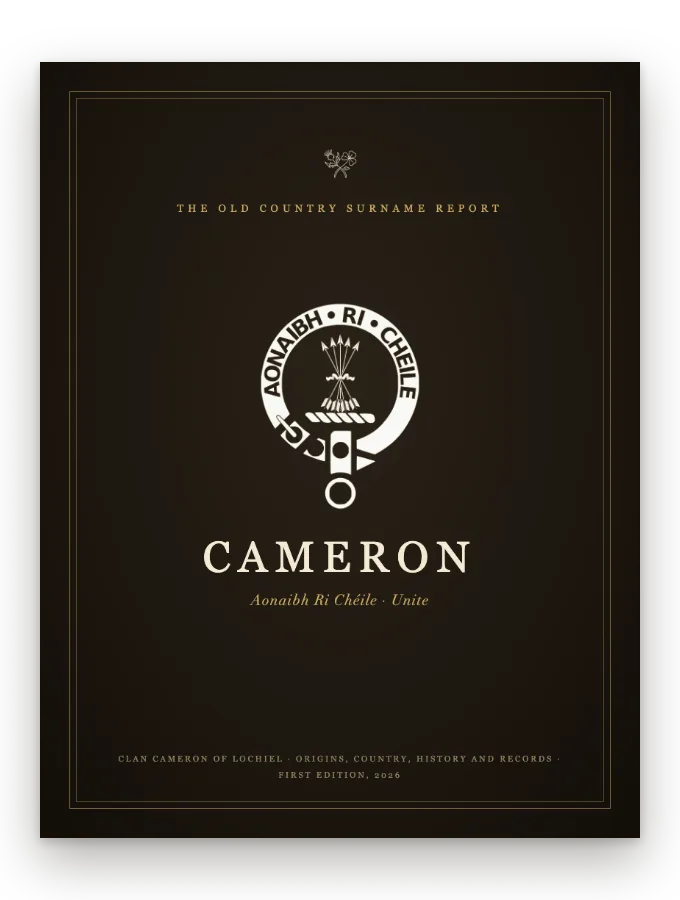
Cover of the Cameron Surname Report
Free to read · Clan Cameron

CameronSurname meaning, origin and history

This report tells the story of the name Cameron: what it means, where it rose, the history it carried, and how it crossed the ocean to the places its bearers live today. It is the history of a name, of the clan that made it famous, and of the people who wore it through six centuries in Lochaber, drawn from charters, muster rolls, the papers of a forfeited estate, regimental records and the work of modern historians.

Get my report · $14.99

39 pages, 16 named sources, in your inbox within a minute.

Read it. If it is not the best account of your name you have seen, reply to your receipt within 14 days and we refund you.

“I have been tracing my family tree for some time, but there were certain stories that even our closest relatives never knew about. This surname report is a true deep dive. Thank you.”Susan D., reader

Not today? Read the Cameron chapter free. We will email it to you.Rather read it later? We will email you the Cameron chapter.

One email: the link to this page and the free Clan Finder, eighteen clans and every surname recorded as belonging to them, on two printable pages. Nothing else unless you tick the box.

The Cameron name at a glance

Meaning
“Crooked nose,” from the Gaelic cam (crooked) and sròn (nose)
Language of origin
Scottish Gaelic, Camshron
Earliest written record
Robert de Cambrun, holding land in Fife under William the Lion; the clan named in a charter of 1472
Homeland
Lochaber, from Loch Arkaig and Loch Eil to Ben Nevis
Motto and war cry
Aonaibh ri Chéile (“Unite”) and “Sons of the hounds, come here and get flesh”
Rank today
About 614th most common in the United States, with 55,240 bearers at the 2010 Census; 36th in Scotland in the 2025 NRS tables
Chief today
Donald Andrew John Cameron, 28th of Lochiel, styled simply Lochiel
Seat and plant badge
Achnacarry, between Loch Arkaig and Loch Lochy, and the crowberry
Chapter four, free to read in full

Cameron country

Lochaber is not a county and never was. It is a district at the south-western end of the Great Glen, the geological seam that cuts Scotland in half, and it is defined by water and rock rather than by any line a clerk ever drew. Ben Nevis stands over it. Loch Linnhe carries the sea into it. Behind Ben Nevis the freshwater lochs run inland one after another, Loch Lochy, Loch Arkaig, Loch Eil, and the glens that feed them were the arteries of the clan. Achnacarry, the chief's house, sits on a narrow neck of land between Loch Lochy and Loch Arkaig, which is precisely why it is there: whoever held that isthmus held the road west.

Whoever held the isthmus between the two lochs held the road west. That is why the house is where it is.

The clan's history is written across it in place names. Torcastle by Banavie, where the thirteenth chief built his stone house before the family moved deeper into the hills. Glen Loy and the burial ground of the Strone Camerons at its foot. Murlaggan on Loch Arkaig, where the chiefs met after Culloden to decide whether to fight on. Kilmallie at Corpach, a burial place of the clan, where Cameron families buried their dead. And the Mile Dorcha, the Dark Mile, a mile of road under interlaced trees between Achnacarry and Loch Arkaig, which is the single most atmospheric stretch of tarmac in the Highlands and takes about four minutes to drive.

It is easy country to reach and hard country to leave. Fort William is three hours from Glasgow by road and a little over four by the West Highland Line, which is worth taking for its own sake. From there Achnacarry is half an hour, Glenfinnan is half an hour the other way, and the Commando Memorial at Spean Bridge stands between them looking straight at the mountains the clan lived under. The glens your people left are still there, and most of them are empty enough that you can hear the water.
Inverlochy and Ben Nevis - Alfred de Bréanski Snr, oil on canvas, late nineteenth century. The mouth of the Great Glen, where the clan fought its two battles of
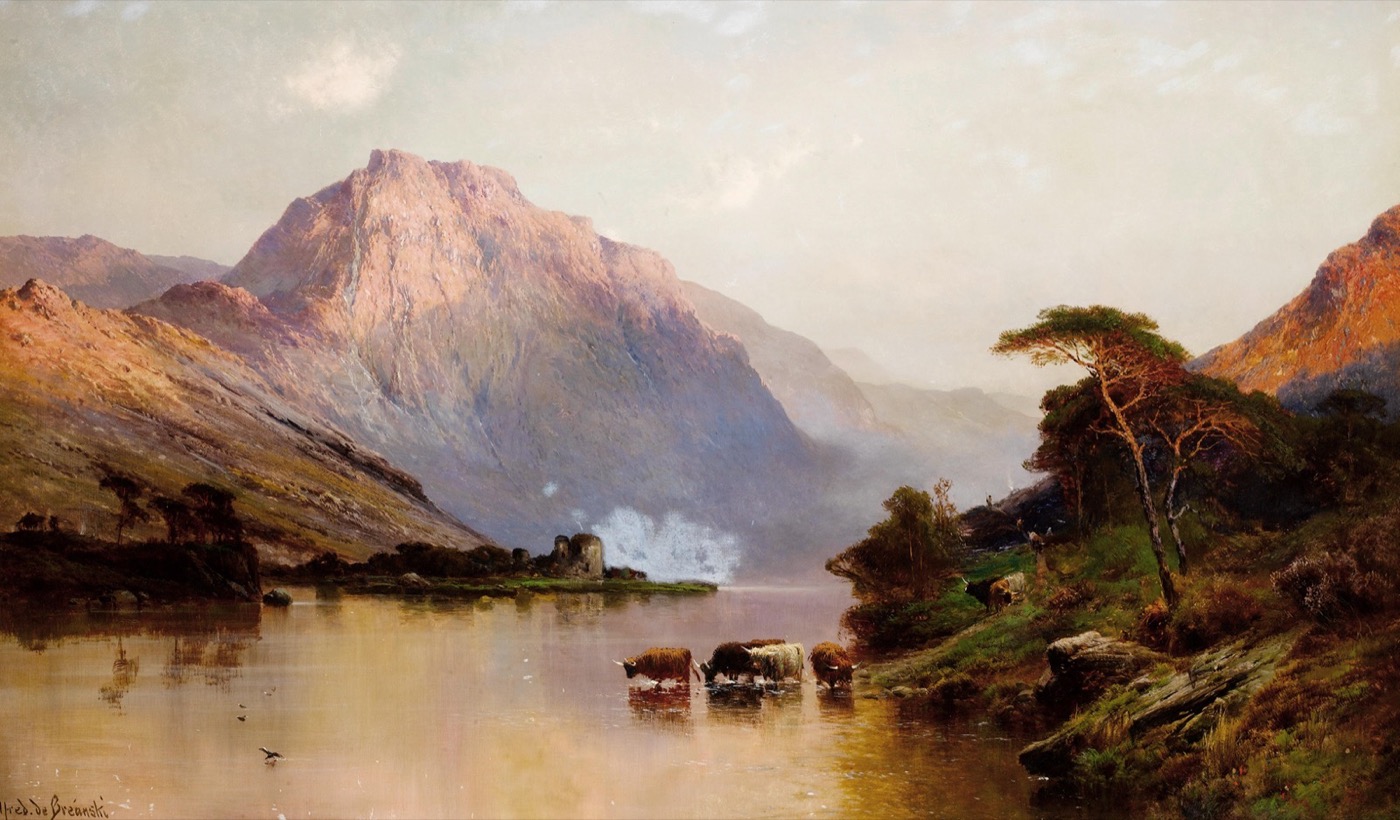
Inverlochy and Ben Nevis - Alfred de Bréanski Snr, oil on canvas, late nineteenth century. The mouth of the Great Glen, where the clan fought its two battles of Inverlochy. Public domain.
Clan Cameron · 39 pages

The full Cameron surname report

That was one chapter. The report carries the rest: where the name comes from, the clan and its chiefs, heraldry, the stories, a timeline, migration, the name today, notable bearers, and a page on tracing your own line. Every claim sourced the same way as the chapter above.

Get my report · $14.99

Instant download, yours to keep and print

Read it. If it is not the best account of your name you have seen, reply to your receipt within 14 days and we refund you.

Not your name? Search yours, or read another name's free chapter.

The editions

Read it, watch it, or keep it on the shelf.

One piece of research, three more ways to have it. Every edition includes the Cameron report itself.

Watch itin five days$39.99

The Cameron report and a five and a half minute film of the name, your spelling on the title.

Get the film · $39.99
Keep itin two weeks$79

The Cameron report as a hardback, posted free to your door.

Get the book · $79
All three Best valuesaves $19.99$99

The report, the film and the hardback. Bought apart they are $118.99.

Get all three · $99

For the wall. The Cameron record on one framed sheet, 16 by 12 inches, $89 posted free. See the framed plate.

A gift? Send the Cameron report on a day you choose, with a card.

The sources page, in fullWhere every claim on this page comes from.
Where the record is uncertainWhere tradition and record disagree in these pages, we have said so in the text rather than choosing quietly. Sir Ewen at Achdalieu is the clearest case: a wonderful story, told first by his own kinsman, and flagged here as exactly that. That is the standard this report is built to.
  • John Stewart of Ardvorlich, The Camerons: A History of Clan Cameron (Clan Cameron Association, 1971), as extracted at length on the association's own site, for the clan's descent, chiefs, feuds and campaigns.
  • Clan Cameron Association, septs and surname variations page, for the sept roll, the branch names, and the clan's own account of the Taillear Dubh and the Taylors of Cowal.
  • The Old Country, EP05 sept research file, our own primary-source verification of the Taylor and Cameron association, which records the exact wording of the clan's list.
  • Court of the Lord Lyon and published blazons of the arms of Cameron of Lochiel, for the shield, crest badge, supporters and the standing of arms in Scots law.
  • John Drummond of Balhaldie, Memoirs of Sir Ewen Cameron of Locheill, written by the chief's own grandson and quoted at length in the clan history, for the Achdalieu fight of 1654; recorded here as tradition rather than as documentary record.
  • Contemporary Jacobite accounts of the raising of the standard, 19 August 1745, for the numbers at Glenfinnan and the terms Lochiel obtained.
  • Robert Chambers, History of the Rebellion of 1745-46 (1827-28), as the earliest source for the epithet Gentle Lochiel.
  • Records of the burning of Achnacarry, 28 May 1746, and the annexation of the Lochiel estate to the Crown until 1784.
  • Trial and execution records of Dr Archibald Cameron, Tyburn, 7 June 1753.
  • Regimental histories of the 79th and the Queen's Own Cameron Highlanders, with the National Army Museum, for the raising of 1793, the Erracht tartan, the battle honours, the 1873 title and the amalgamations of 1961, 1994 and 2006.
  • Imperial War Museum and Commando Veterans Association records for the Commando Basic Training Centre at Achnacarry, 1942 to 1945, and the Commando Memorial of 1952.
  • Ontario Heritage Trust plaque, The MacMillan Emigration 1802, Williamstown, Ontario, for the three ships, the four hundred emigrants and the move to Glengarry; accounts of the Lochaber emigration of 1802 and of the clearance of the Lochiel lands from 1801, with the Cameron cairn on the Achnacarry estate.
  • United States Census Bureau, 2010 surnames file (Cameron: 55,240 bearers, rank 614), with National Records of Scotland surname data for the Scottish ranking.
  • George F. Black, The Surnames of Scotland (1946), for the Lowland territorial Camerons of Fife and the Lennox and the earliest recorded forms of the name.
  • Clan member crest badge illustration by the Wikimedia Commons contributor Celtus, used under CC BY-SA 3.0.
  • OpenStreetMap contributors (openstreetmap.org), Open Database Licence, for the coastline and the lochs of the Lochaber map.

This history is written from public-domain sources and the family's own published records, every one of them listed. Where tradition and record disagree the text says so rather than choosing quietly. No image on this page is AI-generated.

First edition · Second edition

More surname histories, free to read

Every surname we have written →