The Old Country
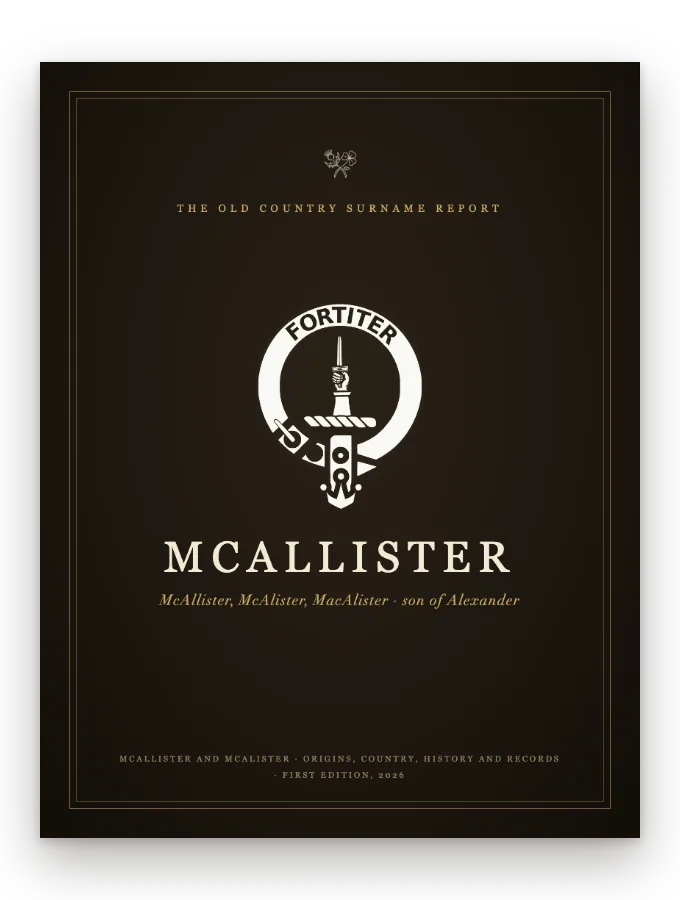
Cover of the McAllister Surname Report
Free to read · Son of Alexander: Loup and Tarbert in Kintyre, Arran and Bute, north Antrim, and the brothers' letters from Cape Fear

McAllisterSurname meaning, origin and history

This report tells the story of the name McAllister. It covers what the name means, when it was first written down, the families who carried it, and how it reached Ulster and America.

Get my report · $14.99

44 pages, 23 named sources, in your inbox within a minute.

Read it. If it is not the best account of your name you have seen, reply to your receipt within 14 days and we refund you.

“I have been tracing my family tree for some time, but there were certain stories that even our closest relatives never knew about. This surname report is a true deep dive. Thank you.”Susan D., reader

Not today? Read the McAllister chapter free. We will email it to you.Rather read it later? We will email you the McAllister chapter.

One email: the link to this page and the free Clan Finder, eighteen clans and every surname recorded as belonging to them, on two printable pages. Nothing else unless you tick the box.

The McAllister name at a glance

Meaning
Son of Alexander, from the Gaelic MacAlasdair
Kind of name
A patronymic: a name made from an ancestor's name
First written as a surname
Ranald Makalestyr, lease of lands in Arran, 1455
Homeland
North Kintyre in Argyll, with Arran, Bute and north Antrim
The crest and mottoes
An arm holding a dagger; Fortiter, Per mare per terras
Main families
Loup, Tarbert, Balinakill and Glenbarr; in Ulster, the Route and Glens
United States today
McAllister 28,274 and McAlister 10,954 people at the 2020 Census
Scotland today
Mcallister 136 and Mcalister 13 register entries in 2025
Chapter four, free to read in full

Loup, Tarbert and the two lochs

The McAllister country is a strip of sea coast. Kintyre is a long finger of land on the west coast of Scotland, pointing south towards Ireland. Near its top, two sea lochs nearly cut it off: Loch Fyne on the east side and West Loch Tarbert on the west. Only a mile or so of land lies between them. Tarbert means a place where boats are carried across.

Loup lies on the Kintyre shore at the Atlantic end of West Loch Tarbert. Joan Blaeu's map of 1654 prints it as Loub, beside the church of Kilcalmonell. The name comes from a word for a curve or bend, from the shape of the shore. A hill by the village of Clachan still has the name. The old church there, the main church of north Kintyre, stands among carved stones linked with the chiefs. Balinakill House, home of Coll McAlester before he sailed to America, is at Clachan too.

From the tip of Kintyre to Antrim is about 12 miles of water.

Tarbert Castle stands above the harbour on the Loch Fyne side. In 1580 Charles M'Allister was its constable, the man who kept it for its owner. Further down the coast lies Glenbarr, where another branch had its house, now called Glenbarr Abbey.

Now look south. From the tip of Kintyre the coast of Antrim is about 12 miles off. That is why this name is on both shores. To people who travelled by boat, this was not a border. It was the road between two pieces of the same country.
The north shore of West Loch Tarbert. Blaeu's map prints Loub, the McAllister chiefs' land, on the Kintyre side of this water, though The Clan Donald says north
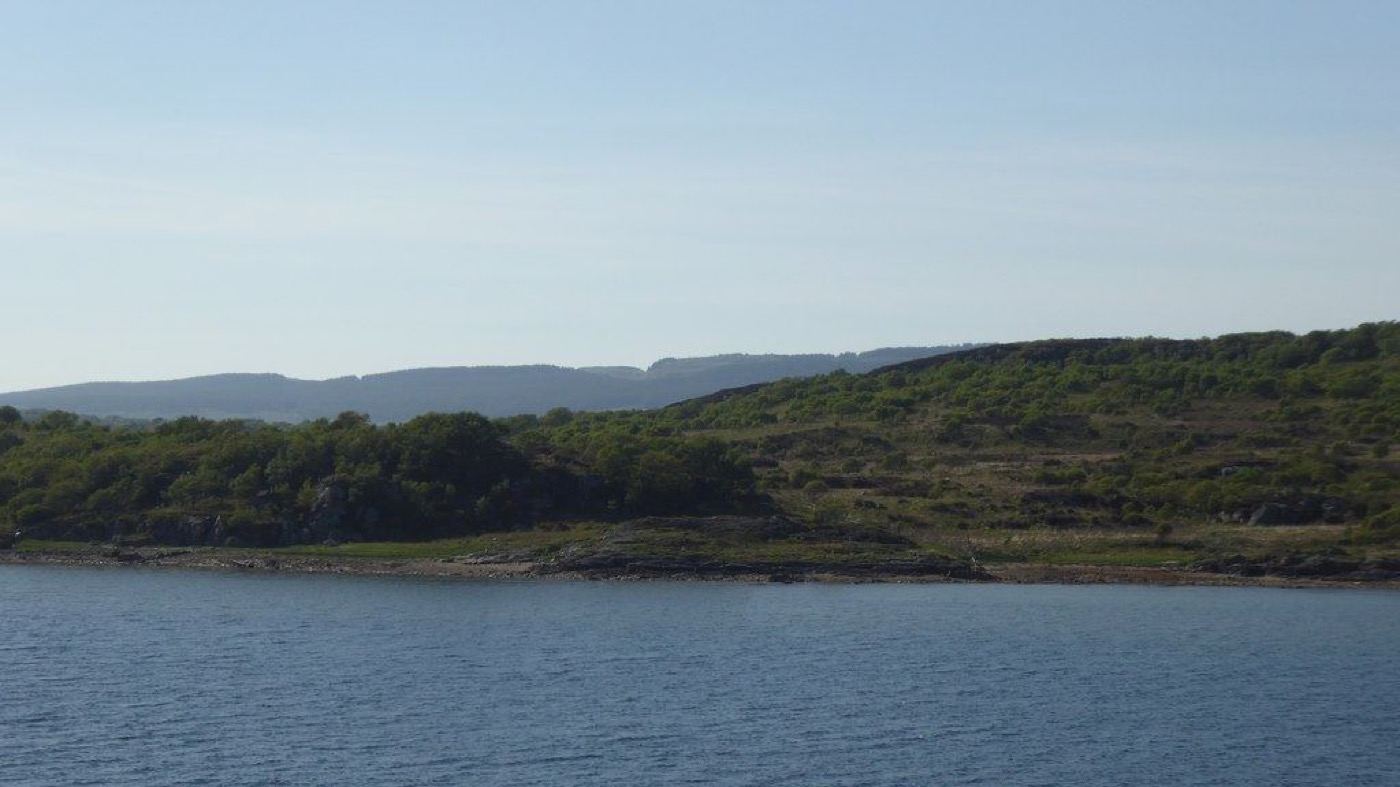
The north shore of West Loch Tarbert. Blaeu's map prints Loub, the McAllister chiefs' land, on the Kintyre side of this water, though The Clan Donald says north of it. Photograph by Alpin Stewart, 2018, used under CC BY-SA 2.0.
Son of Alexander: Loup and Tarbert in Kintyre, Arran and Bute, north Antrim, and the brothers' letters from Cape Fear · 44 pages

The full McAllister surname report

That was one chapter. The report carries the rest: where the name comes from, the clan and its chiefs, heraldry, the stories, a timeline, migration, the name today, notable bearers, and a page on tracing your own line. Every claim sourced the same way as the chapter above.

Get my report · $14.99

Instant download, yours to keep and print

Read it. If it is not the best account of your name you have seen, reply to your receipt within 14 days and we refund you.

Not your name? Search yours, or read another name's free chapter.

The editions

Read it, watch it, or keep it on the shelf.

One piece of research, three more ways to have it. Every edition includes the McAllister report itself.

Watch itin five days$39.99

The McAllister report and a five and a half minute film of the name, your spelling on the title.

Get the film · $39.99
Keep itin two weeks$79

The McAllister report as a hardback, posted free to your door.

Get the book · $79
All three Best valuesaves $19.99$99

The report, the film and the hardback. Bought apart they are $118.99.

Get all three · $99

For the wall. The McAllister record on one framed sheet, 16 by 12 inches, $89 posted free. See the framed plate.

A gift? Send the McAllister report on a day you choose, with a card.

The sources page, in fullWhere every claim on this page comes from.
Where the record is uncertainWhere tradition and record disagree in these pages, we have said so in the text rather than choosing quietly. Where one writer is the only authority for a statement, the report says whose it is. No commercial surname site was used.
  • George Fraser Black, The Surnames of Scotland (New York, 1946), s.v. Macalaster, Macalexander and Alexander.
  • Patrick Hanks (ed.), Dictionary of American Family Names (Oxford, 2003), s.v. McAllister, McAlister, McCallister and MacAllister.
  • Patrick Woulfe, Sloinnte Gaedheal is Gall (Dublin, 1923), s.v. Mac Alasdair and Mac Alastruim.
  • Edward MacLysaght, The Surnames of Ireland (Dublin, 1985), s.v. Alexander, Mac Illesher, Lester and Lister.
  • Robert Bell, The Book of Ulster Surnames (Belfast, 1988), pp. 128-129.
  • A. Macdonald and A. Macdonald, The Clan Donald, vols. 1 to 3 (Inverness, 1896 to 1904), vol. 2 pp. 27-55 and vol. 3 pp. 184-194.
  • Annals of the Kingdom of Ireland by the Four Masters, ed. John O'Donovan, entries for 1299 and 1366; CELT, University College Cork (T100005C).
  • George Hill, An Historical Account of the MacDonnells of Antrim (Belfast, 1873).
  • Calendar of the State Papers relating to Ireland, vol. XXXV no. 23, as printed in The Clan Donald, vol. 2.
  • Register of the Privy Council of Scotland, vols. VI and XIII, as printed in The Clan Donald, vol. 2.
  • The 1641 Depositions, Trinity College Dublin, MS 838, fols. 32v-33r, examination of Coll McAllester (1641dep.abdn.ac.uk, item 42637).
  • Seamus Pender (ed.), A Census of Ireland circa 1659 (Dublin, 1939), pp. 5, 19 and 145.
  • McAllister Family Papers, North Carolina State Archives, P.C. 1738.1-2, finding aid with letter abstracts, 1747 to 1935.
  • Heritage Ireland (Office of Public Works), Dwyer McAllister Cottage education sheet.
  • Federal Judicial Center, Biographical Directory of Article III Federal Judges: Matthew Hall McAllister.
  • Biographical Directory of the United States Congress, Archibald McAllister (M000295).
  • U.S. Census Bureau, Frequently Occurring Surnames from the 2010 and 2020 Censuses.
  • National Records of Scotland, Most Common Surnames 2025 (May 2026), sheet Surnames TimeSeries 1975to2025.
  • National Archives of Ireland, Census of Ireland 1901 and 1911, surname search (exact match).
  • Sir Bernard Burke, The General Armory (London, 1884), s.v. Macalister.
  • James Fairbairn, Fairbairn's Book of Crests, 4th edition (Edinburgh, 1905), s.v. Macalister and McAlister.
  • Wikipedia, used only as a pointer and checked where the report names a person: Clachan, Kintyre; Ward McAllister; Alexander Macalister; R. A. S. Macalister; Sir Donald MacAlister.
  • Clan member crest badge illustration by the Wikimedia Commons contributor Celtus, used under CC BY-SA 3.0.

This history is written from public-domain sources and the family's own published records, every one of them listed. Where tradition and record disagree the text says so rather than choosing quietly. No image on this page is AI-generated.

First edition · last revised

More surname histories, free to read

Every surname we have written →