 The Old Country
The Old Country
The Old Country
This report tells the story of a name that looks, at first glance, like an American city and nothing older. It is in fact a Scottish barony, and a plain one: Houston, from Hugh's toun, the town that grew around the twelfth-century holding of a Norman knight named Hugh de Paduinan in the low, wooded parish of Kilpeter, west of Paisley in Renfrewshire. The family that took his name held that barony for close to six centuries, did homage to an English king at Berwick in 1296, lost a laird at Linlithgow Bridge in 1526, sat as baronets of Nova Scotia from 1668, and finally sold the estate in 1740, leaving behind a crest that says everything the family itself never claimed: an hourglass, and the motto In time.
The barony of Houston sits in the Gryffe valley of Renfrewshire, low, fertile ground a few miles west of Paisley and some six miles northwest of the city itself, nothing like the hill-country strongholds this series more often describes. By tradition the lands were called Kilpeter, named for a parish church dedicated to Saint Peter, before their supposed grant to Hugh de Paduinan; the village that grew up around the holding took his name instead, and the united parish of Houston and Killellan, formed in 1771 when the neighbouring rural parish of Killellan merged into it, still governs the ground today. The present village, largely an eighteenth-century planned replacement for an older settlement that had grown up around a sixteenth-century castle, is a working Renfrewshire community rather than a heritage attraction, with a mercat cross, a parish kirk and the burn that gives several of its street names their sound.
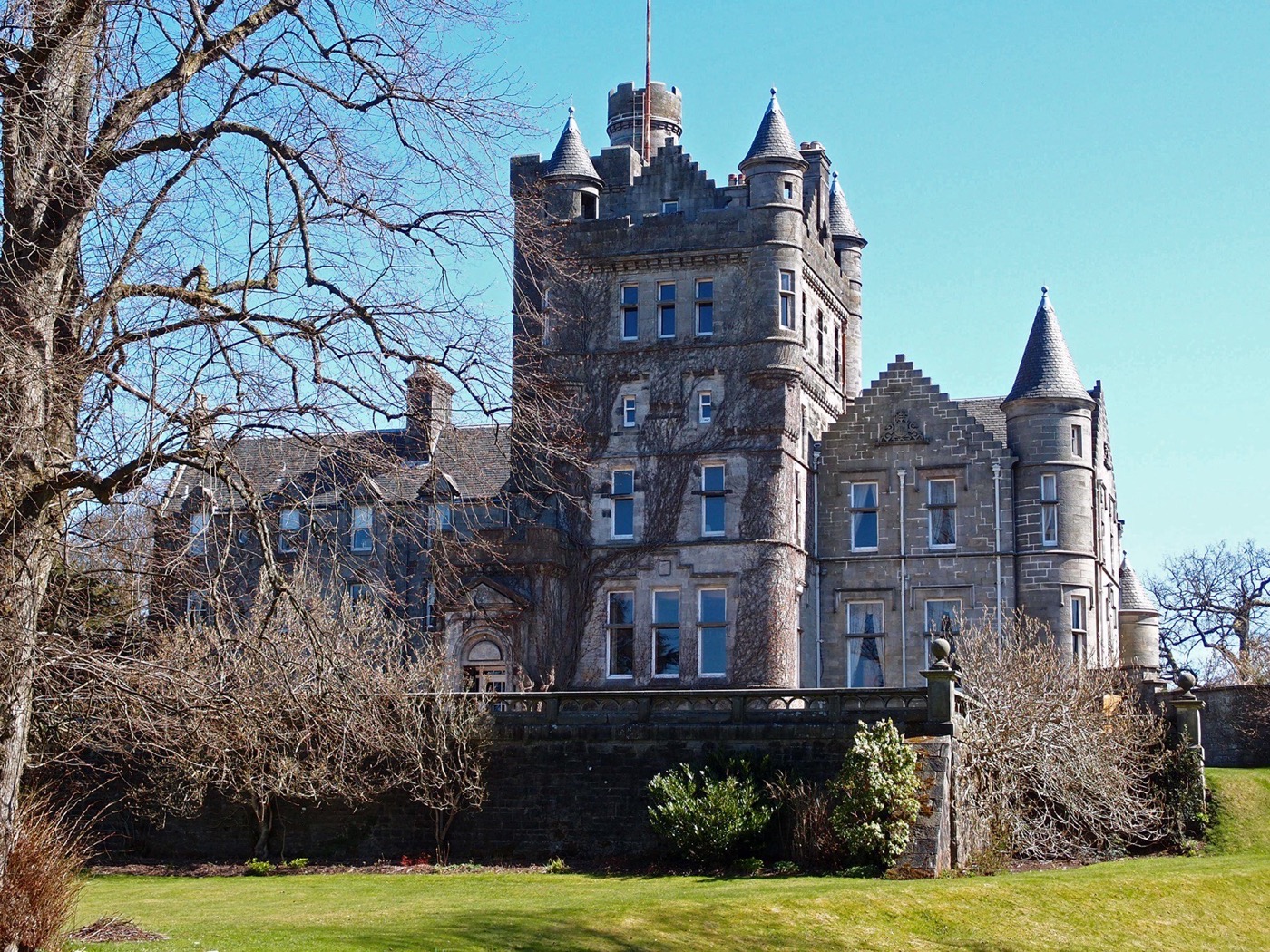
The family's own seat did not survive its 1740 sale in any form a visitor can stand in front of today. What did survive, a few miles to the southeast, is Johnstone Castle, built as Easter Cochrane and enlarged by the Houstons of Johnstone after Burke's General Armory names them the line carrying the chiefly arms forward; George Houston laid out the streets of the town of Johnstone itself from 1782, on ground his family's cadet branch had inherited by marriage. The nineteenth-century Houston House that stands on or near the old barony's ground today was built for the Speirs family, the tobacco merchants who acquired the estate from James Macrae in 1782, more than forty years after the Houstouns sold it out of the family's hands; the house was not built for any Houston, and this report states that plainly rather than letting a grand building borrow a name it does not carry.
A third site belongs to the family's earliest dated appearance rather than to its later estate: Paisley Abbey, a few miles east, where Hugh de Paduinan is recorded witnessing Walter fitz Alan's founding charter in the years 1165 to 1173. The abbey survives as a working parish church today, rebuilt and restored across several centuries, and remains the closest thing this name has to a birthplace on paper.
That was one chapter. The report carries the rest: where the name comes from, the clan and its chiefs, heraldry, the stories, a timeline, migration, the name today, notable bearers, and a page on tracing your own line. Every claim sourced the same way as the chapter above.
Get the Houston report$14.99 · instant download, yours to keep and print
Not your name? Search yours, or read how we work, with another full chapter.
This history is written by AI from public-domain sources and the family's own published records, every one of them listed above. Where tradition and record disagree the text says so rather than choosing quietly. No image on this page is AI-generated.
First edition · last revised