The Old Country
Cover of the Hughes Surname Report
Free to read · Son of Hugh, of Wales, England and Ulster

HughesSurname meaning, origin and history

This report tells the story of a surname that reached its modern spelling by three separate roads. In England, Hughes is the patronymic of Hugh, the English form of the Continental Germanic name Hugo, built on an element meaning mind, heart or spirit. In Wales the same name was borrowed as Huw and carried for centuries as the changing patronymic ap Huw, before Welsh families settled into hereditary surnames in the sixteenth and seventeenth centuries, later than England had. And in Ireland an unconnected Gaelic name, Ó hAodha, descendant of Aodh, was anglicised along a line drawn by province. Woulfe's dictionary of 1923 puts it in one sentence: generally Hughes in the North and Hayes in the South.

Get my report · $14.99

38 pages, 18 named sources, in your inbox within a minute.

Read it. If it is not the best account of your name you have seen, reply to your receipt within 14 days and we refund you.

“I have been tracing my family tree for some time, but there were certain stories that even our closest relatives never knew about. This surname report is a true deep dive. Thank you.”Susan D., reader

Not today? Read the Hughes chapter free. We will email it to you.Rather read it later? We will email you the Hughes chapter.

One email: the link to this page and the free Trades Sheet, the trades hidden in English and Scottish surnames, and the names that grew out of them, on two printable pages. Nothing else unless you tick the box.

The Hughes name at a glance

Meaning
Son of Hugh in England and Wales, from the Germanic hug-, mind or heart. In Ireland an unrelated name: Ó hAodha, descendant of Aodh, and sometimes Mac Aodha, son of Aodh
Language of origin
Three, independently: English from Norman French, Welsh from the patronymic ap Huw, and Irish Gaelic
Recorded heartland
North Wales (Merionethshire, Denbighshire, Flintshire) and Ulster, where the 1901 census put 5,999 of Ireland's 11,737 Hughes
Earliest dated record
Hughes of Gwerclas, whose pedigree has an ancestor's lands confirmed by Edward I in 1284, and the surname taken by Humffrey Hughes, heir in 1600
Homeland
North Wales and Ulster, reached independently; and Connacht, where Mayo and Galway held 1,577 Hughes in 1901, in McHugh country
Crest
No single Hughes crest. Burke records at least nine distinct Hughes coats; the cover carries the Gwerclas lion
Chief today
None. Hughes was never a clan and has no chief; its arms belong to named gentry lines, never to the surname at large
Recorded counts
United States 2010: 236,271, rank 90. Ireland 1901: 11,737, and 11,675 in 1911. Scotland 2024: 288, rank 62
Chapter four, free to read in full

North Wales, and the Ulster counties

North Wales carries the name's oldest documented roots. Gwerclas lies in Edeirnion, the upper valley of the River Dee around Corwen in Merionethshire, where the Hughes of Gwerclas held their barony; the family's pedigree traces its lands to a confirmation by Edward I in 1284 and its surname to Humffrey Hughes, who succeeded in 1600. Some authorities, the Dictionary of Welsh Biography notes, place the birth of the inventor David Edward Hughes at Green y Ddwyryd, near Corwen, though that dictionary itself gives London. North of Edeirnion, either side of the Vale of Clwyd, lie Denbighshire and Flintshire, the country of the separate Hughes of Kinmel and Llewerllyd, whose crest was confirmed in 1620. Kinmel stayed with the family and its heirs from 1786 until the freehold was sold in 2001, and the estate's papers, beginning in 1391, are now at Bangor University.

North Wales and Ulster gave this name to the record by two roads that never crossed. Only the modern spelling makes them look like one story.

Ulster carries the name's second, unconnected home, and here the numbers are exact. The census of 1901 indexed 11,737 Hughes in Ireland, and 5,999 of them lived in the nine Ulster counties. Armagh led every county in Ireland with 1,595, about thirteen in every thousand people the census indexed there; Monaghan followed at about eleven in a thousand and Tyrone at seven and a half. Antrim held 1,159 and Down 796. At the other end of the island the name all but vanishes: 70 in Cork, 8 in Clare, 5 in the whole of Kerry. Matheson's survey of the 1890 birth registers had already found the same shape, 180 of 334 Hughes births in Ulster and 7 in Munster, with Armagh recording 47 Hughes births that year, second only to Murphy's 50 in the county.

Connacht is the third piece of the map, and the one most accounts leave out. Mayo held 1,072 Hughes in 1901 and Galway 505, in counties where Hayes is rare and McHugh is common, which points to Woulfe's Mac Aodha rather than his Ó hAodha. The Welsh and Irish homelands never touched. A Merionethshire family taking an English-style surname under Humffrey Hughes and Gaelic families in Armagh or Mayo taking an English spelling for an unrelated name arrived, independently, at the same six letters.
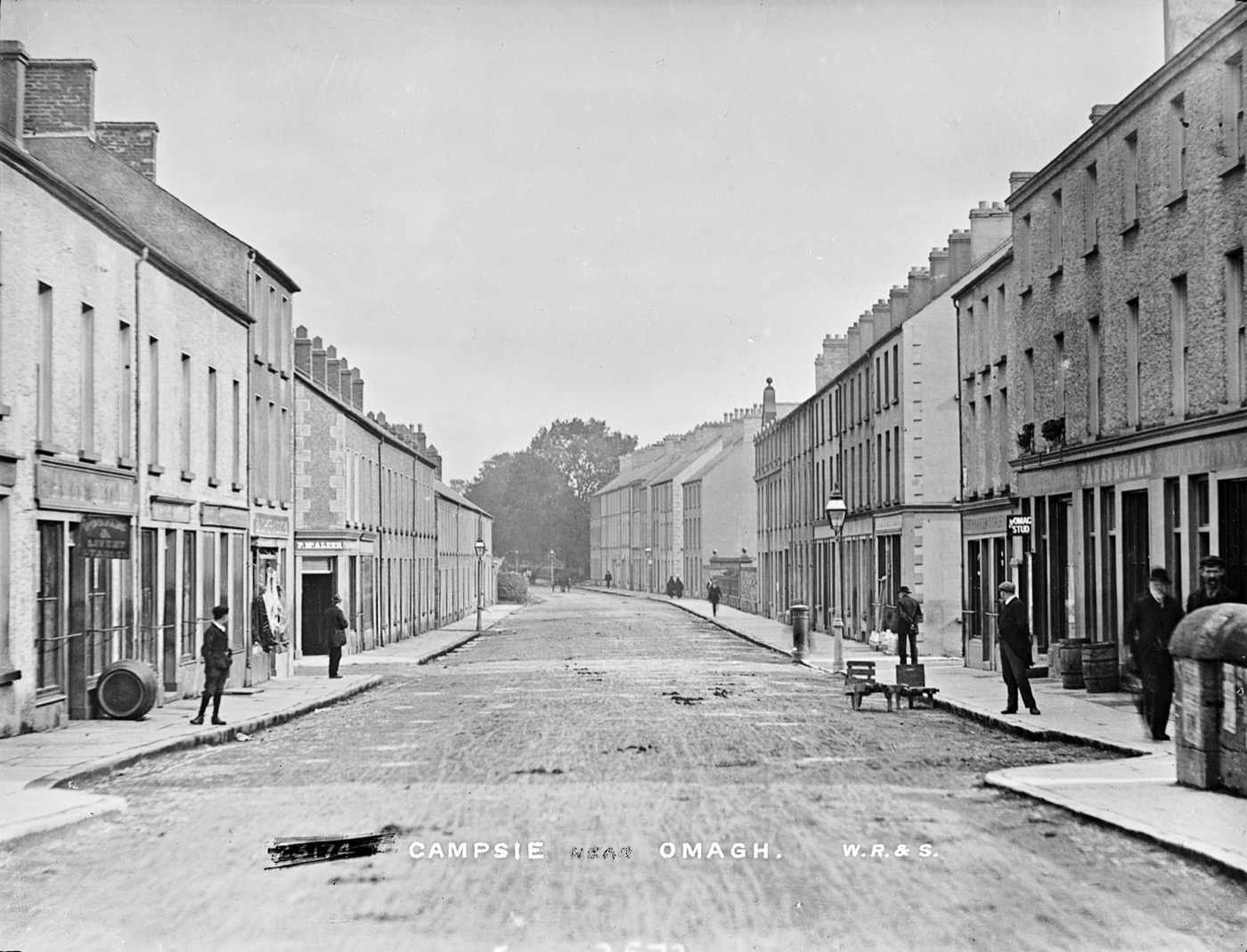
Campsie, Omagh, County Tyrone, photographed around 1900 to 1910. Tyrone held 1,124 people named Hughes in the 1901 census, the fourth highest count of any Irish
Campsie, Omagh, County Tyrone, photographed around 1900 to 1910. Tyrone held 1,124 people named Hughes in the 1901 census, the fourth highest count of any Irish county. National Library of Ireland; no known restrictions.
Son of Hugh, of Wales, England and Ulster · 38 pages

The full Hughes surname report

That was one chapter. The report carries the rest: where the name comes from, the clan and its chiefs, heraldry, the stories, a timeline, migration, the name today, notable bearers, and a page on tracing your own line. Every claim sourced the same way as the chapter above.

Get my report · $14.99

Instant download, yours to keep and print

Read it. If it is not the best account of your name you have seen, reply to your receipt within 14 days and we refund you.

Not your name? Search yours, or read another name's free chapter.

The editions

Read it, watch it, or keep it on the shelf.

One piece of research, three more ways to have it. Every edition includes the Hughes report itself.

Watch itin five days$39.99

The Hughes report and a five and a half minute film of the name, your spelling on the title.

Get the film · $39.99
Keep itin two weeks$79

The Hughes report as a hardback, posted free to your door.

Get the book · $79
All three Best valuesaves $19.99$99

The report, the film and the hardback. Bought apart they are $118.99.

Get all three · $99

For the wall. The Hughes record on one framed sheet, 16 by 12 inches, $89 posted free. See the framed plate.

A gift? Send the Hughes report on a day you choose, with a card.

The sources page, in fullWhere every claim on this page comes from.
Where the record is uncertainWhere a claim rests on one account, the text names whose account it is. Where the record disagrees with itself, as it does over David Edward Hughes's birth and Langston Hughes's birth year, both versions are given.
  • Rev. Patrick Woulfe, Sloinnte Gaedheal is Gall: Irish Names and Surnames (Dublin, 1923), s.v. Ó hAodha, for the English forms O'Hea, Hayes, Hews and Hughes, the families of the name, the North and South anglicisation and O'Hea in west Cork; and s.v. Mac Aodha, for Hughes and McHugh as forms of son of Aodh.
  • National Archives of Ireland, Census of Ireland 1901 and 1911, surname search (exact match), for every Irish census count in this report: Hughes, Hayes, O'Hea, McHugh, Hughs, Hughey and Hewes by county, and the county totals behind the density figures.
  • Sir Robert E. Matheson, Special Report on Surnames in Ireland (Dublin, 1894), for the 1890 rank, estimate and births by province and county; and his Varieties and Synonymes of Surnames and Christian Names in Ireland (Dublin, 1901), for Hews and Hughs as varieties of Hughes.
  • Sir Bernard Burke, The General Armory of England, Scotland, Ireland, and Wales (London, 1884), for the Hughes of Gwerclas, Hughes of Kinmel and Llewerllyd and further separate Hughes blazons, the 1620 crest, and the Powys and Cadwallader descents.
  • James Fairbairn, Fairbairn's Book of Crests of the Families of Great Britain and Ireland (1905), volume 1, for the three Hughes of Gwerclas crests and further Hughes crest entries.
  • Cover device: the crest of Hughes of Gwerclas, a demi-lion rampant sable issuing from a ducal coronet or, after Burke and Fairbairn; source illustration by the Wikimedia Commons contributor AlexD, used under CC BY-SA 3.0.
  • Burke, A Genealogical and Heraldic Dictionary of the Landed Gentry (1850), vol. 1, Hughes of Gwerclas (archive.org vol1genealogical00burk, read 18 October 2026), for the family's pedigree, the grant of 1284, the plea of 1334, Humffrey Hughes's assumption of the surname and William Hughes, the representative in 1850; Wikipedia, Kinmel Hall, for the estate's ownership from 1786, the sale of the freehold in 2001; Cadw's listing of Kinmel Hall, for its acquisition in 1786 and the house of the 1870s; Hugh and Pugh, for the Germanic and Welsh patronymic derivations; and Hughes (surname), for the fire claim tested in the Checked-and-cut chapter.
  • The Catholic Encyclopedia, volume 7 (New York, 1910), John Hughes, by Patrick Hayes, for his birth, his father's emigration, his own crossing, his ordination, consecration and succession, the archdiocese of 1850, Fordham, 1844, the cornerstone and his death; with Wikipedia's John Hughes (archbishop) and St. Patrick's Cathedral (New York City) for the nickname and the Dubois refusal; Fordham University, for his entry as a student in 1820.
  • Dictionary of Welsh Biography, Hughes, David Edward, by Edwin Augustine Owen, for his birth and its disputed place, Bala, Virginia, Bardstown, the microphone and the waves he detected; Wikipedia's David E. Hughes, for the 1830 date, the 1880 demonstration, the Legion of Honour, Highgate and his will; United States patent 14,917, issued 20 May 1856; and the Royal Society's Hughes Medal page.
  • Australian Dictionary of Biography, volume 9 (1983), Hughes, William Morris (Billy), by L. F. Fitzhardinge, for his birth, parents, Llandudno, the Duke of Westminster, his seats, the premiership, the referendums and his death; and the Parliamentary Education Office for his 51 years and 7 months in Parliament.
  • Office of the Historian, United States Department of State, Charles Evans Hughes, and Wikipedia, Charles Evans Hughes, for his parents, education, offices and dates, and the 1916 result in California.
  • Dictionary of Canadian Biography, volume XV, Hughes, Sir Samuel, by Robert Craig Brown, for his birth, his father's emigration from Ireland and his offices.
  • Wikipedia, for Langston Hughes (with Jennifer Schuessler, Langston Hughes Just Got a Year Older, New York Times, 2018), Howard Hughes and Ted Hughes.
  • Archives Hub, Kinmel Manuscripts (Bangor University, GB 222 KIN), and the National Library of Wales, Wills and Probate Records, for the trace chapter.
  • National Records of Scotland, Most Common Surnames 2024, the tables for 2024 and the 1975 to 2024 time series, for the Scottish counts.
  • United States Census Bureau, Frequently Occurring Surnames from the 2010 Census and the equivalent 2020 file, for the counts, ranks and race and ethnicity shares of Hughes and the spellings named in the variants chapter.
  • OpenStreetMap contributors (openstreetmap.org), Open Database Licence, for the coastline of the map.
  • Plate credits, licence templates and the provenance of every image are set out in assets_hughes/MANIFEST.md.

This history is written from public-domain sources and the family's own published records, every one of them listed. Where tradition and record disagree the text says so rather than choosing quietly. No image on this page is AI-generated.

First edition · last revised

More surname histories, free to read

Every surname we have written →