 The Old Country
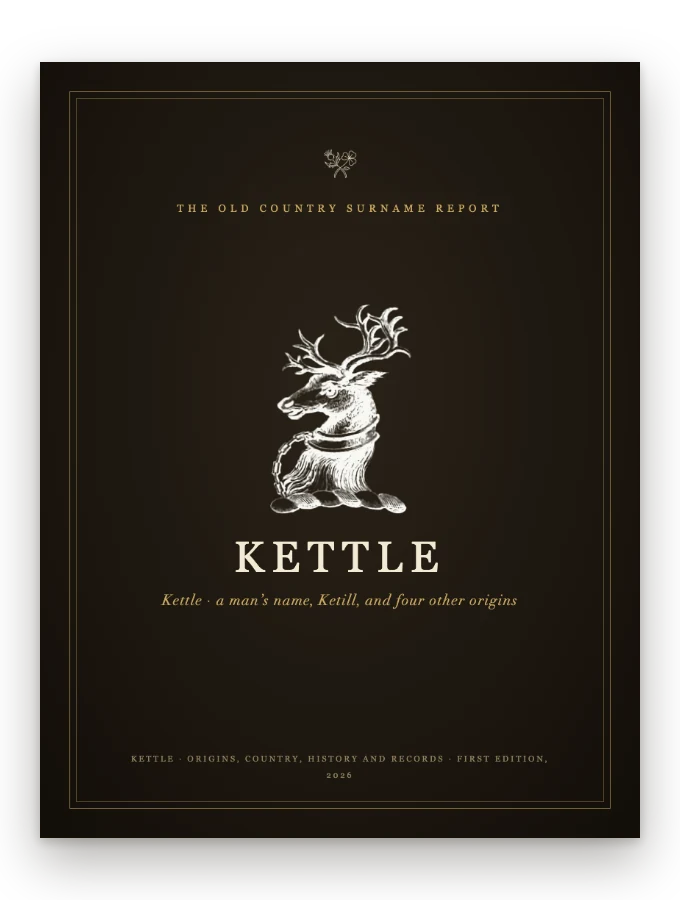
Kettle is an English surname that the dictionaries trace to a Norse man's name, Ketill, which was also the Norse word for a kettle or cauldron; that is a fact about a word and about men named in records such as Domesday Book, and it says nothing about any reader's ancestors. Reaney and Wilson, Bardsley and the American dictionary of family names agree on that root, and Black reads the Scottish Kettle the same way. The American dictionary gives the same spelling a second origin: an English translation of the German name Kessel.
No email needed. It starts just below.
40 pages, 29 named sources, in your inbox within a minute.
The next page asks where to post it.
The hardback could not be added just now. Get your report here, and the hardback is offered on the next page for the same $79 in all.
Read it. If it is not the best account of your name you have seen, reply to your receipt within 14 days and we refund you.
“I have been tracing my family tree for some time, but there were certain stories that even our closest relatives never knew about. This surname report is a true deep dive. Thank you.”Susan D., reader
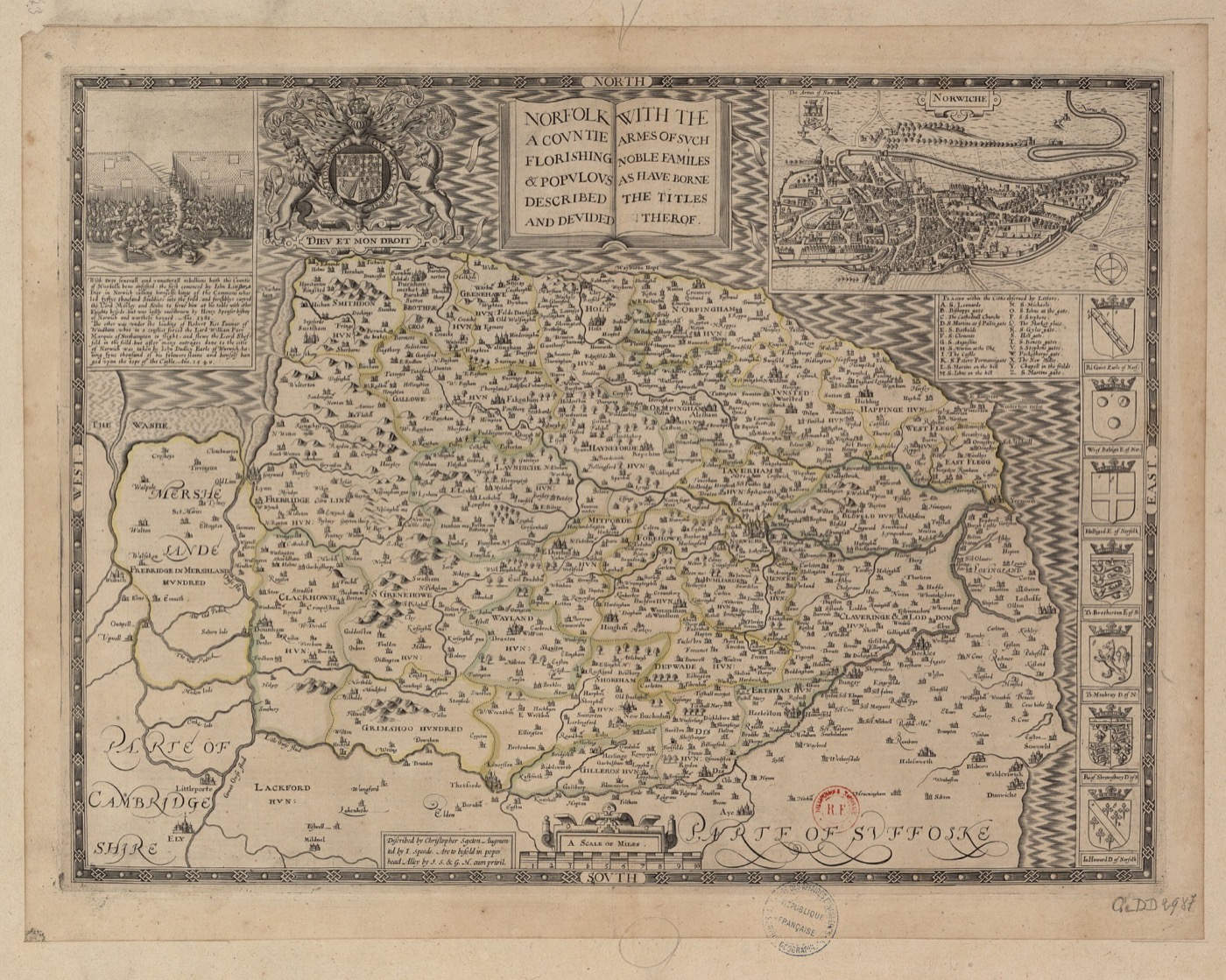
The records put the name in no single home county. The first hereditary form is in London about 1200. By the 1270s Kettle, as Ketel, is in Cambridgeshire, Norfolk and Worcestershire; by the 1290s in Sussex and in the East Riding of Yorkshire; in 1327 in Suffolk; and in 1379 in the West Riding. That is a spread from the south coast to the north of England between 1273 and 1379, drawn from the tax rolls that survive in print, and it is not a census. Domesday Book's first name stands in the same country: of its 113 rows for Ketil as a holder in 1066, Norfolk has 25 and Yorkshire 24, and these are rows, never men, and never families of the name.
Guppy, who in 1890 counted surnames among the farmers of each county, has no Kettle in his index or in his county lists; his Kettlewell, a surname of the place, stands at 7 per 10,000 farmers in the North and East Ridings of Yorkshire (page 511). No count of the name in England and Wales is given here, and none is estimated. Scotland, from Black, is Fife, Perthshire and Shetland, with Muthill and Doune among the Perthshire parishes. Ireland in 1901 and 1911 is Dublin and Cavan above all, and Fermanagh and Cavan for Kettyle.
Across the Atlantic the first census of the United States, in 1790, has 17 index lines under Kettle: 12 in Massachusetts, of which 5 point to Charlestown pages, 2 in Rhode Island, 2 in New York and 1 in Pennsylvania (12 + 2 + 2 + 1 = 17). They are lines in an index, never people. In New South Wales the index lines include a convict of 1806 and a merchant of 1807. Where a person lived does not say which of the five origins his name has.
That was one chapter. The report carries the rest: where the name comes from, the family and its places, heraldry, the stories, a timeline, migration, the name today, notable bearers, and a page on tracing your own line. Every claim sourced the same way as the chapter above.
Get my report · $14.99Instant download, yours to keep and print
Read it. If it is not the best account of your name you have seen, reply to your receipt within 14 days and we refund you.
Not your name? Search yours, or read another name's free chapter.
One piece of research, three more ways to have it. Every edition includes the Kettle report itself.
The Kettle report and a five and a half minute film of the name, your spelling on the title.
Get the film · $39.99The Kettle report as a hardback, posted free to your door.
Get the book · $79The report, the film and the hardback. Bought apart they are $118.99.
Get all three · $99For the wall. The Kettle record on one framed sheet, 16 by 12 inches, $89 posted free. See the framed plate.
A gift? Send the Kettle report on a day you choose, with a card.
This history is written from public-domain sources and the family's own published records, every one of them listed. Where tradition and record disagree the text says so rather than choosing quietly. No image on this page is AI-generated.
First edition · last revised