 The Old Country
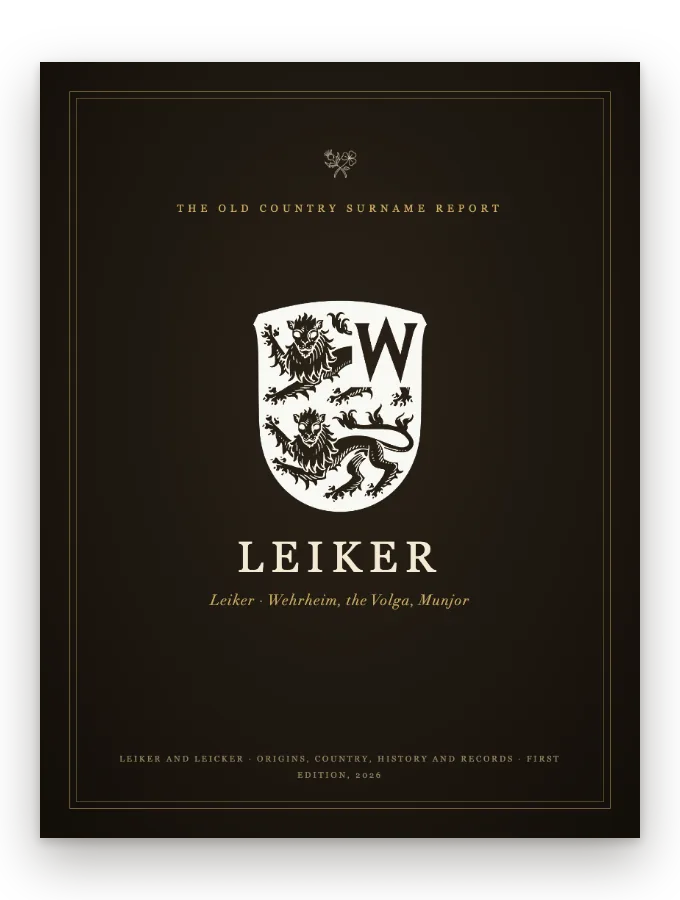
Leiker is a small name with a deep record. The 2020 Census counted 1,706 Americans who carry it, and nearly every line of its written history runs through three places. The first is Wehrheim, a village in the Taunus in Hessen, which Henrich Leicker left with his wife and children in June 1766. The second is Ober-Monjou, a Catholic colony on the meadow side of the Volga, founded in 1767. The third is Munjor, in Ellis County, Kansas, which nine Leiker households helped to found in 1876. What the name means is uncertain, and this report says so in the dictionaries' own words.
No email needed. It starts just below.
43 pages, 19 named sources, in your inbox within a minute.
The next page asks where to post it.
The hardback could not be added just now. Get your report here, and the hardback is offered on the next page for the same $79 in all.
Read it. If it is not the best account of your name you have seen, reply to your receipt within 14 days and we refund you.
“I have been tracing my family tree for some time, but there were certain stories that even our closest relatives never knew about. This surname report is a true deep dive. Thank you.”Susan D., reader
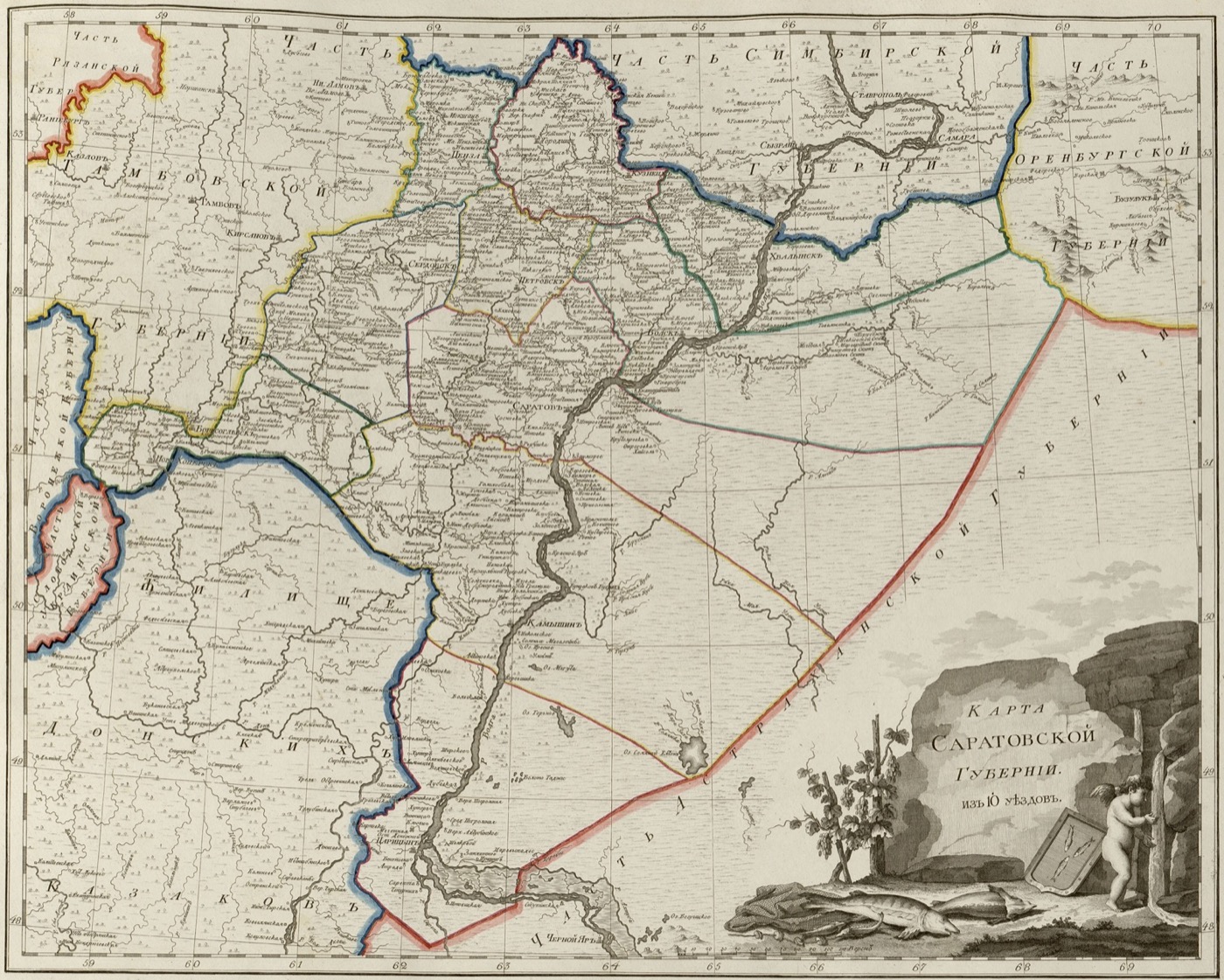
The family's second home was a colony on the Volga. Ober-Monjou was founded as a Roman Catholic colony on 5 March 1767, by the Volga German Institute's account, by colonists recruited by Baron Caneau de Beauregard; Father Francis Laing, writing in Kansas in 1910, gives the year as 1766. It stood on the east bank, the meadow side, north of Saratov, and it took its name from Otto Friedrich von Monjou, the second director of the Kontora, the government office at Saratov that ran the colonies. A decree of 26 February 1768 recognised Ober-Monjou as its official name. In the Jubilee volume the Kansas settlers printed in 1926, the village their families came from is Obermonjour, in the Government of Samara.
The Institute's table of the colony's people shows how it grew. In 1767 Ober-Monjou had 82 households and 299 people; in 1798, 76 households and 429 people; in 1857, 197 households and 1,897 people; in 1897, 2,251 people; and in 1910, 392 households and 2,752. The colony governed itself in the Volga way, which Laing describes: a Vorsteher, or mayor, with two or four councillors and a secretary, and the heads of families as the assembly. The land belonged to the government and was divided again from time to time by lot, each household receiving a share in keeping with the number of its male members.
For a century the colony's Catholics belonged to the parish of Katharinenstadt; in 1874 Ober-Monjou became a parish of its own, with a resident priest. A daughter colony, Neu-Ober-Monjou, was founded from it in 1859, a year on which Laing and the Institute agree, and the Institute counts Leikers among the families of Neu-Ober-Monjou and of Brunnental as well as of the mother colony. It was from Ober-Monjou, Laing records, that every Leiker in his Kansas lists of 1876 came.
That was one chapter. The report carries the rest: where the name comes from, the region and its records, arms, seals and marks, the stories, a timeline, migration, the name today, notable bearers, and a page on tracing your own line. Every claim sourced the same way as the chapter above.
Get my report · $14.99Instant download, yours to keep and print
Read it. If it is not the best account of your name you have seen, reply to your receipt within 14 days and we refund you.
Not your name? Search yours, or read another name's free chapter.
One piece of research, three more ways to have it. Every edition includes the Leiker report itself.
The Leiker report and a five and a half minute film of the name, your spelling on the title.
Get the film · $39.99The Leiker report as a hardback, posted free to your door.
Get the book · $79The report, the film and the hardback. Bought apart they are $118.99.
Get all three · $99For the wall. The Leiker record on one framed sheet, 16 by 12 inches, $89 posted free. See the framed plate.
A gift? Send the Leiker report on a day you choose, with a card.
This history is written from public-domain sources and the family's own published records, every one of them listed. Where tradition and record disagree the text says so rather than choosing quietly. No image on this page is AI-generated.
First edition · last revised