 The Old Country
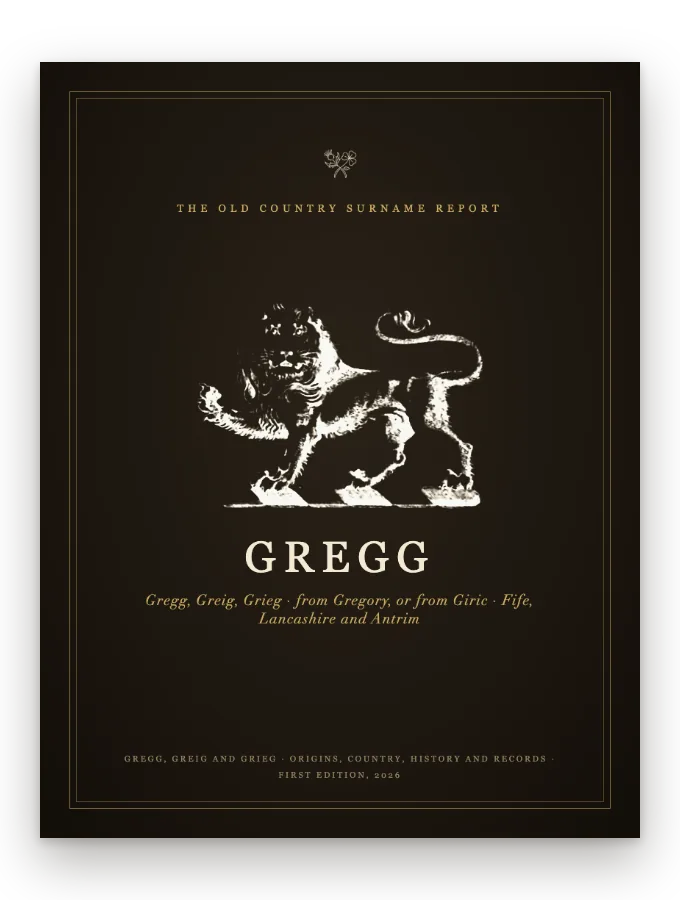
This report tells the story of the name Gregg, with its Scottish form Greig and its Norwegian form Grieg. It covers what the name means, when it was first written down, the families who carried it, and how it crossed the sea.
No email needed. It starts just below.
44 pages, 25 named sources, in your inbox within a minute.
The next page asks where to post it.
The hardback could not be added just now. Get your report here, and the hardback is offered on the next page for the same $79 in all.
Read it. If it is not the best account of your name you have seen, reply to your receipt within 14 days and we refund you.
“I have been tracing my family tree for some time, but there were certain stories that even our closest relatives never knew about. This surname report is a true deep dive. Thank you.”Susan D., reader
The Scottish Greigs belong to the east coast. Black's earliest records run from Fife to Aberdeen, with Stirling and Leith between. The National Records of Scotland counted 122 Greig entries in the registers of births, marriages and deaths in 2025, when Greig ranked 200th. Gregg, in Scotland, is a name of about a dozen entries a year.
Two Greig families in the national biographies came from that coast. Inverkeithing, a small port in Fife, was home to Charles Greig, shipowner, and his son Samuel, who became an admiral in Russia. Cairnbulg, a small coastal village by Fraserburgh in Aberdeenshire, was where John Greig farmed before his son went to Norway. In the 1680s a Bailie Greig held office in Fraserburgh itself.
In Ireland the spelling is Gregg, and its home is Antrim and Down, Belfast's two counties. In the Irish census indexes of 1901 and 1911, of the Gregg records with a county, 57.2 and 58.5 per cent were in Antrim or Down. The 1901 index holds 1,055 Gregg records in all: 352 in Antrim and 243 in Down.
The rest spread thinly. In 1901 Donegal held 63, Londonderry 51, Fermanagh 38, Dublin 37 and Cork 30. Of the entries in the two censuses, 31.6 per cent were Presbyterian, 28.2 per cent Church of Ireland and 18.9 per cent Roman Catholic. Most of the Greggs in the national biographies are Irish, many of them Church of Ireland clergy; the Scottish ones spell it Greig.
That was one chapter. The report carries the rest: where the name comes from, the clan and its chiefs, heraldry, the stories, a timeline, migration, the name today, notable bearers, and a page on tracing your own line. Every claim sourced the same way as the chapter above.
Get my report · $14.99Instant download, yours to keep and print
Read it. If it is not the best account of your name you have seen, reply to your receipt within 14 days and we refund you.
Not your name? Search yours, or read another name's free chapter.
One piece of research, three more ways to have it. Every edition includes the Gregg report itself.
The Gregg report and a five and a half minute film of the name, your spelling on the title.
Get the film · $39.99The report, the film and the hardback. Bought apart they are $118.99.
Get all three · $99For the wall. The Gregg record on one framed sheet, 16 by 12 inches, $89 posted free. See the framed plate.
A gift? Send the Gregg report on a day you choose, with a card.
This history is written from public-domain sources and the family's own published records, every one of them listed. Where tradition and record disagree the text says so rather than choosing quietly. No image on this page is AI-generated.
First edition · last revised