The Old Country
Cover of the MacNeil Surname Report
Free to read · Son of Niall: Barra and Kisimul, Gigha and Taynish, Colonsay, Galloway and Antrim, the Cape Fear, Pictou, Cape Breton and Quebec

MacNeilSurname meaning, origin and history

This report is about a surname that means son of Niall, and about the several families who carried it. George Black's Surnames of Scotland, the standard dictionary of Scottish names, heads one entry with eight spellings, MacNeil, MacNeill, MacNeal and their cousins, and gives the Gaelic MacNeill as "son of Neil". Black counts two clans of the name, of Barra and of Gigha. The record adds more: MacNeills in Galloway and Ayrshire before any document names the Barra family, the McNeills of Colonsay who fill the national biographies, and the McNeills of County Antrim in Ireland.

Get my report · $14.99

41 pages, 28 named sources, in your inbox within a minute.

Read it. If it is not the best account of your name you have seen, reply to your receipt within 14 days and we refund you.

“I have been tracing my family tree for some time, but there were certain stories that even our closest relatives never knew about. This surname report is a true deep dive. Thank you.”Susan D., reader

Not today? Read the MacNeil chapter free. We will email it to you.Rather read it later? We will email you the MacNeil chapter.

One email: the link to this page and the free Clan Finder, eighteen clans and every surname recorded as belonging to them, on two printable pages. Nothing else unless you tick the box.

The MacNeil name at a glance

Meaning
Son of Niall, the Gaelic MacNeill; Black and Woulfe both read Niall as champion.
Earliest records
In 1329 Robert the Bruce confirmed land in the Rhinns of Galloway to John, son of Gilbert McNeill; Nigel M'Nele was laird of Blairquhan in Ayrshire about 1370 to 1380.
The Barra family
First in a dated document in 1427: a charter of Barra and Boisdale that names Rodericum Makneill.
Homes of the name
Barra; Gigha and Taynish in Argyll; Colonsay; Galloway and Ayrshire; and County Antrim in Ireland.
The chief
Styled MacNeil of Barra, Chief of the MacNeils, in a Lyon Court entry of 12 October 2001.
Scotland today
222 register entries in 2025 across MacNeil, MacNeill, McNeil and McNeill; 342 in 1975.
United States today
55,709 people at the 2020 Census across the four spellings; McNeil 32,607 and McNeill 18,829.
Ireland in 1901
2,378 people in the four spellings, 1,252 of them in County Antrim.
Chapter four, free to read in full

Barra, Gigha and Colonsay

The Isle of Barra lies at the southern end of the Outer Hebrides, the chain of islands off the north-west coast of Scotland. Its parish takes in the small islands to its south, Vatersay, Mingulay and Berneray among them, and the chain ends at Barra Head. The main village is Castlebay, and in its bay, on a rock, stands Kisimul Castle, the house of the MacNeil chiefs. Barra was in the county of Inverness-shire until 1975. In 1755 Dr Webster's return counted 1,150 people in the parish. The minister of the 1790s counted 1,604, "of which only 80 are Protestants", and the census of 1841 counted 2,363.

Barra is the heart of the name because most readers' families sailed from it. It is not the whole of it.

Boisdale, at the south end of South Uist, the island to the north, is the other land named in the MacNeil charter of 1427. Lochboisdale, its harbour, is where the ships of 1851 took on Barra and South Uist people. Eoligarry, at the north end of Barra, is where the island's surgeon and farmer gave his evidence to the Napier Commission, a government inquiry that heard sworn evidence on the islands in 1883.

Far to the south, off the Kintyre peninsula in Argyll, lies Gigha, a small island the MacNeills of Taynish held from Knapdale on the mainland opposite. The island trust's history says they kept it until 1790 and then sold it to the MacNeills of Colonsay, another branch of the name. In 1615 the Privy Council called Malcolm MacNeill, "uncle to Hector M'Neill of Tawneishe", to answer for the taking of Dunyvaig Castle on Islay, and in 1618 Hector, "being personallie present", promised his help in keeping order. The family sold Gigha in 1865 by one account and 1856 by another, and the islanders who bought it in 2002 were not MacNeills. Colonsay and Oronsay, two small islands joined at low tide, are the home of the McNeills who gave Britain a judge, a diplomat and a soldier who won the Victoria Cross.
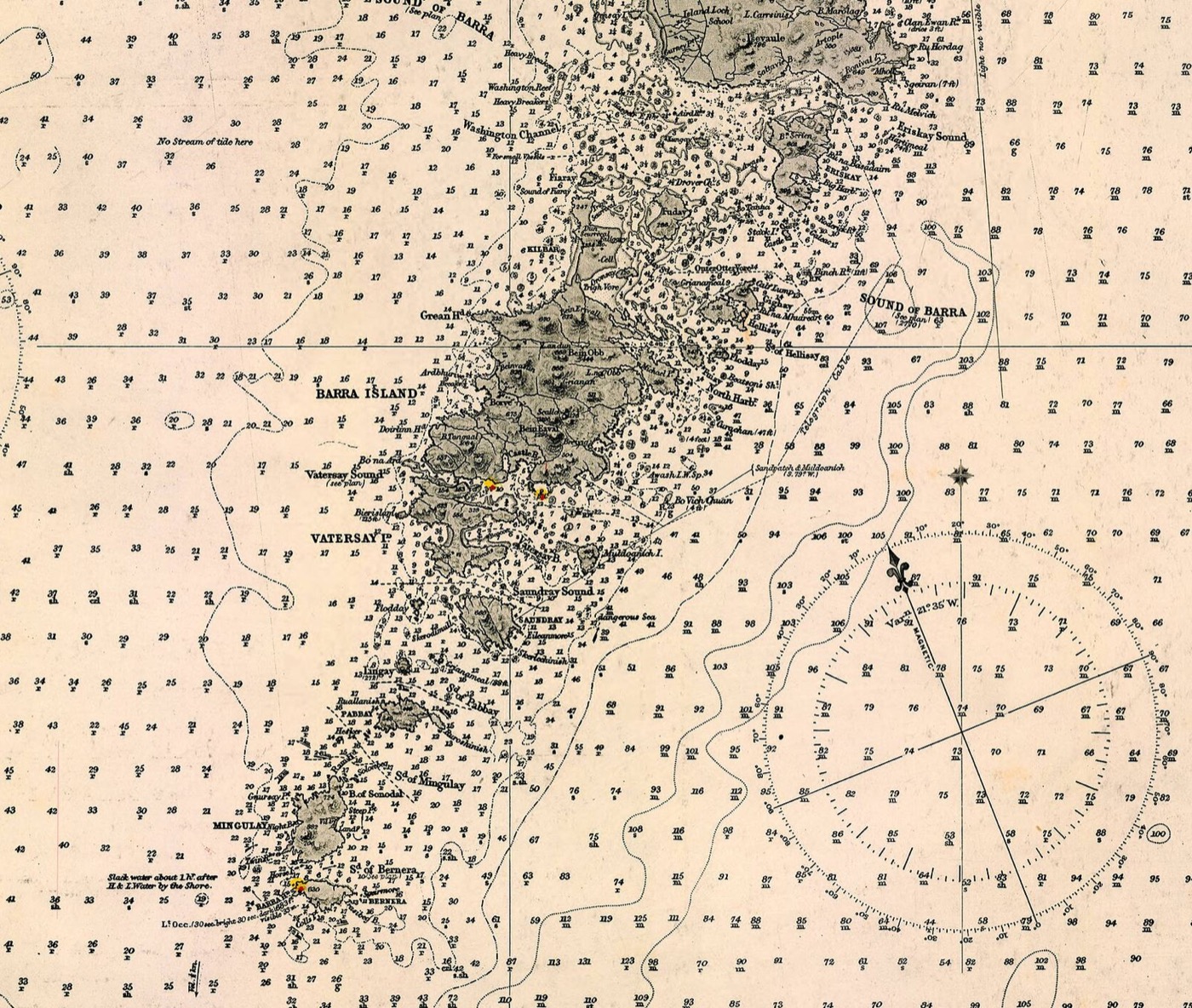
Barra, Vatersay and Mingulay on the Admiralty chart of 1865, surveyed by Captain H. C. Otter, Commander F. W. L. Thomas and A. G. Edye, with north at the top: t
Barra, Vatersay and Mingulay on the Admiralty chart of 1865, surveyed by Captain H. C. Otter, Commander F. W. L. Thomas and A. G. Edye, with north at the top: the parish of the MacNeils of Barra, fourteen years after the ships of 1851. United Kingdom Hydrographic Office; American Geographical Society Library copy, via Wikimedia Commons; public domain.
Son of Niall: Barra and Kisimul, Gigha and Taynish, Colonsay, Galloway and Antrim, the Cape Fear, Pictou, Cape Breton and Quebec · 41 pages

The full MacNeil surname report

That was one chapter. The report carries the rest: where the name comes from, the clan and its chiefs, heraldry, the stories, a timeline, migration, the name today, notable bearers, and a page on tracing your own line. Every claim sourced the same way as the chapter above.

Get my report · $14.99

Instant download, yours to keep and print

Read it. If it is not the best account of your name you have seen, reply to your receipt within 14 days and we refund you.

Not your name? Search yours, or read another name's free chapter.

The editions

Read it, watch it, or keep it on the shelf.

One piece of research, three more ways to have it. Every edition includes the MacNeil report itself.

Watch itin five days$39.99

The MacNeil report and a five and a half minute film of the name, your spelling on the title.

Get the film · $39.99
Keep itin two weeks$79

The MacNeil report as a hardback, posted free to your door.

Get the book · $79
All three Best valuesaves $19.99$99

The report, the film and the hardback. Bought apart they are $118.99.

Get all three · $99

For the wall. The MacNeil record on one framed sheet, 16 by 12 inches, $89 posted free. See the framed plate.

A gift? Send the MacNeil report on a day you choose, with a card.

The sources page, in fullWhere every claim on this page comes from.
Where the record is uncertainWhere this report cites an early record it cites the edition that prints it: the Barra charter of 1427 through Ronald Black, the Council's acts through its printed Register, the Carolina petition through the Colonial Records. Where one writer is the only authority for a statement, the report says whose it is. No commercial surname site was used as corroboration.
  • George F. Black, The Surnames of Scotland (New York, 1946), pp. 550 and 625, s.v. MacNeil, Neil and Neilson; p. 629, s.v. Nigel
  • Ronald Black, "1467 MS: The MacNeils", West Highland Notes and Queries, series 4, no. 6 (February 2018), pp. 3-25
  • W. D. H. Sellar, "Family Origins in Cowal and Knapdale", Scottish Studies 15 (1971), pp. 21-37
  • Rev. Patrick Woulfe, Irish Names and Surnames (Dublin, 1923), s.v. Mac Neill
  • Register of the Privy Council of Scotland, vols 4, 5, 8, 10 and 11 (Edinburgh, 1881-1894)
  • Donald Monro, Description of the Western Isles of Scotland, written 1549 (printed 1774); Martin Martin, A Description of the Western Islands of Scotland (London, 1703)
  • Alexander Mackenzie, History of the Mackenzies (Inverness, 1894), pp. 235 and 548-549; The History of the Highland Clearances (Inverness, 1883)
  • John Lorne Campbell (ed.), The Book of Barra (London, 1936), the letters of General Roderick MacNeil; J. M. Cameron, PhD thesis on Highland emigration, University of Glasgow, 1971
  • A. C. Buchanan, Chief Emigration Agent, Quebec, to John Fleming, 26 November 1851
  • Napier Commission, evidence at Barra, 26 May 1883, and at Lochboisdale, 28 May 1883
  • George Patterson, A History of the County of Pictou (Montreal, 1877), p. 232 and the list of grantees of the 82nd Regiment
  • Rev. James Lawson, The Passengers on the Alexander, 1772 (1990), from the papers in the Public Archives of Prince Edward Island
  • The Statistical Account of Scotland, vol. 13, Parish of Barray; The New Statistical Account of Scotland, vol. 14, Parish of Barray (signed January 1840); census reports through A Vision of Britain through Time
  • William L. Saunders (ed.), The Colonial Records of North Carolina, vol. 4 (Raleigh, 1886), pp. 490 and 532-533 and the Prefatory Notes
  • Burke's Peerage (2003), vol. 2, Macneil of Barra; Historic Environment Scotland, Kisimul Castle, history; Isle of Barra, Kisimul Castle
  • Isle of Gigha Heritage Trust, heritage and community buy-out pages
  • Burke, The General Armory (1884), the entries for Mac Neil of Barra, M'Neill of Gigha, Baron Colonsay and Sir John McNeill; Fairbairn's Book of Crests (1905)
  • Scottish Register of Tartans, references 2679 and 2686
  • Dictionary of National Biography (1893) and its 1912 supplement; Dictionary of Canadian Biography, vols 10, 13 and 16; Australian Dictionary of Biography, vol. 5
  • The Herald (Glasgow), 16 January 2015; Hector L. MacQueen, "Pedigrees, Power and Clanship: the Genealogical Work of David Sellar", Foundations (2023)
  • Edmond S. Meany, Origin of Washington Geographic Names (1923); BC Geographical Names, Port McNeill
  • Biographical Register of Saint Andrew's Society of the State of New York, vol. 4 (1925); W. McMillan, "Early Scotch Settlers in the Upper Cape Fear", Fayetteville Observer, 2 November 1893
  • Calum MacNeil, "Barra and Its History" (2006); Nova Scotia Museum, news release of 7 February 2002
  • Wikipedia, for Eoin MacNeill, F. Marian McNeill, Anna McNeill Whistler and Alexander McNeill of Southland; CBC News, 17 April 2013, for Rita MacNeil
  • National Records of Scotland, Most Common Surnames, 1975 and 2025; United States Census Bureau surname files, 2000, 2010 and 2020; National Archives of Ireland, Census of Ireland 1901 and 1911, exact surname search
  • Clan member crest badge illustration by the Wikimedia Commons contributor Celtus, used under CC BY-SA 3.0.
  • Photographs: M J Richardson (Kisimul Castle) and Stuart Wilding (Gigha), geograph.org.uk, CC BY-SA 2.0; Nessy-Pic (Castlebay), CC BY-SA 3.0. Engraving by Joseph Swain, Wellcome Collection, CC BY 4.0
  • Map coastlines: OpenStreetMap contributors (openstreetmap.org), Open Database Licence; Natural Earth, public domain.

This history is written from public-domain sources and the family's own published records, every one of them listed. Where tradition and record disagree the text says so rather than choosing quietly. No image on this page is AI-generated.

First edition · last revised

More surname histories, free to read

Every surname we have written →