 The Old Country
The Old Country
The Old Country
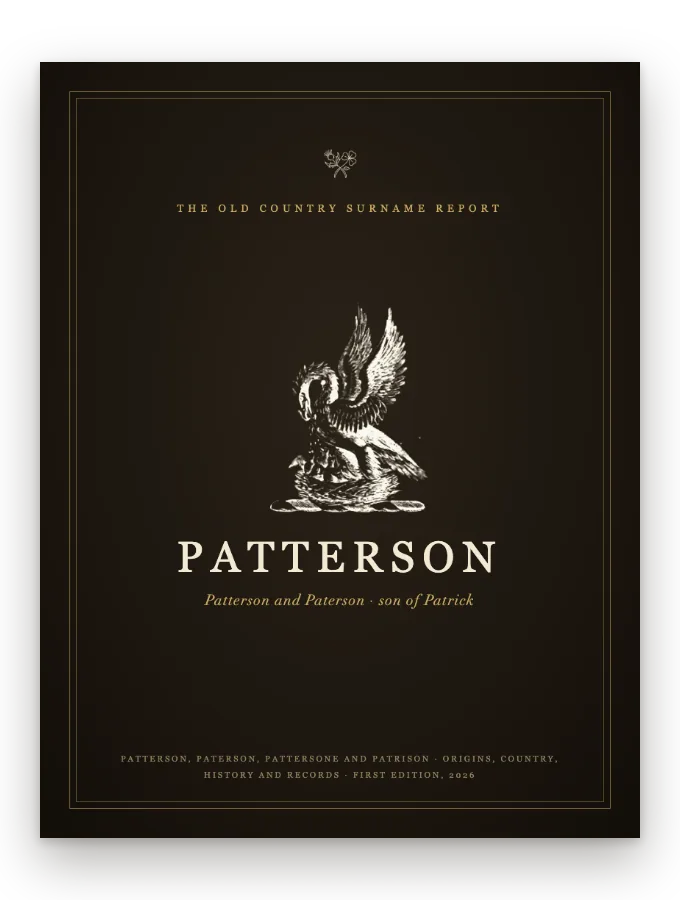
This report is about a name that reaches you in two spellings, and about what the record actually says when you ask which of them is older. Almost every account of Patterson says the same thing: Scotland spells it with one t, Ulster and America with two. That is a strong tendency and it is easy to prove. It is not, however, a rule, and the exceptions are not modern accidents. They sit in the oldest records the name has.
The country of this name begins further north than most people expect. The oldest documents belong to Aberdeen, and they belong to it twice over: to the cathedral chapter of Old Aberdeen, whose register records the perambulation of 1446, and to the burgh council of new Aberdeen a mile down the road, whose court book records a Trinity friar's procurator in 1447, a rebellious burgess in 1463 and a Dundee privateer's testimonial in 1544. These are not the same men and they are not one family. They are what a common patronymic looks like in a busy trading town: several unrelated households arriving at the same surname within a generation of each other because several unrelated men were called Patrick.
From the sixteenth century the name is thickest in the middle of Scotland. Burke's armigerous Patersons are spread across Dalkeith in Midlothian, Dunmure in Fife, Bannockburn in Stirlingshire, Castle Huntly in the Carse of Gowrie and Kinnettles in Angus, with the family of John Paterson, Bishop of Ross, holding arms at Seafield and at Aberdeen. A second Paterson baronetcy, of Eccles in Berwickshire, was created the year after Bannockburn's. That is the Lowland and east coast belt, and it is where the single t hardened into the Scottish standard. It still is. In 2024 the National Records of Scotland's birth, marriage and death registers logged 520 Paterson entries and 120 Patterson entries, and Paterson was the twenty first most common surname in the country that year.
Then there is Ulster, and Ulster is where the second t lives. The plantation carried Lowland Scots across the North Channel from the 1600s onward, and by the time a modern census could count them the result was unambiguous. In 1901 there were 5,548 Pattersons in Ireland and 268 Patersons: twenty to one, and the other way round from Scotland. County Down held 1,649 and County Antrim 1,510, and the nine counties of Ulster together held about 86 of every 100 Pattersons on the island. Nearly half of them, 2,495, were returned as Presbyterian. That is not a family. It is a migration, and it is the reason so many readers of this report spell their own name with two t's.
That was one chapter. The report carries the rest: where the name comes from, the clan and its chiefs, heraldry, the stories, a timeline, migration, the name today, notable bearers, and a page on tracing your own line. Every claim sourced the same way as the chapter above.
Get the Patterson report$14.99 · instant download, yours to keep and print
Not your name? Search yours, or read how we work, with another full chapter.
This history is written by AI from public-domain sources and the family's own published records, every one of them listed above. Where tradition and record disagree the text says so rather than choosing quietly. No image on this page is AI-generated.
First edition · last revised