The Old Country
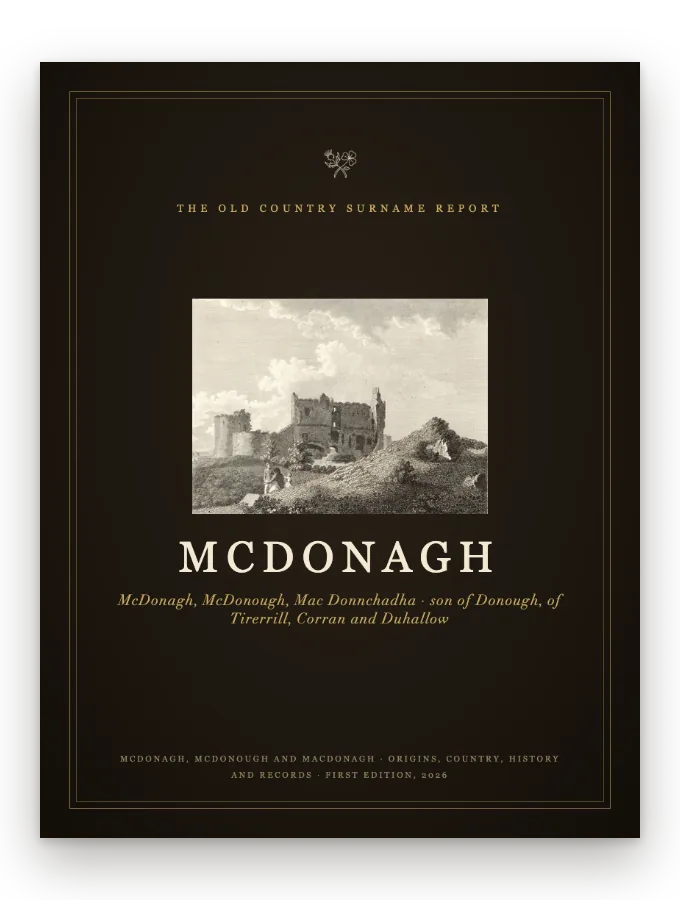
Cover of the McDonagh Surname Report
Free to read · Mac Donnchadha, son of Donnchadh: the lords of Tirerrill and Corran in Sligo, a Duhallow family in Cork, and the Galway families, as McDonagh and McDonough

McDonaghSurname meaning, origin and history

This report tells the story of the name McDonagh: what it means, where the record finds it, the people who carried it, and how it travelled. If your name is McDonough, MacDonagh, MacDonough or McDonogh, this report is yours too.

Get my report · $14.99

45 pages, 25 named sources, in your inbox within a minute.

Read it. If it is not the best account of your name you have seen, reply to your receipt within 14 days and we refund you.

“I have been tracing my family tree for some time, but there were certain stories that even our closest relatives never knew about. This surname report is a true deep dive. Thank you.”Susan D., reader

Not today? Read the McDonagh chapter free. We will email it to you.Rather read it later? We will email you the McDonagh chapter.

One email: the link to this page and the free Sept Sheet, every Irish name on the shelf, its spellings and its families, county by county, on two printable pages. Nothing else unless you tick the box.

The McDonagh name at a glance

Meaning
Son of Donnchadh, from the Gaelic Mac Donnchadha
Kind of name
A Mac name from a common first name; it began more than once
In the Annals of Loch Ce
Conchobhar Carrach Mac Donnchadha, in the year 1248
Homeland
Tirerrill and Corran in Sligo, Duhallow in Cork, and Galway
Ireland, 1901
6,838 people recorded; 46.6 per cent in Galway
Ireland, births of 1890
174 entries in the birth index, 141 of them in Connacht
United States, 2020
21,005 as McDonough (1,677th); 2,118 as McDonagh
Scotland, 2025
30 as McDonagh and 10 as McDonough, as counted by the National Records of Scotland
Chapter four, free to read in full

Tirerrill and Corran

Tirerrill and Corran are two old baronies in the south of County Sligo, in the north-west of Ireland. Tirerrill runs down to Lough Arrow. Corran lies to the west of it, round the town of Ballymote. The Four Masters call them "the two cantreds of the Mac Donoughs, namely, Corann and Tirerrill". A cantred was a district of the old kind.

The family came from the MacDermots, lords of Moylurg, next door in Roscommon. John O'Donovan, who edited the Four Masters in the 1850s, calls them three times "a branch of the Mac Dermots of Moylurg". The Sligo historian Terence O'Rorke takes their Donough to be the son of Tomaltagh Mac Dermot who died in 1232.

The two cantreds of the Mac Donoughs, namely, Corann and Tirerrill: the Four Masters, in 1593.

The annals give them their titles. The Annals of Ulster name Tomaltach Mac Donnchaidh "lord of Tir-Oilella", Tirerrill, in 1315. The Annals of Connacht and the Four Masters put the same muster in 1318. In 1349 the Four Masters record "Maurice Mac Donough, Chief of Corran". In 1595 Red Hugh O'Donnell named two lords of the family, one for each country. From 1315 to 1595 is 280 years.

The first of the family the annals name is earlier. In 1248 the Annals of Loch Ce and the Annals of Connacht record a killing by Conchobhar Carrach Mac Donnchadha. The Four Masters call him Cathal Carrach. A Mac Donough held as a hostage in 1210 is older still, but he comes before the Donough of 1232, so we do not call him the family's first.
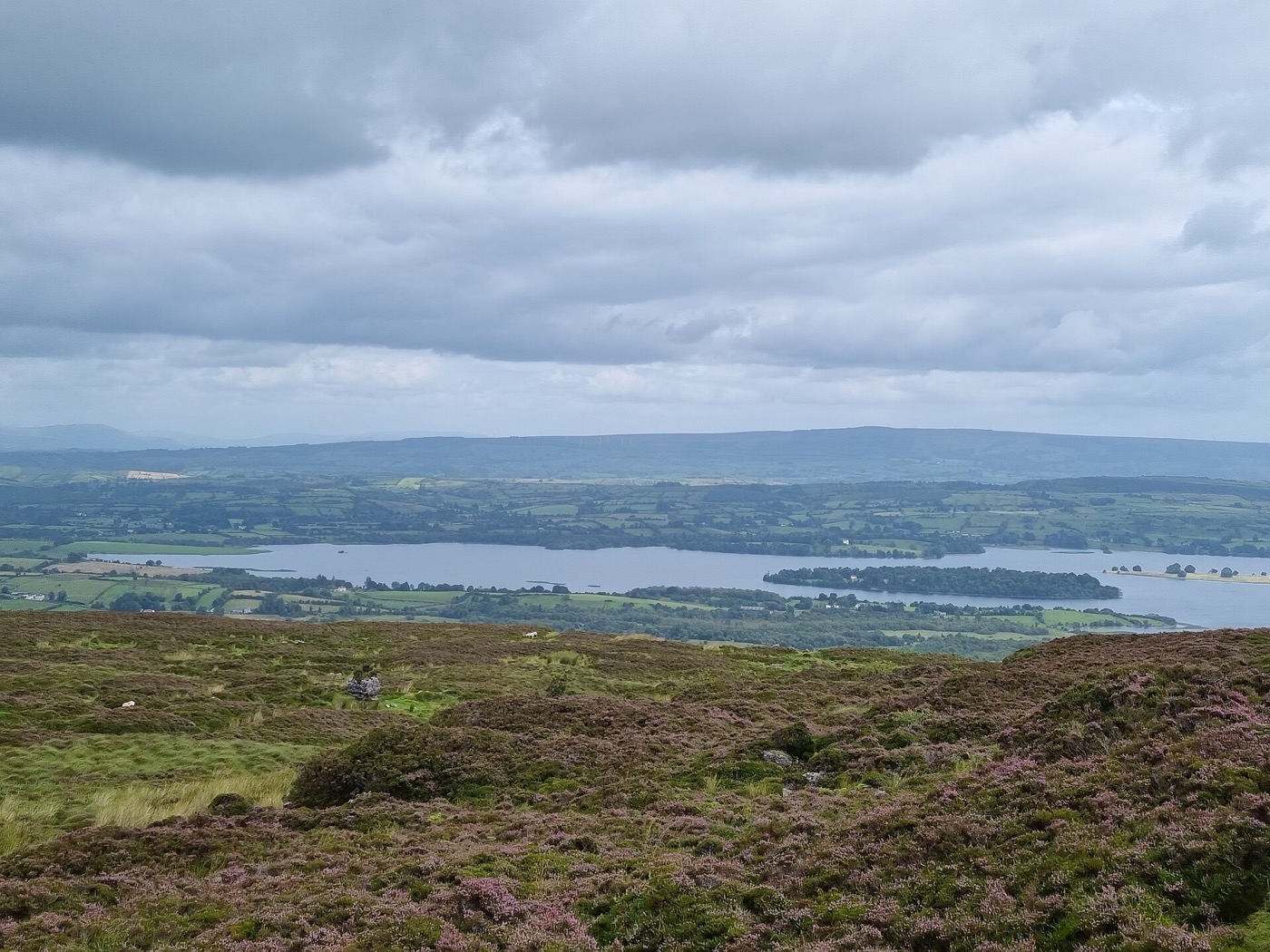
Lough Arrow from the Carrowkeel hills, County Sligo. The Mac Donnchadha lords of Tirerrill held the country round the lake. Photograph by Enter, 2025, CC BY-SA
Lough Arrow from the Carrowkeel hills, County Sligo. The Mac Donnchadha lords of Tirerrill held the country round the lake. Photograph by Enter, 2025, CC BY-SA 4.0.
Mac Donnchadha, son of Donnchadh: the lords of Tirerrill and Corran in Sligo, a Duhallow family in Cork, and the Galway families, as McDonagh and McDonough · 45 pages

The full McDonagh surname report

That was one chapter. The report carries the rest: where the name comes from, the family and its chiefs, heraldry, the stories, a timeline, migration, the name today, notable bearers, and a page on tracing your own line. Every claim sourced the same way as the chapter above.

Get my report · $14.99

Instant download, yours to keep and print

Read it. If it is not the best account of your name you have seen, reply to your receipt within 14 days and we refund you.

Not your name? Search yours, or read another name's free chapter.

The editions

Read it, watch it, or keep it on the shelf.

One piece of research, three more ways to have it. Every edition includes the McDonagh report itself.

Watch itin five days$39.99

The McDonagh report and a five and a half minute film of the name, your spelling on the title.

Get the film · $39.99
Keep itin two weeks$79

The McDonagh report as a hardback, posted free to your door.

Get the book · $79
All three Best valuesaves $19.99$99

The report, the film and the hardback. Bought apart they are $118.99.

Get all three · $99

For the wall. The McDonagh record on one framed sheet, 16 by 12 inches, $89 posted free. See the framed plate.

A gift? Send the McDonagh report on a day you choose, with a card.

The sources page, in fullWhere every claim on this page comes from.
Where the record is uncertainWhere tradition and record disagree, we say so. No commercial surname site was used.
  • Patrick Woulfe, Irish Names and Surnames (Sloinnte Gaedheal is Gall) (Dublin, 1923), under Mac Donnchadha.
  • Patrick Hanks, Dictionary of American Family Names (2nd edition, Oxford, 2022), under McDonough and McDonagh.
  • R. E. Matheson, Special Report on Surnames in Ireland (Dublin, 1894), pages 9, 29 and 58; and Varieties and Synonymes of Surnames and Christian Names in Ireland (Dublin, 1901), pages 24 and 51.
  • Annals of the Four Masters, edited and translated by John O'Donovan (Dublin, 1848-51; 1856 printing), CELT edition, for 1210 to 1598, with the editor's notes.
  • Annals of Loch Ce, edited and translated by W. M. Hennessy (London, 1871), CELT edition, for 1248 to 1584.
  • Annals of Connacht, edited by A. Martin Freeman (Dublin, 1944), CELT edition, for 1232 to 1516.
  • Annals of Ulster, edited and translated by B. Mac Carthy (Dublin, 1887-1901), CELT edition, for 1211, 1315 and 1383.
  • Eugene O'Curry, Lectures on the Manuscript Materials of Ancient Irish History (Dublin, 1861; 1878 reprint), lecture 9, on the Book of Ballymote.
  • Terence O'Rorke, The History of Sligo: Town and County (Dublin, 1889), volume 2, on Ballymote, Ballindoon and Terence MacDonagh, with Beranger's note of 1779 and Hamilton's account of 1690.
  • W. G. Wood-Martin, History of Sligo, County and Town (Dublin, 1882), volume 1.
  • CODECS (Collaborative Online Database and e-Resources for Celtic Studies): the record for Dublin, Royal Irish Academy, MS 23 P 12, the Book of Ballymote.
  • Francis Grose, The Antiquities of Ireland (London, 1791-95), volume 1, on Ballymote Castle.
  • Charles Smith, The Ancient and Present State of the County and City of Cork (1750; Cork, 1815 reprint), volume 1, on Kanturk and Duhallow.
  • Dictionary of Irish Biography (Royal Irish Academy): the entries for Terence MacDonagh, Thomas MacDonagh and Joseph MacDonagh.
  • Rodney Macdonough, Life of Commodore Thomas Macdonough, U.S. Navy (Boston, 1909).
  • J. H. Tuke, Reports and Papers relating to the Proceedings of the Committee of Mr. Tuke's Fund for assisting Emigration from Ireland, during the years 1882, 1883, and 1884 (London, 1885).
  • US National Archives, Narrations blog, 18 December 2009: on name changes in immigration records.
  • Edward MacLysaght, The Surnames of Ireland, under MacDonagh: quoted from our MacCarthy report; the book could not be re-read for this report.
  • Sir Bernard Burke, The General Armory of England, Scotland, Ireland, and Wales (London, 1884), under Mac Donogh and McDonagh.
  • Dail Eireann debates, 11 April 2001: the Minister's answer on chiefs of the name.
  • National Archives of Ireland, census of Ireland 1901 and 1911: the name counted in every spelling listed in the variants, by county.
  • US Census Bureau, surnames occurring 100 or more times, 2010 and 2020.
  • National Records of Scotland, Most Common Surnames 2025, time series 1975 to 2025.
  • Andrew Hamilton, A True Relation of the Actions of the Inniskilling-Men (London, 1690), on Fish Island and "Blind MacDonagh".
  • Cover: Ballymote Castle, plate 2, engraved by Medland after Francis Grose, published 27 January 1792 by S. Hooper; public domain.

This history is written from public-domain sources and the family's own published records, every one of them listed. Where tradition and record disagree the text says so rather than choosing quietly. No image on this page is AI-generated.

First edition · last revised

More surname histories, free to read

Every surname we have written →