 The Old Country
The Old Country
The Old Country
This report tells the story of a Galloway family whose name means, at bottom, a description of somebody else entirely: Mac Dubhghaill, son of the dark stranger, built from dubh, dark, and gall, foreigner, the word Gaelic speakers used for Danes and, more loosely, for Norsemen in general. It is the same compound that gives Clan MacDougall of Lorn its name, and the two names are close enough in sound and spelling that they are still confused today, on crest shops and family trees alike. They are not the same family. The Lorn MacDougalls descend from Dubhgall, son of Somerled of Argyll; the Galloway MacDowalls claim descent from a different Dougal, said to be a grandson of Fergus, Lord of Galloway, a contemporary of Somerled who ruled a separate princedom in the southwest. This report keeps the two apart, tells each what the record actually supports, and explains the split in full in its own chapter.
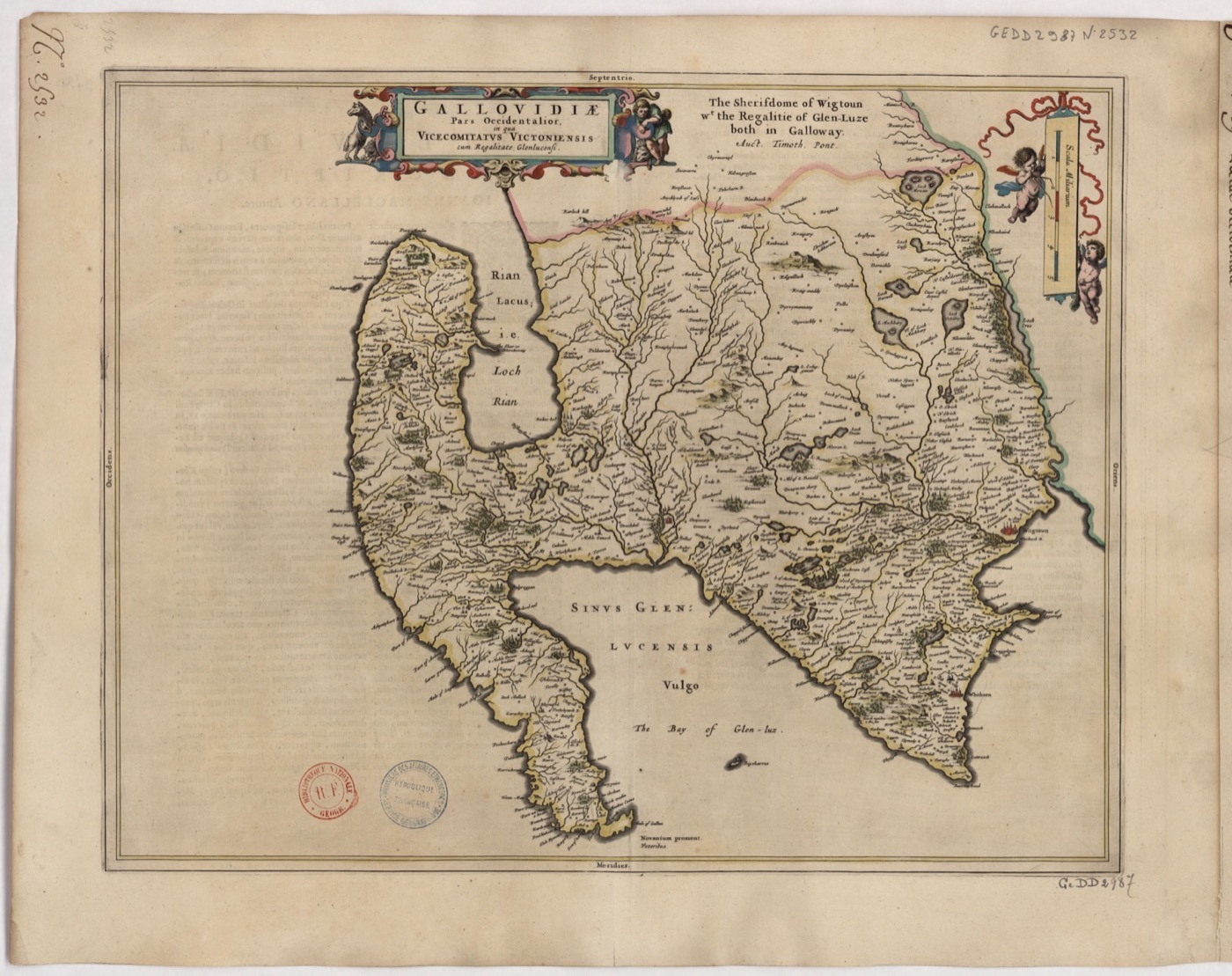
The Rhinns of Galloway is the hammerhead peninsula that forms the westernmost tip of mainland Scotland, hinged to the rest of Wigtownshire by a narrow isthmus and bounded on its eastern flank by Loch Ryan, the sea loch whose shore gave this family its single most dramatic dated moment. It is farming and fishing country, drier and milder than most of Scotland thanks to the Gulf Stream, dotted with small parishes, Stoneykirk, Kirkmaiden, Old Luce, whose names recur through this family's charter chest for five centuries. Joan Blaeu's 1654 atlas map of the Sherifdome of Wigtoun, itself based on the survey of Timothy Pont a half-century earlier, shows the whole peninsula in the same detail an eighteenth-century laird's own factor might have carried into the field, Loch Ryan named plainly at the map's centre, exactly where Dungal MacDouall's men waited for Robert Bruce's brothers in February 1307.
Garthland itself, the chiefly seat, stood near Stoneykirk from at least 1295; a datestone found on the Garthland Mains estate reads 1211, which some take as the tower's own building date, though the family's documented tenure begins only with Balliol's charter eighty-four years later. The castle was pulled down around 1840, and nothing of it survives above ground today. Logan, a few miles south in Kirkmaiden parish, fared differently: family tradition holds that its first stronghold, Castle Balzieland, burned down around 1500, though recent documentary research considers that date doubtful; either way, the walled garden built to service the family's later Logan House, raised in 1702, still incorporates the old castle's one surviving corner, and the wider estate is now open to the public as Logan Botanic Garden, a legacy neither king nor battle ever touched.
None of this is a heritage trail built around this family's own memory the way a Highland clan seat sometimes is. Garthland is farmland with no standing building; Logan survives as a garden that outlived the family that built it; Freugh's own tower is gone as completely as Garthland's. What the Rhinns still offer a visitor is the ground itself, largely unchanged, and the sea loch where this family's name first entered a king's own record.
That was one chapter. The report carries the rest: where the name comes from, the clan and its chiefs, heraldry, the stories, a timeline, migration, the name today, notable bearers, and a page on tracing your own line. Every claim sourced the same way as the chapter above.
Get the McDowell report$14.99 · instant download, yours to keep and print
Not your name? Search yours, or read how we work, with another full chapter.
This history is written by AI from public-domain sources and the family's own published records, every one of them listed above. Where tradition and record disagree the text says so rather than choosing quietly. No image on this page is AI-generated.
First edition · last revised