The Old Country
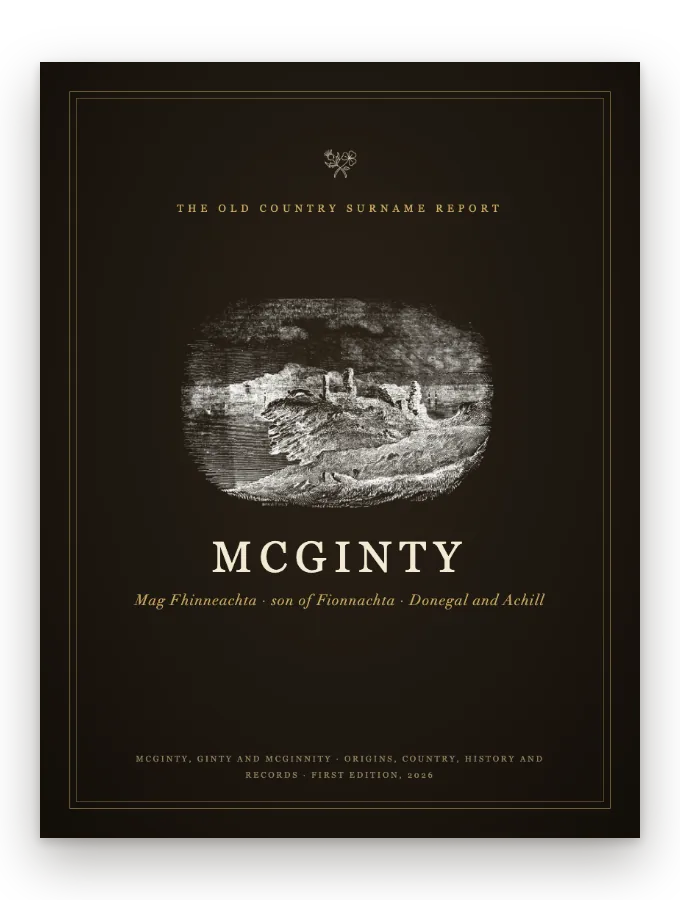
Cover of the McGinty Surname Report
Free to read · Mag Fhinneachta: the McGintys of Donegal and Achill

McGintySurname meaning, origin and history

This report tells the story of the name McGinty: what it means, where it was at home, the people who carried it, and the records that can place one family.

Get my report · $14.99

48 pages, 26 named sources, in your inbox within a minute.

Read it. If it is not the best account of your name you have seen, reply to your receipt within 14 days and we refund you.

“I have been tracing my family tree for some time, but there were certain stories that even our closest relatives never knew about. This surname report is a true deep dive. Thank you.”Susan D., reader

Not today? Read the McGinty chapter free. We will email it to you.Rather read it later? We will email you the McGinty chapter.

One email: the link to this page and the free Sept Sheet, every Irish name on the shelf, its spellings and its families, county by county, on two printable pages. Nothing else unless you tick the box.

The McGinty name at a glance

Meaning
Son of Fionnachta, an old first name Woulfe glosses as "fair-snow"
Irish form
Mag Fhinneachta, written with Mag, not Mac
Oldest Donegal entry found
Bryan m'Genty, in the hearth money roll of 1665, Donaghmore parish
Woulfe's Armagh
"Almost peculiar to Armagh" in the 1500s; no Tudor record shows it
Ireland, 1901
443 of 759 McGintys in Donegal, 217 in Mayo, none in Armagh
Second country
Achill and the Corraun, County Mayo: 170 McGintys in 1901
Ginty
The same name without the Mac: 455 in 1901, mostly Mayo and Sligo
Not the same name
McEntee, McGinley and McGinn are different names
Arms
None printed for any spelling, by Burke or Fairbairn
United States, 2020
5,896 people named McGinty at the census
Scotland
18 to 40 register entries a year, 1975 to 2025
Chapter four, free to read in full

Donegal town to Stranorlar

The McGinty heartland is a stretch of hill country in south Donegal, between Donegal town and the twin towns of Ballybofey and Stranorlar. The census of 1901 shows it clearly. It filed each household's return under a district electoral division, or DED, a small area used for elections and counts. A DED is not a village. It is a block of countryside, often with several townlands inside it.

In 1901 the census wrote 434 people in Donegal as McGinty, in that exact spelling. The DED of Altnapaste held 92 of them, the DED of Clogher 69, and the DED of Tawnawully 64. Then came the DEDs of Donegal and Cloghan, with 21 each, Stranorlar with 19 and Convoy with 17. Those seven held 303 of the 434.

"Principally found" in Donegal.

Robert Matheson, the Registrar-General, saw the same county from the birth registers. His Special Report on Surnames in Ireland counted the births of 1890. There were 12 McGinty births in all Ireland that year, 9 of them in Ulster, and 10 of the 12 spelt McGinty. He wrote that the name was "principally found" in Donegal.

The census of 1911 tells the same story. It counted 782 McGintys in Ireland, 414 in Donegal and 255 in Mayo. And it still found not one in Armagh.
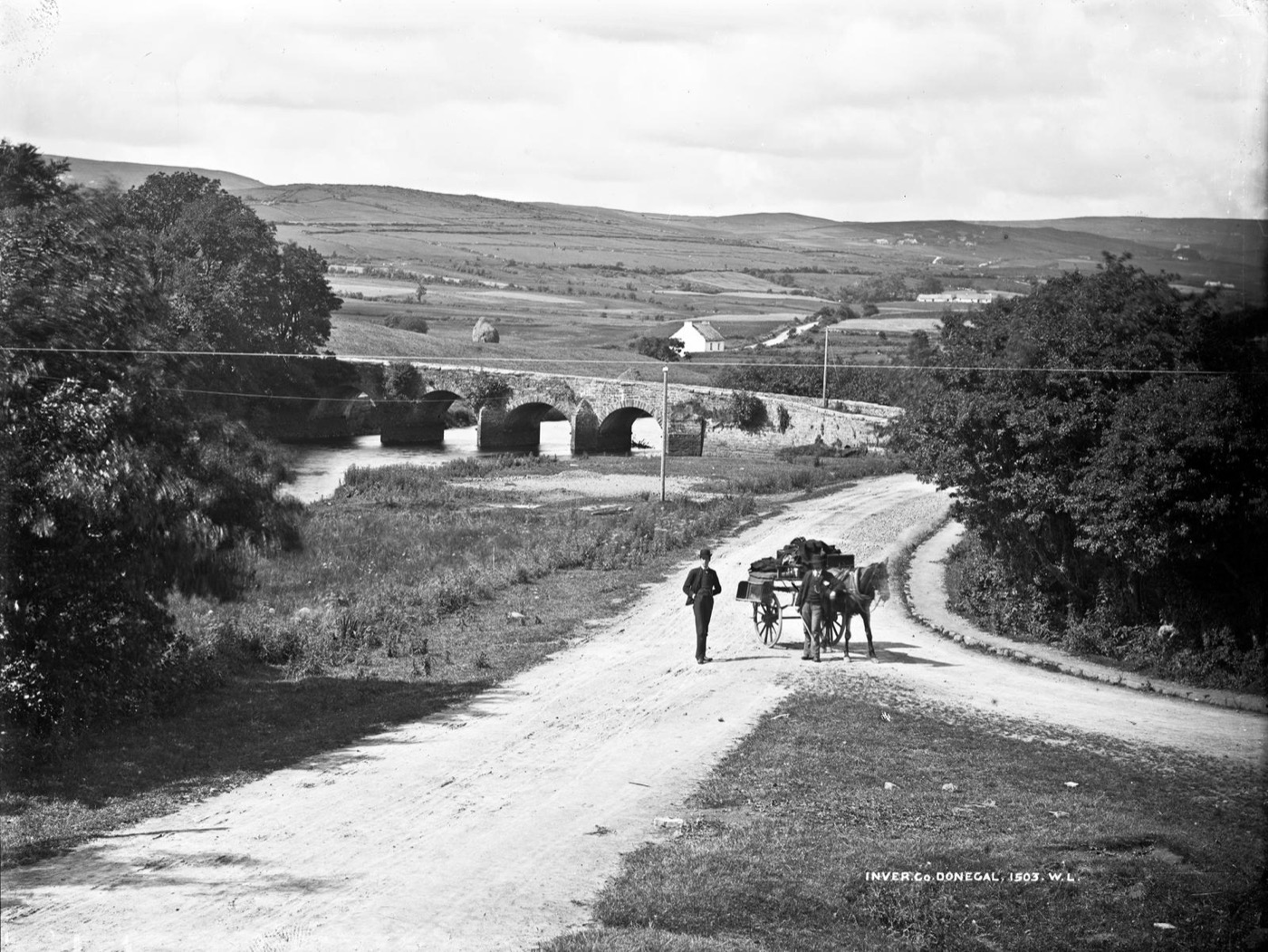
Inver, on Donegal Bay in the south of County Donegal, with a jaunting car on the road by the old stone bridge, in the 1880s or 1890s. In 1901 Donegal held 443 o
Inver, on Donegal Bay in the south of County Donegal, with a jaunting car on the road by the old stone bridge, in the 1880s or 1890s. In 1901 Donegal held 443 of Ireland's 759 McGintys in the short spellings. Photograph by Robert French for the Lawrence firm; National Library of Ireland, no known copyright restrictions.
Mag Fhinneachta: the McGintys of Donegal and Achill · 48 pages

The full McGinty surname report

That was one chapter. The report carries the rest: where the name comes from, the family and its chiefs, heraldry, the stories, a timeline, migration, the name today, notable bearers, and a page on tracing your own line. Every claim sourced the same way as the chapter above.

Get my report · $14.99

Instant download, yours to keep and print

Read it. If it is not the best account of your name you have seen, reply to your receipt within 14 days and we refund you.

Not your name? Search yours, or read another name's free chapter.

The editions

Read it, watch it, or keep it on the shelf.

One piece of research, three more ways to have it. Every edition includes the McGinty report itself.

Watch itin five days$39.99

The McGinty report and a five and a half minute film of the name, your spelling on the title.

Get the film · $39.99
Keep itin two weeks$79

The McGinty report as a hardback, posted free to your door.

Get the book · $79
All three Best valuesaves $19.99$99

The report, the film and the hardback. Bought apart they are $118.99.

Get all three · $99

For the wall. The McGinty record on one framed sheet, 16 by 12 inches, $89 posted free. See the framed plate.

A gift? Send the McGinty report on a day you choose, with a card.

The sources page, in fullWhere every claim on this page comes from.
Where the record is uncertainWhere tradition and record disagree, the text says so. Where one writer is the only authority for a statement, the report says whose it is. No commercial surname site was used.
  • Patrick Woulfe, Irish Names and Surnames (Sloinnte Gaedheal is Gall), Dublin, 1923, the entries Mag Fhinneachta and Mac an tSaoi, with the explanatory note; and the Irish-English index (Dublin: Gill, 1922).
  • Edward MacLysaght, The Surnames of Ireland, the entries (Mac)Ginty and (O)Finaghty.
  • Dictionary of American Family Names, edited by Patrick Hanks (Oxford, 2003), the entries McGinty, McGinnity, McGinity and Ginty.
  • Robert E. Matheson, Special Report on Surnames in Ireland (Dublin, 1909 edition), the births of 1890; and Varieties and Synonymes of Surnames and Christian Names in Ireland (Dublin, 1901), lists 1316 and 1343.
  • The fiants of the Tudor sovereigns, calendared in the Sixth to Twenty-second Reports of the Deputy Keeper of the Public Records in Ireland, with the index of persons.
  • Pender, ed., A Census of Ireland, circa 1659 (Irish Manuscripts Commission, 1939).
  • The hearth money roll of County Donegal, 1665: index and typed copy, Donegal County Archives; and the Londonderry roll of 1663 and the Donegal roll, as transcribed in Bill Macafee's databases of seventeenth-century census substitutes (billmacafee.com).
  • Annals of the Four Masters, in John O'Donovan's edition, Annals of the Kingdom of Ireland; the CELT edition, University College Cork.
  • Census of Ireland, 1901 and 1911, National Archives of Ireland: counts by spelling, county and district electoral division.
  • Donegal deaths: McGinty, John, 2 June 1869, a transcription of the civil certificate by C. Hunt, Ireland Genealogy Projects Archives (igp-web.com).
  • townlands.ie, the townland of Birchhill, County Donegal: barony, civil parish and electoral division.
  • Theodore Roosevelt, The Rough Riders (New York: Scribner, 1899).
  • Leslie A. McRill, "The Story of an Oklahoma Cowboy, William McGinty, and His Wife", The Chronicles of Oklahoma 34:4 (1956); and "Music in Oklahoma by the Billy McGinty Cowboy Band", The Chronicles of Oklahoma 38:1 (1960).
  • Congressional Medal of Honor Society, John J. McGinty III, with the citation; and the US Marine Corps History Division, Who's Who in Marine Corps History.
  • Victoria and Albert Museum, sheet music, "Paddy McGinty's Goat" (S.1292-2014); and the University of Wisconsin, Popular Sheet Music Collection.
  • RTE Archives, profile of Thom McGinty; and RTE Brainstorm, Thom McGinty history profile (2026).
  • Lawrence William White, "The Diceman", History Ireland.
  • The Irish Times, "Remembering the Diceman who brightened a grey, dull Dublin" (2015).
  • John Rooney, A Genealogical History of Irish Families (1895), "The McGinty Family": tradition only.
  • Robert Bell, The Book of Ulster Surnames.
  • George Fraser Black, The Surnames of Scotland.
  • Sir Bernard Burke, The General Armory of England, Scotland, Ireland, and Wales (London, 1884).
  • Fairbairn's Book of Crests of the Families of Great Britain and Ireland, fourth edition (1905).
  • US Census Bureau, surnames from the 2010 and 2020 censuses.
  • National Records of Scotland, Most Common Surnames, 2025, time series 1975 to 2025.
  • Cover: "Kilbarron Castle, County of Donegal", wood engraving by Branston, The Irish Penny Journal, 16 January 1841, public domain. Kilbarron Castle on the Donegal coast: a place in the county, not a McGinty building or emblem.

This history is written from public-domain sources and the family's own published records, every one of them listed. Where tradition and record disagree the text says so rather than choosing quietly. No image on this page is AI-generated.

First edition · last revised

More surname histories, free to read

Every surname we have written →