The Old Country
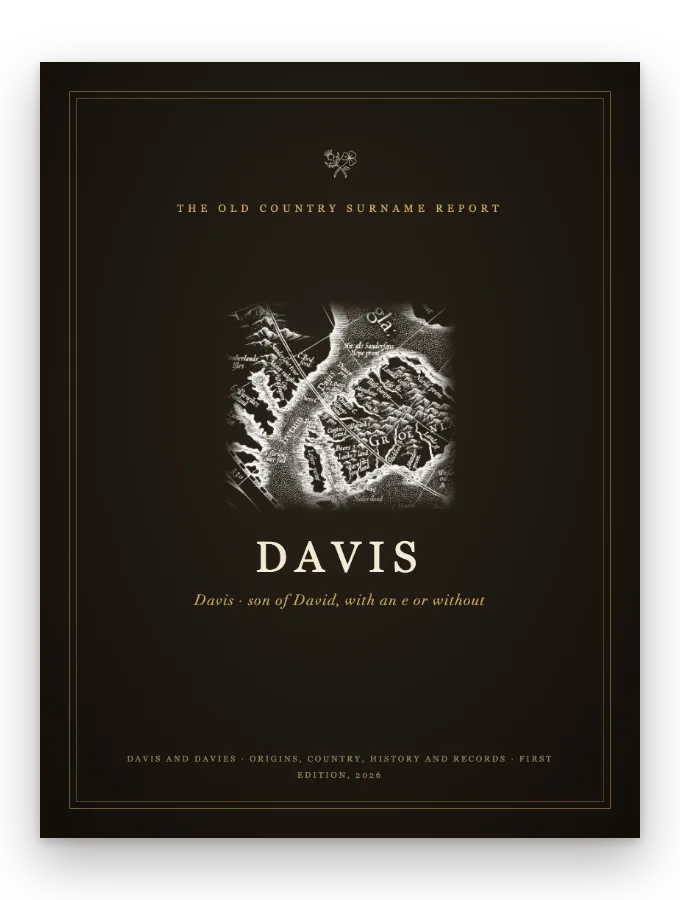
Cover of the Davis Surname Report
Free to read · One name in two spellings: son of David, Davies in Wales and Davis in England and over the border, and the Davises and Davieses who carried it to Pennsylvania, Hawaii, Ohio and Patagonia

DavisSurname meaning, origin and history

Davis is one of the big names of the English-speaking world. The 2020 US Census counted 1,074,448 people with it, the ninth commonest surname in the country. Davies, the same name in its Welsh spelling, counted 33,945.

Get my report · $14.99

42 pages, 23 named sources, in your inbox within a minute.

Read it. If it is not the best account of your name you have seen, reply to your receipt within 14 days and we refund you.

“I have been tracing my family tree for some time, but there were certain stories that even our closest relatives never knew about. This surname report is a true deep dive. Thank you.”Susan D., reader

Not today? Read the Davis chapter free. We will email it to you.Rather read it later? We will email you the Davis chapter.

One email: the link to this page and the free Trades Sheet, the trades hidden in English and Scottish surnames, and the names that grew out of them, on two printable pages. Nothing else unless you tick the box.

The Davis name at a glance

Meaning
Son of David, through Davy, the everyday pet form of David
Language of origin
Middle English and Welsh: a father's name made into a surname
Recorded heartland
Wales for Davies; the English border counties for Davis
Earliest written record
1273 Richard Davi, Suffolk; 1327 John Dauisse, Cambridgeshire
Spellings
Davies in Wales; Davis in England, Ireland and America
Cover
Mercator's Arctic map, 1606, lettered Fretum Dauis; not a coat of arms
Coat of arms
None for the name: Burke prints 57 Davies and Davis entries
Recorded counts
US 2020: Davis 1,074,448 (9th). England and Wales 1853: Davies 5th
Chapter four, free to read in full

The Welsh border: two spellings, one line

Where does Davies end and Davis begin? Henry Guppy tried to find out. In his book Homes of Family Names in Great Britain (1890), he did not count the whole country. He set aside "the names of 26 millions of people". He counted farmers instead, "the most stay-at-home class of the country", from the lists in Kelly's Post Office Directories. A name was noted only if it reached about seven in every 10,000 farmers of a county.

His figures draw a line. In Monmouthshire, the border county in the south-east, there were 430 Davieses and only 12 Davises for every 10,000 farmers. Herefordshire had 250 and 50, and Shropshire 238 and 32. One line of counties further east, the order flips. Worcestershire had 25 Davieses and 85 Davises, Gloucestershire 20 and 80, Somerset 11 and 53. Wales had 500 Davieses in the north and 600 in the south, and no Davis figure at all.

Davies in Wales and the first counties over the border; Davis one line of counties further east.

Guppy drew the plain conclusion: "Davies is essentially the Welsh form, and Davis the English form." He found Monmouthshire's names "almost more Welsh than Wales itself". He believed "the main track of the immigrants from the Principality" ran through that county into England.

Remember what he counted. These are farmers, not people, and only names above his cut-off. Over England and Wales as a whole, working from the Registrar-General's report for 1856, he found 62 Davieses and 23 Davises in every 10,000 people.
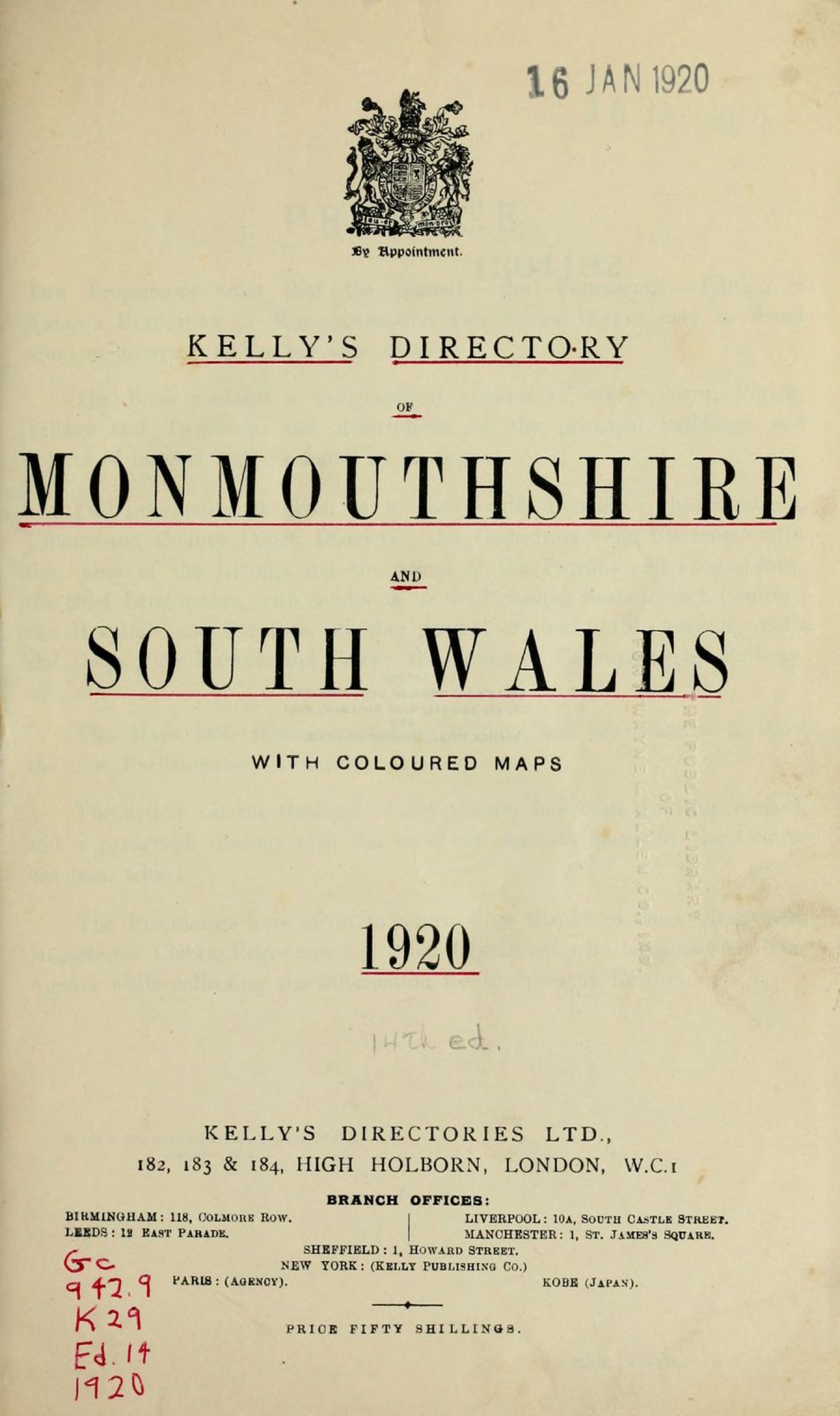
The title page of Kelly's Directory of Monmouthshire and South Wales, 1920. Henry Guppy took his counts of 1890 from the farmers' lists in Kelly's Post Office D
The title page of Kelly's Directory of Monmouthshire and South Wales, 1920. Henry Guppy took his counts of 1890 from the farmers' lists in Kelly's Post Office Directories, county by county. Via Wikimedia Commons; public domain.
One name in two spellings: son of David, Davies in Wales and Davis in England and over the border, and the Davises and Davieses who carried it to Pennsylvania, Hawaii, Ohio and Patagonia · 42 pages

The full Davis surname report

That was one chapter. The report carries the rest: where the name comes from, the family and its places, heraldry, the stories, a timeline, migration, the name today, notable bearers, and a page on tracing your own line. Every claim sourced the same way as the chapter above.

Get my report · $14.99

Instant download, yours to keep and print

Read it. If it is not the best account of your name you have seen, reply to your receipt within 14 days and we refund you.

Not your name? Search yours, or read another name's free chapter.

The editions

Read it, watch it, or keep it on the shelf.

One piece of research, three more ways to have it. Every edition includes the Davis report itself.

Watch itin five days$39.99

The Davis report and a five and a half minute film of the name, your spelling on the title.

Get the film · $39.99
Keep itin two weeks$79

The Davis report as a hardback, posted free to your door.

Get the book · $79
All three Best valuesaves $19.99$99

The report, the film and the hardback. Bought apart they are $118.99.

Get all three · $99

For the wall. The Davis record on one framed sheet, 16 by 12 inches, $89 posted free. See the framed plate.

A gift? Send the Davis report on a day you choose, with a card.

The sources page, in fullWhere every claim on this page comes from.
Where the record is uncertainWhere this report cites an early record it cites the book that prints it: the 1273 and 1327 names through Bardsley and Reaney and Wilson, the Welsh Tract papers through Glenn, the 1853 table through Matheson. Where one writer is the only authority for a statement, the report says whose it is.
  • George Fraser Black, The Surnames of Scotland (New York, 1946), p. 202, for David, Davidson, Davie, Davies, Davy and Dawson.
  • P. H. Reaney and R. M. Wilson, A Dictionary of English Surnames (3rd edition, Oxford, 1995), pp. 127 and 128, for Davies, Davis, Daviss, Davys, Davey, David, Davidson, Daw, Dawkins, Dawson and Davidge.
  • C. W. Bardsley, A Dictionary of English and Welsh Surnames (1901), p. 232, and the Introduction, p. 3.
  • Henry Harrison, Surnames of the United Kingdom (1912 to 1918), the Introduction, for the Registrar-General's report of 1853, the Elizabethan play and the Llantilio Crossenny registers.
  • John and Sheila Rowlands, The Surnames of Wales (Birmingham, 1996), pp. 3, 10, 28 and 29, 31 and 32, 49, 89, 172 and 175; and their article "The Distribution of Surnames in Wales", Nomina 29 (2006), p. 98.
  • Henry Brougham Guppy, Homes of Family Names in Great Britain (London, 1890), pp. 6, 12 and 13, 30, 476 and 477.
  • Patrick Woulfe, Sloinnte Gaedheal is Gall (Dublin, 1923), the entries Dáibhis, Mac Dáibhidh, Mac Dáibhidh Mór, Ó Daimhín and Mac Daibhéid.
  • Edward MacLysaght, The Surnames of Ireland (6th edition, Dublin, 1985), pp. 73, 75 and 76.
  • Robert E. Matheson, Special Report on Surnames in Ireland (Dublin, 1909): the birth indexes of 1890, and his table of the fifty commonest surnames in England in 1853, from the Registrar-General's sixteenth annual report.
  • Dictionary of American Family Names (2nd edition, Oxford, 2022), the entries Davis and Davies.
  • Dictionary of Welsh Biography: Ivor Bulmer-Thomas on David Davies of Llandinam (1959); Noah Hanohano Dolim on Isaac Davis; and the entries for John Davies of Mallwyd, Morris Davies and Thomas Davies, "Tegwyn".
  • Dictionary of Canadian Biography, vol. 1: Margaret Montgomery Larnder, "Davis (Davys), John (d. 1605)" (1966, revised 1979).
  • Dictionary of National Biography, vol. 14 (1888): G. F. R. Barker on Thomas Osborne Davis; and the entries Davys, John, and Davies, Sir John (1569 to 1626).
  • The Autobiography of Elizabeth Davis, a Balaclava Nurse, Daughter of Dafydd Cadwaladyr, ed. Jane Williams (London, 1857), vol. 1, pp. 38 to 40, 73 and 74.
  • Thomas Allen Glenn, Merion in the Welsh Tract (1896), pp. 27, 33, 35 and 69.
  • The Royal Family, "Union Jack", royal.uk (Crown copyright).
  • BBC News, Rhys Ffrancon, "Jones, Davies and Williams: What are the origins of Welsh surnames?" (26 December 2023), quoting Dr Benjamin Guy, and the 2021 census for Wales.
  • Sir Bernard Burke, The General Armory of England, Scotland, Ireland, and Wales (1884), pp. 266 and 267, and the Supplement.
  • US Census Bureau, the surname files of the 2010 and 2020 censuses; National Records of Scotland, Most Common Surnames, 2025 (the time series 1975 to 2025); Nova Scotia Archives, Nova Scotia Births, Marriages, and Deaths.
  • Biographical Directory of the United States Congress, 1774 to 2005 (Washington, 2005), for Jefferson Davis, Henry Winter Davis, David Davis, Edward Davies, Cushman Kellogg Davis and John Wesley Davis.
  • Te Ara, the Dictionary of New Zealand Biography: the entries for Charles Oliver Bond Davis and Rowland Robert Teape Davis.
  • Jeremy Howat's compiled list of the Mimosa's passengers (argbrit.org); the University of Rio Grande Madog Center and Ceredigion Archives on the Welsh party of 1818 to Gallipolis, with the History of Gallia County (1882); Convict Records of Australia, for John Davis, alias Davies, in the Albion.
  • The cover: Gerard Mercator's map of the northern lands, Septentrionalium Terrarum descriptio, as reissued by Hondius in his Atlas of 1606 (Geographicus scan), public domain, via Wikimedia Commons; the strait lettered Fretum Dauis, Davis Strait, drawn as white line. It is a map, not a coat of arms.

This history is written from public-domain sources and the family's own published records, every one of them listed. Where tradition and record disagree the text says so rather than choosing quietly. No image on this page is AI-generated.

First edition · last revised

More surname histories, free to read

Every surname we have written →