The Old Country
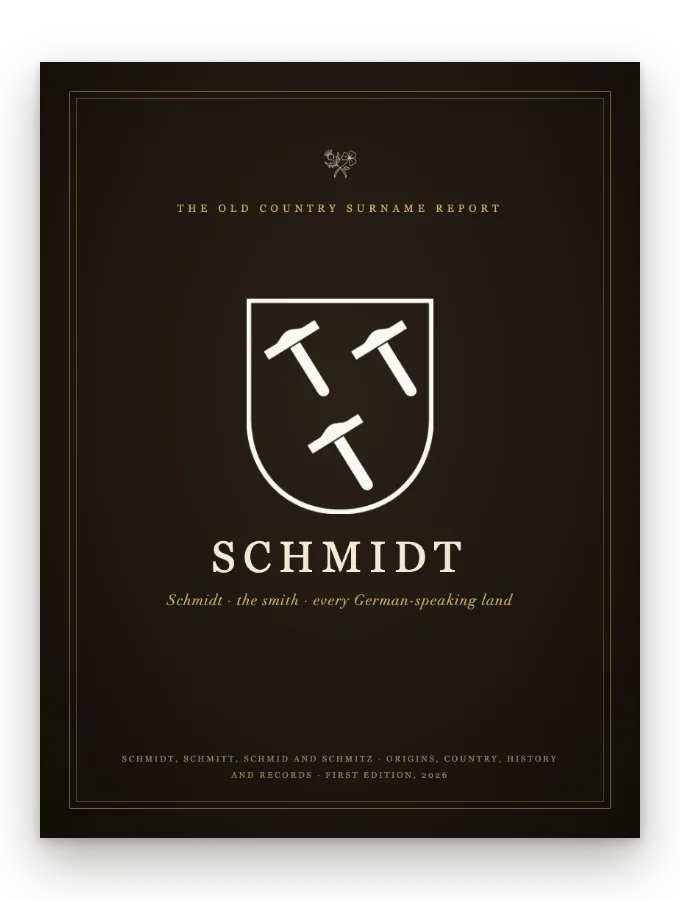
Cover of the Schmidt Surname Report
Free to read · the smith's name, from every German-speaking land

SchmidtSurname meaning, origin and history

Schmidt is the smith. Before it was anyone's surname it was the plainest word in the workshop: Middle High German smit, Old High German smid, the man who worked metal at a forge. The Grimms' great dictionary of the German language adds the detail that matters for a name. The old word at first covered a worker in any metal, gold and silver included, and only later narrowed to the blacksmith, whose best-known work was making and fitting horseshoes. Duden's dictionary of German family names explains in a single sentence why the surname is so common: when surnames were forming there was at least one smithy in almost every place.

Get my report · $14.99

47 pages, 22 named sources, in your inbox within a minute.

Read it. If it is not the best account of your name you have seen, reply to your receipt within 14 days and we refund you.

“I have been tracing my family tree for some time, but there were certain stories that even our closest relatives never knew about. This surname report is a true deep dive. Thank you.”Susan D., reader

Not today? Read the Schmidt chapter free. We will email it to you.Rather read it later? We will email you the Schmidt chapter.

One email: the link to this page and the free Name Atlas, ten German names and the region each spelling belongs to, on two printable pages. Nothing else unless you tick the box.

The Schmidt name at a glance

Meaning
The smith. Middle High German smit, Old High German smid, a worker in metal; the older word covered gold and silver work as well as the forge
Name type
Occupational, with the dialect in the spelling: Schmid and Schmitt Upper German, Schmitz Rhenish, the smith's, Smit and Smid Dutch and North German
Heimat
Every German-speaking land: a trade name has no single home. Schmidt is listed in every German state; the spelling, not the name, points to a region
Earliest documented bearer
None can be named for a trade worked everywhere. The earliest in Socin's collection of Upper Rhine names is Marcuardus faber at Basel, 1212 or 1213; Johannes dictus Schmit of Waldshut follows in 1288
Heraldry
None for the name. The cover carries the arms of Schmidtheim, a village in the Eifel, three silver hammers on red: the village's arms, not this name's
Recorded surname ranks
United States: 147,034 bearers and rank 185 in 2010, 142,290 and rank 193 in 2020. Germany: rank 2, behind Mueller, from Geogen
The clerk's Smith, 1727
On the ship Molly at Philadelphia, 30 September 1727, the captain's list has Hanse Michell Smith; the list the men signed has Michel Schmidt, very probably the same man
Pennsylvania, 1790
The published 1790 census volume for Pennsylvania prints no Schmidt, Schmid or Schmitt anywhere in its text, against 792 lines of its body that begin with Smith
Chapter four, free to read in full

Every German-speaking land

A trade name has a Heimat the way a language has one: a country rather than a village. Schmidt's country is every German-speaking land and some beyond it, since the Dictionary of American Family Names, which gives Schmidt as German and Jewish (Ashkenazic), finds the surname established in Denmark, in Alsace and Lorraine, in the Netherlands, Hungary and Poland as well. Within Germany the highest district rate Geogen finds for the standard spelling is in Altenkirchen in the Westerwald, 1,350 listings at about 1,045 per 100,000 residents, followed by Hildburghausen in Thuringia and the Rhein-Lahn and Lahn-Dill districts. The largest raw counts are simply the big cities: Berlin, Hamburg, the Hanover region, Munich and Cologne.

Schmidt is listed in every German state at rates within about two to one; it is the spellings, not the name, that carry the map.

Beyond Germany the southern form leads. The Swiss Federal Statistical Office names Mueller the commonest surname in Switzerland, followed by Meier and Schmid, and Rietstap's armorial lists separate Schmid families at Basel, Bern, Chur, Lucerne and Solothurn. In the Netherlands the Meertens Institute's count of 2007 puts Smit ninth among all Dutch surnames, with 43,498 bearers, one of twenty-five occupational names in the national top hundred. Two German towns carry the trade in their own names, Schmiedefeld am Rennsteig in Thuringia and Schmitten in the Taunus, and they show the same thing from the other side: the forge named the place.

What the map cannot do is place a family. A spelling points to a region, but spellings drifted, clerks set them down by ear, and a household that moved took its spelling with it. A family story that names a village is worth more than any distribution table, and a story that names only a region is worth what the table is worth, which is a direction rather than an address. The chapters that follow work from documents outward, because for a name this common the document is the only thing that separates one Schmidt household from the next in the same district.
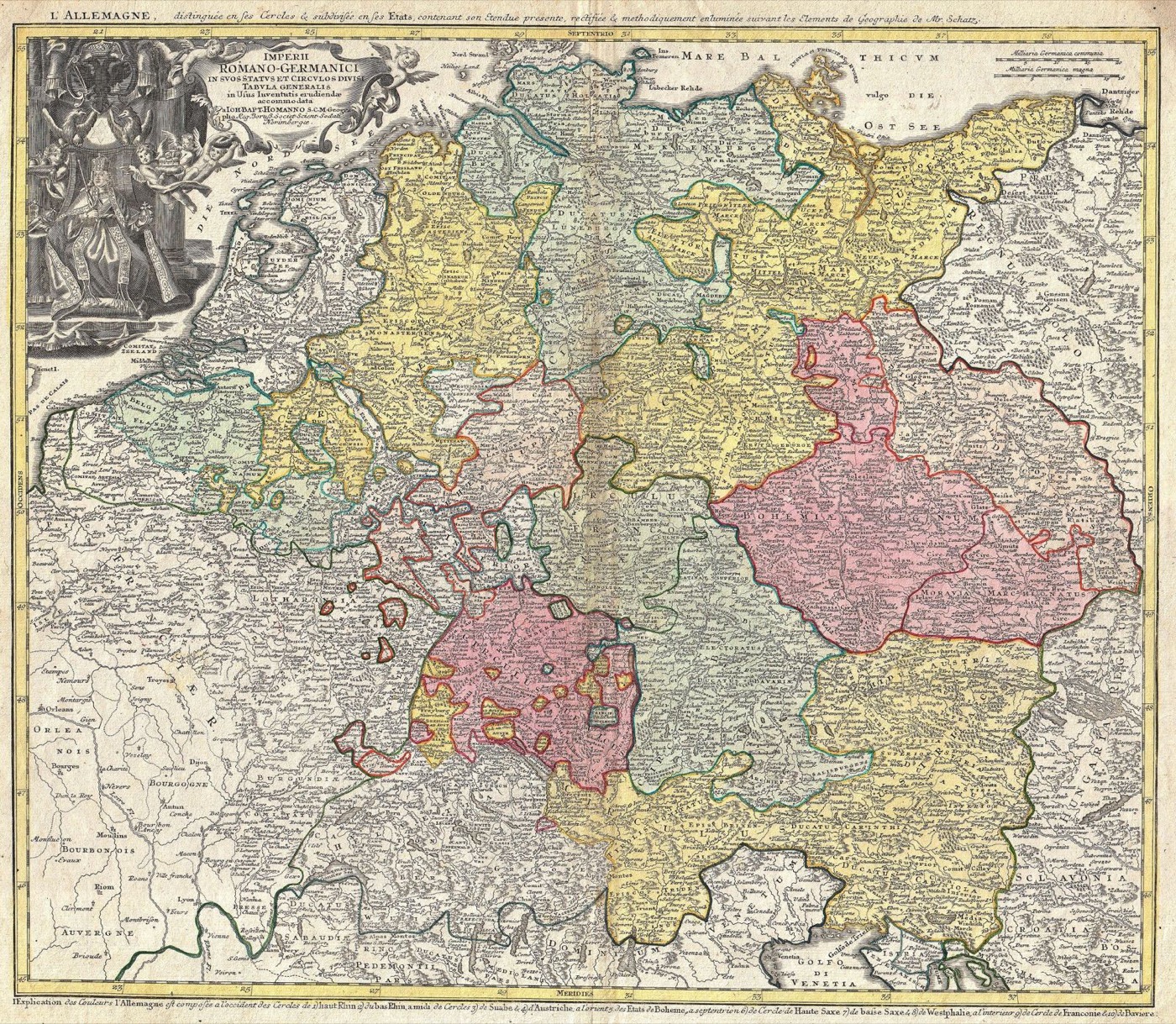
The German lands in about 1740, from the Low Countries to Hungary: the ground on which Schmidt, Schmid, Schmitt, Schmitz and the Dutch Smit divide by region - H
The German lands in about 1740, from the Low Countries to Hungary: the ground on which Schmidt, Schmid, Schmitt, Schmitz and the Dutch Smit divide by region - Homann workshop, Imperii Romano-Germanici Tabula Generalis, engraved map, Nuremberg, c. 1740. Public domain.
the smith's name, from every German-speaking land · 47 pages

The full Schmidt surname report

That was one chapter. The report carries the rest: where the name comes from, the region and its records, arms, seals and marks, the stories, a timeline, migration, the name today, notable bearers, and a page on tracing your own line. Every claim sourced the same way as the chapter above.

Get my report · $14.99

Instant download, yours to keep and print

Read it. If it is not the best account of your name you have seen, reply to your receipt within 14 days and we refund you.

Not your name? Search yours, or read another name's free chapter.

The editions

Read it, watch it, or keep it on the shelf.

One piece of research, three more ways to have it. Every edition includes the Schmidt report itself.

Watch itin five days$39.99

The Schmidt report and a five and a half minute film of the name, your spelling on the title.

Get the film · $39.99
Keep itin two weeks$79

The Schmidt report as a hardback, posted free to your door.

Get the book · $79
All three Best valuesaves $19.99$99

The report, the film and the hardback. Bought apart they are $118.99.

Get all three · $99

For the wall. The Schmidt record on one framed sheet, 16 by 12 inches, $89 posted free. See the framed plate.

A gift? Send the Schmidt report on a day you choose, with a card.

The sources page, in fullWhere every claim on this page comes from.
Where the record is uncertainWhere this report prints a number it comes from a file or page that publishes it, and where two sources disagree it says which one it follows. Two kinds of claim were held to a higher bar: any statement that something does not exist, above all the absence of arms for the surname and of the German spellings from Pennsylvania's 1790 census; and any date attached to a named person, given only where a published record carries it.
  • Kluge, Etymologisches Woerterbuch der deutschen Sprache, 6th edition (Strassburg, 1899), entry Schmied, for Middle High German smit, Old High German smid, the Gothic, Norse, English and Dutch forms, and the smithy.
  • Grimm, Deutsches Woerterbuch, volume 9, entry schmied, for the definition, the older and narrower senses, the early modern spelling schmid, and the customaries of 1336, 1394 and 1454.
  • Kohlheim and Kohlheim, Duden Familiennamen: Herkunft und Bedeutung, 2008 edition, pages 539 and 540, entries Schmid, Schmidt, Schmitt and Schmitz, for the derivation, the smithy in almost every place, Schmid as the southern by-form and Schmitz as the Rhineland patronymic.
  • Hans Bahlow, Deutsches Namenlexikon (1972), entries Schmidt and Faber, for the dialect regions of the spellings, the guild compounds, Schmiedel and its dated bearers, and Faber as the humanists' name.
  • Hanks, Lenarcic and McClure (eds), Dictionary of American Family Names, 2nd edition (Oxford University Press, 2022), entries Schmidt, Schmitt, Schmid, Schmitz, Schmied, Schmit, Smit, Smid, Faber and Fabricius.
  • Albert Socin, Mittelhochdeutsches Namenbuch nach oberrheinischen Quellen des 12. und 13. Jahrhunderts (Basel, 1903), section smit, faber, pages 531 to 533, for the dated Upper Rhine entries from 1212 or 1213.
  • Geogen (geogen.stoepel.net), Christoph Stoepel's distribution service, for the German ranks and the state and district listing counts of Schmidt, Schmitt, Schmitz, Schmid, Schmied and the rarer forms.
  • United States Census Bureau, the surname files for 2000, 2010 and 2020, for every American count, rank and share printed here.
  • Swiss Federal Statistical Office, Vor- und Nachnamen in der Schweiz; Leendert Brouwer, De top 100 van de familienamen in Nederland (Meertens Instituut), for Smit and Smits.
  • Walter Allen Knittle, Early Eighteenth Century Palatine Emigration (1937), appendices B to F and page 193.
  • Ralph Beaver Strassburger and William John Hinke, Pennsylvania German Pioneers (1934), volume one, for the Molly, the St Andrew, the Mercury and the Davy, the totals, the rule on spelling and every count of entries.
  • Detailed Reports on the Salzburger Emigrants Who Settled in America, edited by Samuel Urlsperger, volume 10 (University of Georgia Press), Appendix II, The German-speaking Transports to Georgia 1734 to 1752.
  • Heads of Families at the First Census of the United States taken in the year 1790 (Bureau of the Census, 1907 to 1908), the volumes for twelve states.
  • Arthur Scherr, Change-of-Name Petitions of the New York Courts, Names 34:3 (1986), pages 284 to 302, for the 1867 petition of Balthaser and Amelia Smith.
  • C. B. Schmidt, Reminiscences of Foreign Immigration Work for Kansas, Transactions of the Kansas State Historical Society, volume 9 (1906), pages 485 to 493; Kansas Historical Society, Kansapedia, C. B. Schmidt; Norman E. Saul, The Migration of the Russian-Germans to Kansas, Kansas Historical Quarterly 40:1 (1974).
  • W. B. Hennessy, Past and Present of St. Paul, Minnesota (1906); St. Paul Heritage Preservation Commission, Jacob Schmidt Brewing Company Historic District (2011); One Hundred Years of Brewing (Chicago and New York, 1903), pages 276 and 342.
  • Vasiliki Fouka, How Do Immigrants Respond to Discrimination? The Case of Germans in the US During World War I, American Political Science Review 113:2 (2019).
  • The London Gazette, deed-poll notices published 1914 to 1920, including issue 28935, page 8189, 13 October 1914.
  • J.-B. Rietstap, Armorial general, 2nd edition, volume 2 (Gouda, 1887), pages 711 to 717; HEROLD, Verein fuer Heraldik, Genealogie und verwandte Wissenschaften, Berlin, its statute of the Deutsche Wappenrolle and its published answers on family arms; the Zunft zur Schmiden, Zurich; the Haus der Bayerischen Geschichte for Schmidmuehlen.
  • Neue Deutsche Biographie, for Bernhard Schmidt, Max Stirner, Christoph von Schmid, Carlo Schmid, Bruno Schmitz and the fathers' trades; LeMO for Helmut Schmidt; the Australian Dictionary of Biography; the Manitoba Historical Society; Volopedia (University of Tennessee); the Baseball and Pro Football Halls of Fame; the Associated Press; NobelPrize.org; the Biographical Directory of the United States Congress.
  • FamilySearch, Latin Genealogical Word List; US National Archives, Naturalization Records; Staatsarchiv Hamburg, Link to your Roots; passagierlisten.de; meyersgaz.org; archion.de; Matricula Online; Landesarchiv Baden-Wuerttemberg.
  • Plate credits are printed with each picture. The cover device is the civic arms of Schmidtheim in the Eifel, now part of Dahlem, rendered as a single white line device: the village's arms and not this name's, public domain as the official arms of a German public body.

This history is written from public-domain sources and the family's own published records, every one of them listed. Where tradition and record disagree the text says so rather than choosing quietly. No image on this page is AI-generated.

First edition · last revised

More surname histories, free to read

Every surname we have written →