 The Old Country
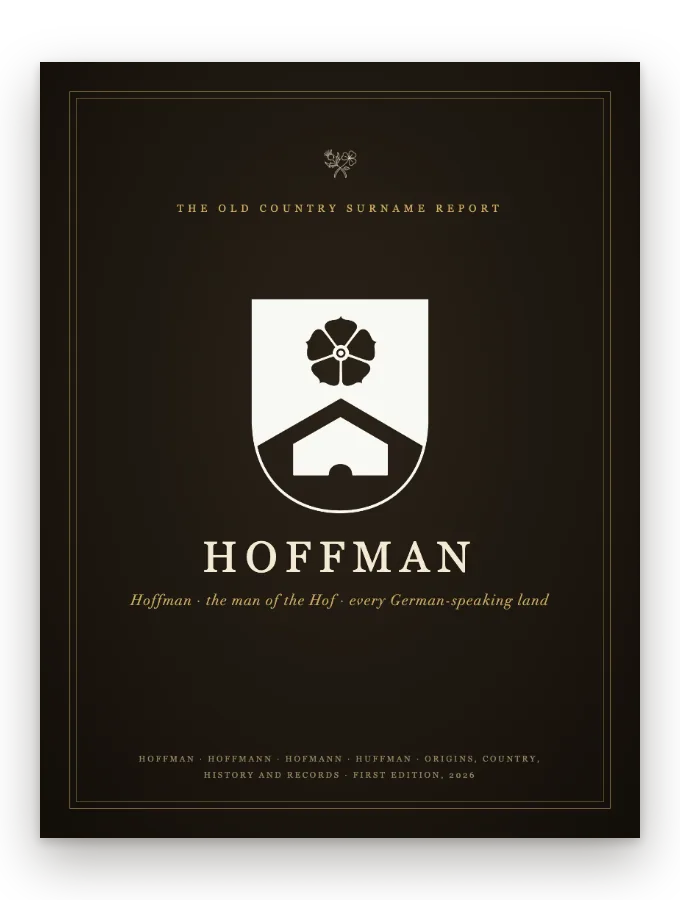
Hoffman is a status name. Before it was anyone's surname it was a word for the man of a Hof, the German farm, manor farm or courtyard, and its Middle High German form was hoveman. The authorities give the word several senses and put them in different orders. Matthias Lexer's Middle High German dictionary of 1872 gives a servant at a prince's court and the farmer belonging to a Hof. The Grimms' German dictionary gives the man who works a Hof as his own or as a dependent, then the overseer of a large estate, and calls the courtier the usual sense. Patrick Hanks's Dictionary of American Family Names gives a status name for a steward on a farm or estate. Hoffmann with two f's and Hofmann with one are the same word: Heintze's German name book of 1908 says the surname Hofmann is usually written Hoffmann.
No email needed. It starts just below.
47 pages, 19 named sources, in your inbox within a minute.
The next page asks where to post it.
The hardback could not be added just now. Get your report here, and the hardback is offered on the next page for the same $79 in all.
Read it. If it is not the best account of your name you have seen, reply to your receipt within 14 days and we refund you.
“I have been tracing my family tree for some time, but there were certain stories that even our closest relatives never knew about. This surname report is a true deep dive. Thank you.”Susan D., reader
A status name has a Heimat the way a dialect has one: a region and a boundary, not a village and a church. For a name made from the Hof the region is very wide. A Hof, in Hanks's words, was a farm, a manor farm or a courtyard, and the legal dictionary's Hofmann runs from the manager of a lord's manor farm to its tenant, its leaseholder and the farmer who belonged to it. Every German-speaking district had such farms and such men, which is why the name is German everywhere and the name of no one country.
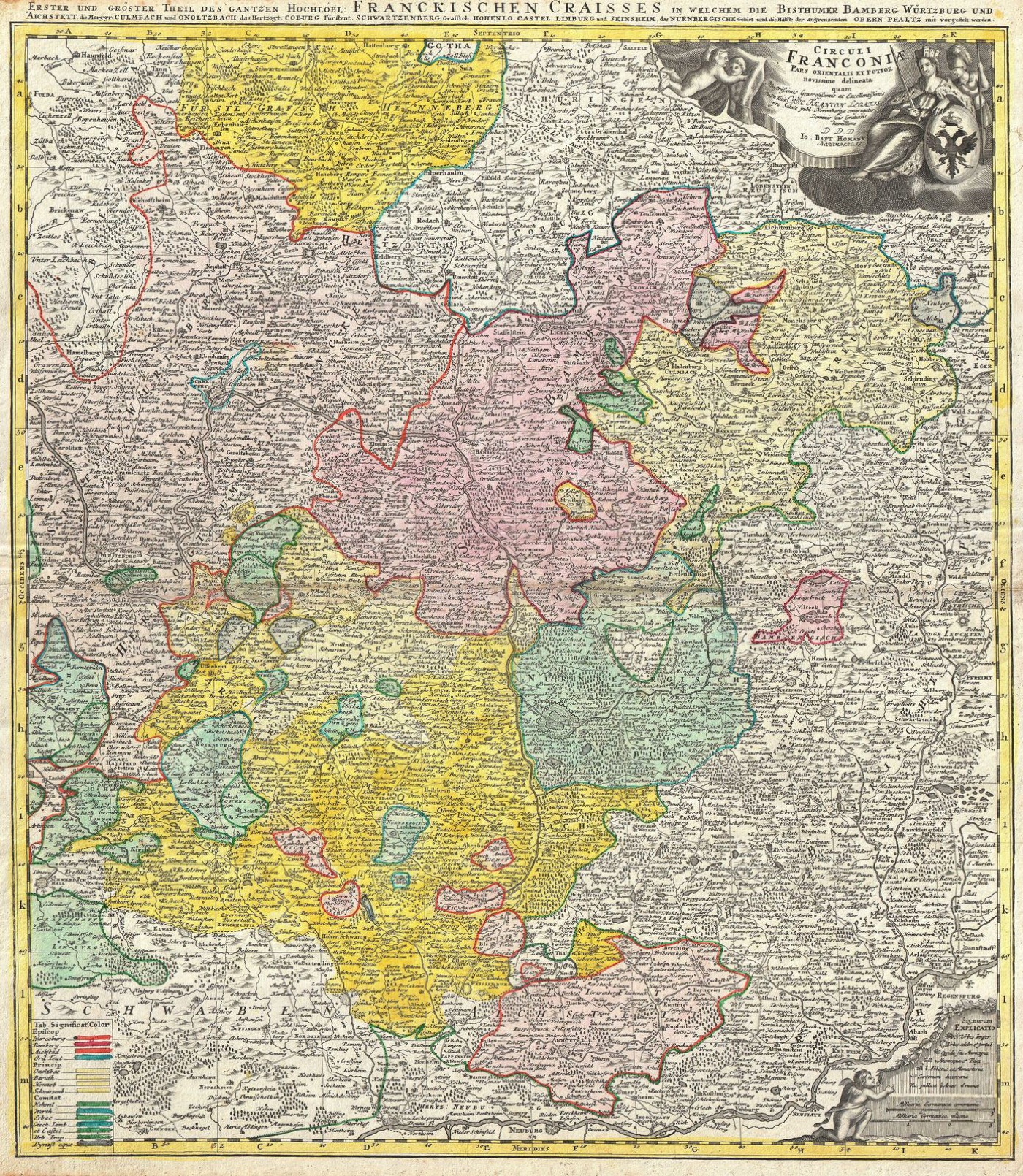
What the directories show is where the two spellings cluster now. Geogen's count puts the most Hoffmann listings in North Rhine-Westphalia, 16,498 of 75,810, and, divided by Geogen's own population figures, the most per head in the small Saarland, 244.6 for every 100,000 people, with Rhineland-Palatinate next at 163.9. Hofmann is a southern and central spelling: Bavaria holds 14,719 of its 44,734 listings, and per head Hesse leads with 122.6, then Bavaria with 117.6 and Saxony with 111.3. Johann Baptist Homann's map of about 1720 shows the Franconian country of northern Bavaria, the state where Geogen counts the most Hofmann listings.
A family tradition that names a village is worth more than any distribution map. A tradition that names only a region is worth exactly what the map is worth, a direction rather than an address. The chapters that follow work from documents outward, because for a name made on this many farms that is the only direction that leads anywhere.
That was one chapter. The report carries the rest: where the name comes from, the region and its records, arms, seals and marks, the stories, a timeline, migration, the name today, notable bearers, and a page on tracing your own line. Every claim sourced the same way as the chapter above.
Get my report · $14.99Instant download, yours to keep and print
Read it. If it is not the best account of your name you have seen, reply to your receipt within 14 days and we refund you.
Not your name? Search yours, or read another name's free chapter.
One piece of research, three more ways to have it. Every edition includes the Hoffman report itself.
The Hoffman report and a five and a half minute film of the name, your spelling on the title.
Get the film · $39.99The Hoffman report as a hardback, posted free to your door.
Get the book · $79The report, the film and the hardback. Bought apart they are $118.99.
Get all three · $99For the wall. The Hoffman record on one framed sheet, 16 by 12 inches, $89 posted free. See the framed plate.
A gift? Send the Hoffman report on a day you choose, with a card.
This history is written from public-domain sources and the family's own published records, every one of them listed. Where tradition and record disagree the text says so rather than choosing quietly. No image on this page is AI-generated.
First edition · last revised