 The Old Country
The Old Country
The Old Country
This report tells the story of a name built on a nickname: Armstrong, strong in the arm, a description of a man's own body turned into a surname carried by generations who never met him. Tradition, recorded by George F. Black in The Surnames of Scotland and repeated across nearly every popular account since, holds that the first Armstrong was one Fairbairn, armour-bearer to an early Scottish king, who lifted his king onto his own horse by main strength after the king's mount was killed under him in battle, and was renamed for the deed. No chronicle names the king, the battle or the date, and this report reads the story as what every source treats it as: a legend explaining a nickname, not a record of how one was earned.
Liddesdale is the valley of the Liddel Water, running down from the watershed hills into the Esk near Canonbie, on the Scottish side of a border that, for the Armstrongs' most powerful century, barely functioned as one. Immediately west and south of it lies the Debatable Land proper, the strip between the Esk and the Sark that both Scotland and England claimed for centuries and neither fully policed, finally divided by an official boundary commission only in 1552. This was never a lordship granted by a crown; it was a country the crown mostly could not reach.
Two towers anchor the family's own story here. Mangerton, seat of the chiefly line, sat in Liddesdale itself, a mile south of what is now Newcastleton; Gilnockie, also called Hollows Tower, built about 1520 at the hamlet of Hollows a little north of Canonbie on the Esk, was Johnnie Armstrong's own stronghold, the base from which he ran the Border trade that made his family, briefly, the terror of two kingdoms. Gilnockie stands restored and open. Mangerton does not: part of its ground floor and some low walls are all that is left of it.
The reckoning came from the crown, not from a rival clan. James V rode into this country in 1530 with a royal expedition aimed squarely at breaking Border power, and it worked: the hanging of Johnnie Armstrong at Carlenrig that summer, told in full later in this report, ended the family's open defiance of Edinburgh, though not its presence in the valley. That presence lasted, diminished, until the pacification that followed 1603 finished the job 1530 had started.
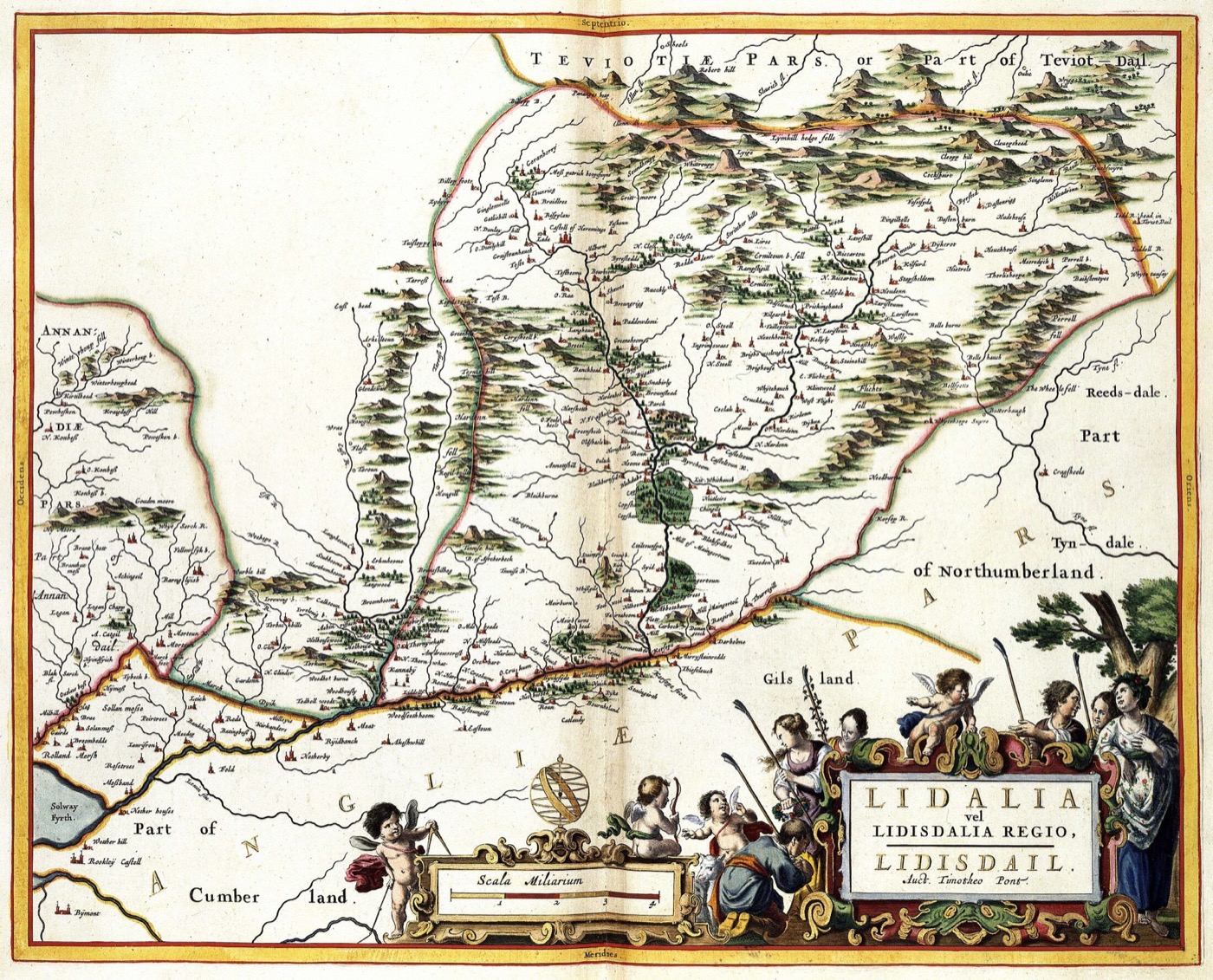
That was one chapter. The report carries the rest: where the name comes from, the clan and its chiefs, heraldry, the stories, a timeline, migration, the name today, notable bearers, and a page on tracing your own line. Every claim sourced the same way as the chapter above.
Get the Armstrong report$14.99 · instant download, yours to keep and print
Not your name? Search yours, or read how we work, with another full chapter.
This history is written by AI from public-domain sources and the family's own published records, every one of them listed above. Where tradition and record disagree the text says so rather than choosing quietly. No image on this page is AI-generated.
First edition · last revised