The Old Country
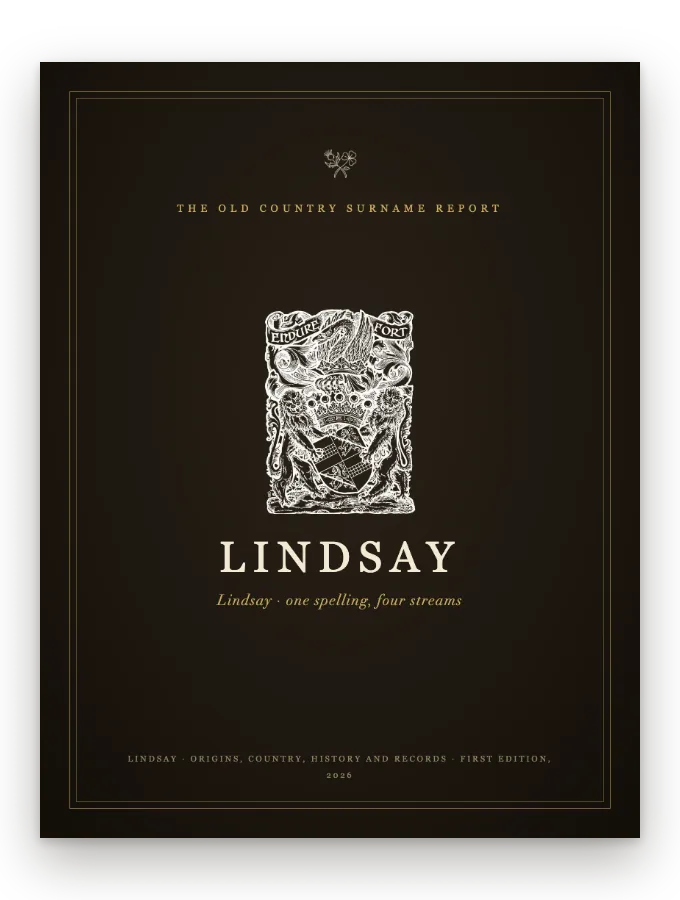
Cover of the Lindsay Surname Report
Free to read · One spelling, four streams: Walter de Lindeseia and the house of Crawford and its lines, the English Lindseys, the Ulster planters and the Gaelic names, and a spelling carried to the Americas by families of every origin

LindsaySurname meaning, origin and history

This report is about one surname that four different kinds of family have carried, and that is easy to take for one. Lindsay is a place-name. Reaney and Wilson's dictionary of English surnames gives Lindsay and Lindsey one entry, from Lindsey in Lincolnshire; Black's Surnames of Scotland gives that and a Norman De Limesay, each as said to be. In Scotland the name belongs first to a house that begins with Walter de Lindeseia, a witness to Earl David's charters about 1120, and grew into the lords of Crawford, Earls of Crawford from 1398, with lines at Glenesk and Edzell, the Byres, Balcarres, the Mount and Spynie. In England Lindseys stand in the record in more than one county, with arms of their own. In Ireland the name came with the plantation of Ulster to Tullaghoge in Tyrone, and Woulfe lists Lindsay as an English name taken by some bearers of three Gaelic names; in Scotland, Black says, some MacLintocks are said to have Englished their name as Lindsay. In the Americas the spelling has been carried by families of every origin.

Get my report · $14.99

43 pages, 25 named sources, in your inbox within a minute.

Read it. If it is not the best account of your name you have seen, reply to your receipt within 14 days and we refund you.

“I have been tracing my family tree for some time, but there were certain stories that even our closest relatives never knew about. This surname report is a true deep dive. Thank you.”Susan D., reader

Not today? Read the Lindsay chapter free. We will email it to you.Rather read it later? We will email you the Lindsay chapter.

One email: the link to this page and the free Clan Finder, eighteen clans and every surname recorded as belonging to them, on two printable pages. Nothing else unless you tick the box.

The Lindsay name at a glance

Meaning
Of Lindsey in Lincolnshire (Reaney and Wilson). Ekwall derives Lindsey from Lindon, the old name of Lincoln, with Old English eg, island. The Scots Peerage says the origin is not certain.
Earliest records
About 1120: Walter de Lindeseia witnesses Earl David's charter for the abbey at Selkirk. In England, Baldric de Lindissi's gift of tithes, confirmed between 1121 and 1129.
The earldom
21 April 1398: Sir David Lindsay of Glenesk is made Earl of Crawford at Perth. The chief of the name on the Standing Council's list is The Earl of Crawford and Balcarres.
In 1296 and 1320
Nine Lindeseye entries on the roll of homage, four of them knights; David de Lindesay seals the Arbroath letter of 6 April 1320.
Four streams
The Scottish house and its lines; English Lindseys from more than one place; Ulster planters and three Gaelic names; in the Americas a spelling of every origin.
Spellings
Lindsay, Lindsey, Lyndsay, Lindesay and Linsey are one name, Lindsey with a caveat; Linzy, Lindley, Lindsley, Linsley and Lynch are different names.
Scotland today
216 register entries in 2025, ranked 90th; 346 in 1975, ranked 86th.
United States today
Lindsey 60,657 at the 2020 Census, ranked 548th; Lindsay 32,075, ranked 1,073rd.
Chapter four, free to read in full

Clydesdale, Angus and Fife

One early Lindsay centre was Clydesdale. Crawford, in upper Clydesdale in Lanarkshire, was Lindsay land by the close of the twelfth century, held, as the Scots Peerage reads the charters, under Swan son of Thor. The register of Newbattle Abbey keeps William de Lindsay's gift of part of his land of Crawford, bounded down to the Clyde, and its editor of 1849 calls the Lindsays the largest benefactors of Newbattle among families still existing. The barony gave the family its title in 1398, when Sir David Lindsay of Glenesk was made Earl of Crawford. Further east, Walter de Lyndesey gave the church of Earlston to Kelso, a grant Lawrie doubts was made before 1160.

Crawford in Clydesdale, Glenesk and Edzell in Angus, the Byres and Balcarres either side of the Forth: three groups of Lindsay lands.

Another Lindsay heartland was Angus. Sir Alexander Lindsay married Katherine, co-heir of Sir John Stirling of Glenesk, by a contract King David confirmed in 1358, and the Peerage says his Angus estates formed "the bulk of what was afterwards styled the earldom of Crawford". Adam lists the Deuchars of Forfarshire among the Lindsay septs, noting that they held the estate of Deuchar under the Lindsays. Alexander, fourth Earl of Crawford, fell back on his castle of Finavon after the battle beside Brechin in 1452, and at Edzell the walled garden of 1604 is the work of the ninth Earl of Crawford's son.

A third group of Lindsay lands lay either side of the Forth. The Byres in East Lothian was a Lindsay barony by Sir William Lindsay's charter of 17 January 1365-66, and its line became Lords Lindsay of the Byres in 1445 and Earls of Lindsay in 1633. In Fife the Mount, just outside Cupar, was the land of Sir David Lyndsay's father, and Balcarres, in the parish of Kilconquhar, was the house of a line from Edzell made Lords Lindsay of Balcarres in 1633 and Earls of Balcarres in 1651; the third Earl, Colin, founded the village he named Colinsburgh. In 1848 the House of Lords accepted the Earl of Balcarres's claim to be Earl of Crawford, and the chief on the Standing Council's list is The Earl of Crawford and Balcarres.
Balcarres House in the parish of Kilconquhar, Fife, the house of the Lindsays of Balcarres, Earls of Balcarres from 1651. Photograph by James Allan, 2013, geogr
Balcarres House in the parish of Kilconquhar, Fife, the house of the Lindsays of Balcarres, Earls of Balcarres from 1651. Photograph by James Allan, 2013, geograph.org.uk; CC BY-SA 2.0.
One spelling, four streams: Walter de Lindeseia and the house of Crawford and its lines, the English Lindseys, the Ulster planters and the Gaelic names, and a spelling carried to the Americas by families of every origin · 43 pages

The full Lindsay surname report

That was one chapter. The report carries the rest: where the name comes from, the clan and its chiefs, heraldry, the stories, a timeline, migration, the name today, notable bearers, and a page on tracing your own line. Every claim sourced the same way as the chapter above.

Get my report · $14.99

Instant download, yours to keep and print

Read it. If it is not the best account of your name you have seen, reply to your receipt within 14 days and we refund you.

Not your name? Search yours, or read another name's free chapter.

The editions

Read it, watch it, or keep it on the shelf.

One piece of research, three more ways to have it. Every edition includes the Lindsay report itself.

Watch itin five days$39.99

The Lindsay report and a five and a half minute film of the name, your spelling on the title.

Get the film · $39.99
Keep itin two weeks$79

The Lindsay report as a hardback, posted free to your door.

Get the book · $79
All three Best valuesaves $19.99$99

The report, the film and the hardback. Bought apart they are $118.99.

Get all three · $99

For the wall. The Lindsay record on one framed sheet, 16 by 12 inches, $89 posted free. See the framed plate.

A gift? Send the Lindsay report on a day you choose, with a card.

The sources page, in fullWhere every claim on this page comes from.
Where the record is uncertainWhere this report cites an early record it cites the edition that prints it: Walter's charters through Lawrie and the Kelso cartulary, the roll of 1296 through the Bannatyne Club's Instrumenta Publica, the joust through Laing's Wyntoun, the play through Laing's Lyndsay, the Ulster grants through Hill. Where one writer is the only authority for a statement, the report says whose it is. No commercial surname site was used as corroboration.
  • C. W. Bardsley, A Dictionary of English and Welsh Surnames (1901), p. 465, s.v. Lindsey and Lindley
  • Sir James Balfour Paul (ed.), The Scots Peerage, vol. 1 (Edinburgh, 1904), Lindsay, Earl of Balcarres; vol. 3 (1906), Lindsay, Earl of Crawford, pp. 1-51; vol. 5 (1908), Lindsay, Earl of Lindsay; vol. 8 (1911), Lindsay, Lord Spynie
  • Sir Archibald C. Lawrie, Early Scottish Charters prior to A.D. 1153 (Glasgow, 1905), nos. XXXV, XLVI, L and CCLXX, with the notes; Liber S. Marie de Calchou (Bannatyne Club, 1846), vol. 1, charter 1
  • J. H. Round, Calendar of Documents preserved in France, vol. 1 (1899), no. 636; Open Domesday, Farforth and Oxcombe; William Dugdale, Monasticon Anglicanum, vol. 6 part 2 (1846), the Templars' inquest of 1185, pp. 827-829
  • Encyclopaedia Britannica, 11th edition (1911), vol. 16, Lincolnshire, and Lindsay (family)
  • Lord Lindsay, Lives of the Lindsays, vol. 1 (Wigan, 1840; London, 1849; the edition of 1858)
  • Patrick Woulfe, Sloinnte Gaedheal is Gall: Irish Names and Surnames (Dublin, 1923), index
  • Instrumenta Publica sive Processus super Fidelitatibus et Homagiis Scotorum (Bannatyne Club, 1834), pp. 13, 119-166 and the Index Nominum; National Records of Scotland, transcription and translation of the Declaration of Arbroath, SP13/7
  • Andrew of Wyntoun, The Orygynale Cronykil of Scotland, ed. David Laing, vol. 3 (Edinburgh, 1872), book IX ch. xi, pp. 47-50
  • David Laing (ed.), The Poetical Works of Sir David Lyndsay (Edinburgh, 1871 and 1879): the memoir, Eure's notes of 1540 and the Cupar proclamation
  • Andrew Jervise, The History and Traditions of the Land of the Lindsays in Angus and Mearns, 2nd ed. (Edinburgh, 1882), pp. 45-48; Historic Environment Scotland, Edzell Castle and Garden
  • W. R. Macdonald, Scottish Armorial Seals (1904), nos. 1631-1695; Burke, The General Armory (1884), pp. 609-611; Fairbairn's Book of Crests (1905), vol. 1, p. 343
  • Fac simile of an ancient heraldic manuscript emblazoned by Sir David Lyndsay of the Mount, Lyon King of Arms, 1542 (Edinburgh: W. and D. Laing, 1822), folio 44 and the register
  • Standing Council of Scottish Chiefs, members; Scottish Register of Tartans, Lindsay, refs 2115-2121; Frank Adam, The Clans, Septs and Regiments of the Scottish Highlands (1908); Clan Lindsay USA, Are You A Lindsay?
  • Dictionary of National Biography, vol. 33 (1893), the Lindsay entries, pp. 279-318, and vol. 3 (1885), Barnard, Lady Anne; Dictionary of Canadian Biography, vols 6, 10 and 16; Australian Dictionary of Biography, vols 10 and 18; Library of Congress Name Authority File
  • George Hill, An Historical Account of the Plantation in Ulster (1877), pp. 141-142, 288, 304-305, 549-550; the Donegal muster roll of 1630, as printed in the Donegal Annual
  • John Camden Hotten, The Original Lists of Persons of Quality, 1600-1700 (London, 1874), pp. 179, 290; C. K. Bolton, Scotch Irish Pioneers in Ulster and America (1910), pp. 155, 263, 329, 335; George Patterson, A History of the County of Pictou (1877)
  • Encyclopedia of Oklahoma History and Culture, Lindsay; Handbook of Texas Online, Lindsay, TX
  • Heads of Families at the First Census of the United States taken in the Year 1790 (Bureau of the Census, 1907-08), the state indexes
  • National Records of Scotland, Most Common Surnames, 2025; United States Census Bureau surname files, 2000, 2010 and 2020; National Archives of Ireland, Census of Ireland 1901 and 1911, exact surname search
  • The arms of Lindsay, Earl of Crawford, engraved for The Scots Peerage, vol. 3 (1906), public domain.
  • Photographs: Jonathan Oldenbuck (Edzell garden wall), 2008, CC BY-SA 3.0, Wikimedia Commons; Terrorford (Crawford Castle), 2006, public domain
  • Maps: Joan Blaeu, the shire of Angus, David Rumsey Map Collection, David Rumsey Map Center, Stanford Libraries; Christopher Saxton, Lincolnshire, 1576, University of Exeter Special Collections, CC0
  • Black, Surnames of Scotland (1946), s.v. Lindsay, MacClintock; Reaney and Wilson, Dictionary of English Surnames (1995); Ekwall, English Place-Names (1960), s.v. Lindsey; Wyntoun, ed. Laing (1872), ii. 321; Woulfe (1923); Oxford DNB, Lyndsay; Lindsay of Pitscottie.
  • Map coastlines: Natural Earth, public domain; Scotland: (c) OpenStreetMap contributors, Open Database Licence.

This history is written from public-domain sources and the family's own published records, every one of them listed. Where tradition and record disagree the text says so rather than choosing quietly. No image on this page is AI-generated.

First edition · last revised

More surname histories, free to read

Every surname we have written →