The Old Country
Cover of the Cook Surname Report
Free to read · Cook, and Cooke as the same name: a trade word, not a family

CookSurname meaning, origin and history

This report tells the story of a trade name, not a family. Cook comes from the Old English coc, a word borrowed from the Latin coquus, for the man who cooked for a household or sold hot food ready to eat. London had a public cookshop on the bank of the Thames by the 1170s, and every town of any size needed someone to fill the word, so the surname was coined over and over, independently, in kitchens and cookshops across England and lowland Scotland. That is why this report cannot give it one home, one seat or one coat of arms. What it can give is the record: Burke's General Armory lists more than a dozen unrelated Cook and Cooke families with arms of their own, from Doncaster to Dublin, and the Yorkshire poll tax of 1379 writes the name four different ways on its way to settling.

Get my report · $14.99

39 pages, 18 named sources, in your inbox within a minute.

Read it. If it is not the best account of your name you have seen, reply to your receipt within 14 days and we refund you.

“I have been tracing my family tree for some time, but there were certain stories that even our closest relatives never knew about. This surname report is a true deep dive. Thank you.”Susan D., reader

Not today? Read the Cook chapter free. We will email it to you.Rather read it later? We will email you the Cook chapter.

One email: the link to this page and the free Trades Sheet, the trades hidden in English and Scottish surnames, and the names that grew out of them, on two printable pages. Nothing else unless you tick the box.

The Cook name at a glance

Meaning
One who cooked, or sold cooked food: Old English coc, from the Latin coquus. A name for the job, not for one family
Language of origin
English and Scots, coined wherever a household needed the word; in the Gaelic west sometimes an English form of MacCook
Recorded heartland
No single heartland: separate families in Yorkshire, Essex, Northamptonshire, Kent, Fife, Dublin and London
Earliest written record
Galter Coc in Domesday Book, 1086, in Essex (Reaney and Wilson); in Scotland, Richard the cook, cocus, holding land in Berwick after 1147 (Black)
Homeland
England and lowland Scotland generally, with Gaelic-born Cooks in Islay, Kintyre and Arran
Crest
No single Cook crest: Burke lists more than a dozen unrelated grants. The cover device draws one, the arms granted in 1785 through Captain Cook's widow
Chief today
None. An occupational surname, never a clan
Recorded surname ranks
Cook: 290,386 at the 2020 US Census (66th); Cooke: 31,451 (1,096th). Scotland 2024: Cook 183 (119th). Ireland 1911: Cooke 3,013, Cook 359
Chapter four, free to read in full

No one country, and one very long voyage

An occupational name has no ancestral county, and this report will not invent one. The name turns up independently wherever English or Scots was spoken and a household needed a word for the person who cooked: in the West Riding villages of the 1379 poll tax, in Essex, Northamptonshire and Kent, on the Fife coast at Pittenweem, in Dublin and London, and later in Plymouth Colony, Illinois and New South Wales. The census of Ireland found Cookes in every one of the thirty two counties in 1901, thickest in Dublin, Antrim and Galway.

No single county holds this name. Its widest travels belong to one man who happened to carry it.

The places tied to single bearers can still be visited. Marton-in-Cleveland in Yorkshire is where James Cook was born on 27 October 1728, and Whitby is where he was apprenticed in 1746 to the shipowner John Walker and where the Endeavour was built. Melbourne in Derbyshire is where Thomas Cook was born in 1808; Leicester is where he lived, where his first excursion began and where he died, at Stoneygate, in 1892, and the Record Office for Leicestershire, Leicester and Rutland, at Wigston, now holds the archive of the firm he founded. Cook County, Illinois, was created on 15 January 1831 and named for a congressman who had died a little over three years before in Scott County, Kentucky, where he was born.

The widest places belong to one man's voyages, and they were named after him rather than settled by his family. In the South Pacific, Cook himself called one island of a group Hervey Island, and the name Cook Islands first appeared on a Russian chart by Admiral Krusenstern in the 1820s. In New Zealand, Captain John Lort Stokes of HMS Acheron gave Mount Cook its English name in 1851, and since the Ngai Tahu settlement of 1998 its official name has been Aoraki / Mount Cook. On the far side of the ocean, Cook anchored in Ship Cove, now Resolution Cove, in Nootka Sound off Vancouver Island, in the spring of 1778, and in Hawaii he was killed at Kealakekua Bay on 14 February 1779.
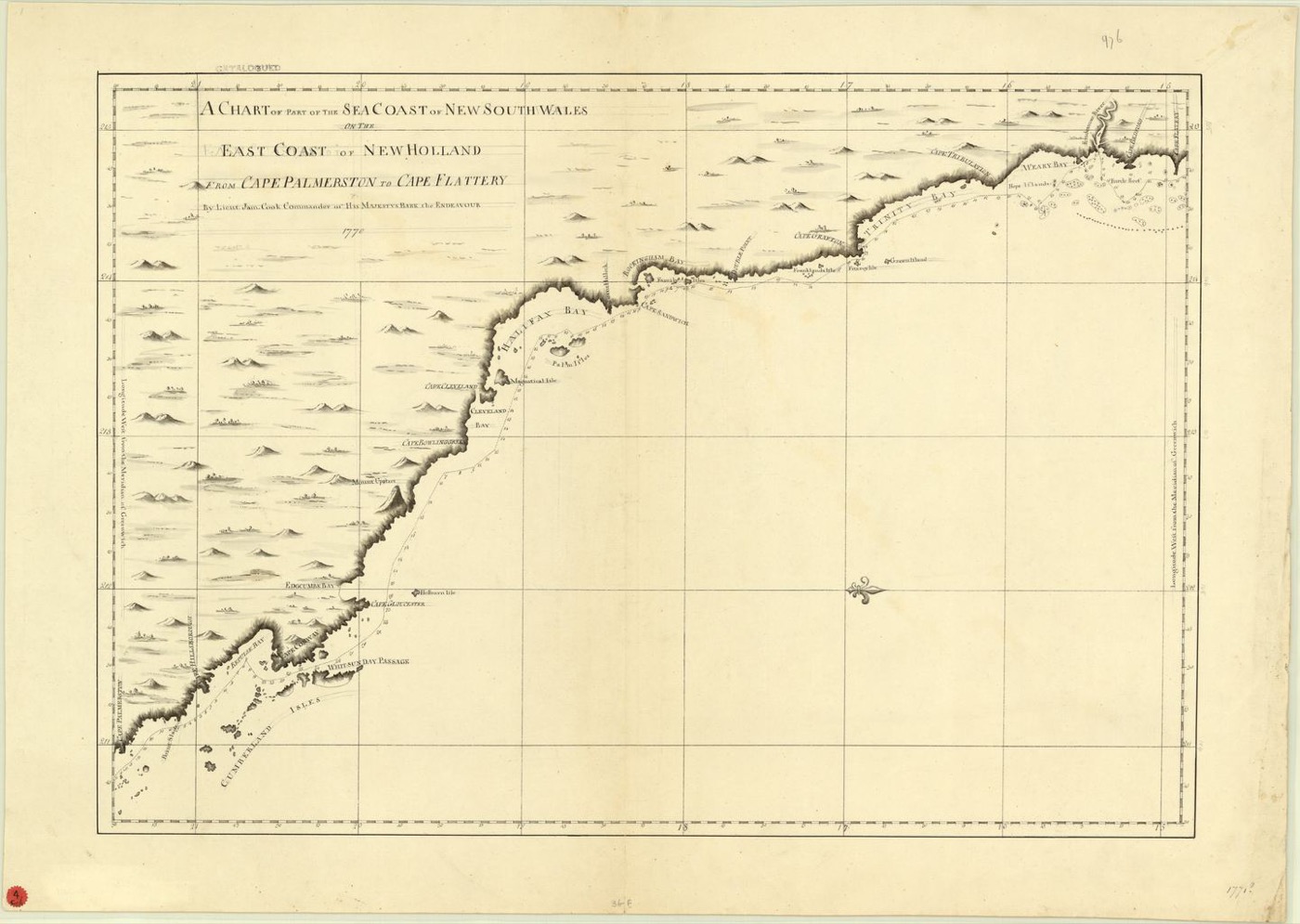
A Chart of Part of the Sea Coast of New South Wales on the East Coast of New Holland, one of four manuscript charts from Cook's first voyage, drawn in 1770. Coo
A Chart of Part of the Sea Coast of New South Wales on the East Coast of New Holland, one of four manuscript charts from Cook's first voyage, drawn in 1770. Cook's own chart of the coast he had just made the first clear European delineation of. University of Wisconsin-Milwaukee Libraries, World Digital Library; public domain.
Cook, and Cooke as the same name: a trade word, not a family · 39 pages

The full Cook surname report

That was one chapter. The report carries the rest: where the name comes from, the clan and its chiefs, heraldry, the stories, a timeline, migration, the name today, notable bearers, and a page on tracing your own line. Every claim sourced the same way as the chapter above.

Get my report · $14.99

Instant download, yours to keep and print

Read it. If it is not the best account of your name you have seen, reply to your receipt within 14 days and we refund you.

Not your name? Search yours, or read another name's free chapter.

The editions

Read it, watch it, or keep it on the shelf.

One piece of research, three more ways to have it. Every edition includes the Cook report itself.

Watch itin five days$39.99

The Cook report and a five and a half minute film of the name, your spelling on the title.

Get the film · $39.99
Keep itin two weeks$79

The Cook report as a hardback, posted free to your door.

Get the book · $79
All three Best valuesaves $19.99$99

The report, the film and the hardback. Bought apart they are $118.99.

Get all three · $99

For the wall. The Cook record on one framed sheet, 16 by 12 inches, $89 posted free. See the framed plate.

A gift? Send the Cook report on a day you choose, with a card.

The sources page, in fullWhere every claim on this page comes from.
Where the record is uncertainWhere a widely repeated claim has no printed source standing behind it, most notably two early citations sometimes given for this surname, this report says so and leaves the claim out rather than borrow a certainty it has not earned.
  • Bardsley, A Dictionary of English and Welsh Surnames (1901), under Cook, Cooke, for the occupational reading and Coke as an early form; Online Etymology Dictionary, 'cook', for Old English coc from Latin coquus.
  • Harrison, Surnames of the United Kingdom, vol. 2, for the 1465 statute of Edward IV.
  • P. H. Reaney and R. M. Wilson, A Dictionary of English Surnames, 3rd ed. (Oxford, 1995), s.v. Cook (archive.org scan, leaf 180, read 18 October 2026), for Galter Coc in Domesday Book, 1086.
  • George F. Black, The Surnames of Scotland (New York, 1946), s.vv. Cook and MacCook (archive.org scan, leaves 245 and 552, read 18 October 2026), for Richard the cook at Berwick after 1147 and the two sources of MacCook.
  • The Yorkshire Archaeological Journal, vols 5 to 7 (1879 to 1882), the West Riding poll tax of 2 Richard II (1379), for Knaresborough, Ripon and the Cok, Coke, Cook and Cooke entries.
  • William FitzStephen's description of London (about 1173), in the translation printed with Stow's Survey of London (1912 edition); H. T. Riley, Memorials of London and London Life (1868), for the cooks' prices of 1378; the Worshipful Company of Cooks' published timeline, and Wikipedia's article on the Company, for the 1482 charter.
  • Burke, The General Armory (1884), under Cook and Cooke, for every blazon quoted (Captain Cook's on p. 223); Fairbairn's Book of Crests (1905), vol. 1, for the sea chart crest at Edinburgh and Aberdeen.
  • The Captain Cook Society, 'Cook's Coat of Arms', for the 1785 Letters Patent, their blazon, crest and mottoes, and their holding at the State Library of New South Wales. The cover device is a line drawing made for this report from that blazon and Burke's.
  • Woulfe, Irish Names and Surnames (1923), for Cook and Cooke among the English forms of Gaelic names; Clan Donald USA, 'Are You a MacDonald?', for MacCook.
  • National Archives of Ireland, Census of Ireland 1901 and 1911, surname search (exact match); US Census Bureau surname files for 2010 and 2020; National Records of Scotland, Most Common Surnames 2024 and the 1975 to 2024 time series.
  • Dictionary of Canadian Biography, 'Cook, James'; Wikipedia, 'James Cook', with the National Museum of Australia and the World Digital Library's description of the WDL6775 chart; Wikipedia, 'Willem Janszoon', 'Cook Islands' and 'Aoraki / Mount Cook'.
  • Wikipedia, 'Francis Cooke', and the General Society of Mayflower Descendants, 'The Cooke Family', for Plymouth Colony.
  • Dictionary of National Biography, 1901 supplement, and Encyclopaedia Britannica (1911), 'Cook, Thomas'; Wikipedia, 'Thomas Cook', 'Thomas Cook & Son' and 'Thomas Cook Group'; Leicestershire County Council, on the Thomas Cook archive.
  • Wikipedia, 'Daniel Pope Cook', '1824 United States presidential election' and 'Cook County, Illinois'; the US House of Representatives' History, Art and Archives office; FamilySearch Research Wiki, 'Cook County, Illinois Genealogy'.
  • Wikipedia, 'Frederick Cook', for the Belgica, Mount McKinley, the Pole claim and the 1923 conviction; Encyclopaedia Britannica and the Texas State Historical Association for the Pole dispute.
  • Australian Dictionary of Biography, 'Cook, Sir Joseph (1860-1947)', vol. 8 (1981); Wikipedia, 'Sam Cooke' (citing Peter Guralnick, Dream Boogie, 2005), 'Thomas Cooke (mayor)' and 'Anthony Cooke'; History of Parliament, 'Cooke, Sir Anthony (c.1505-76)', read 18 October 2026, for his death in 1576 and his daughters' marriages.
  • Natural Earth (naturalearthdata.com), public domain, for the coastline of the map.
  • Jost Amman and Hans Sachs, Standebuch (1568), in the 1884 Munich facsimile (archive.org), for Der Koch. Every plate is credited in its caption.

This history is written from public-domain sources and the family's own published records, every one of them listed. Where tradition and record disagree the text says so rather than choosing quietly. No image on this page is AI-generated.

First edition · last revised

More surname histories, free to read

Every surname we have written →