 The Old Country
The Old Country
The Old Country
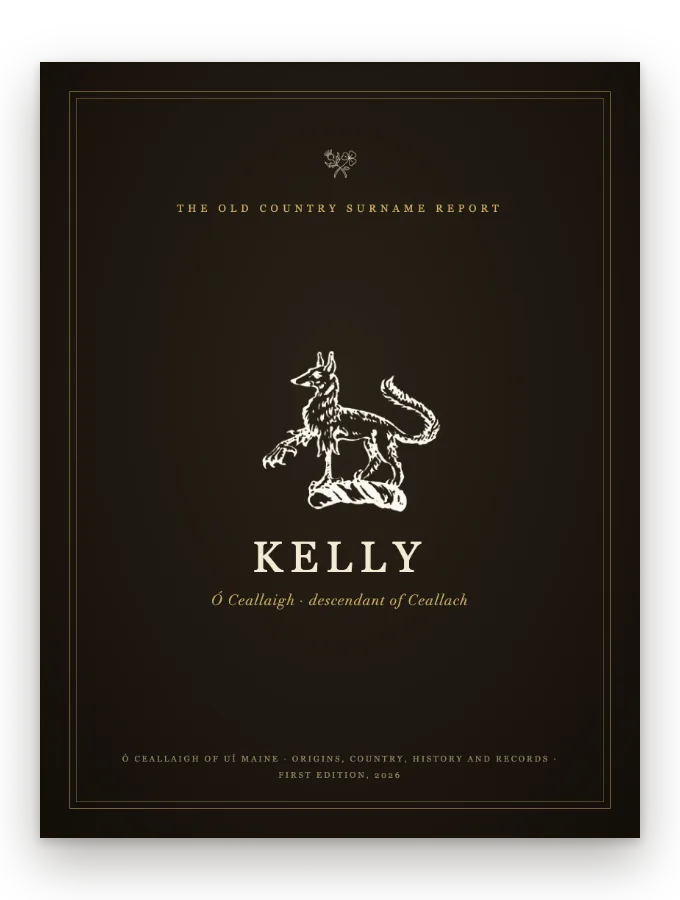
Kelly is among the most common surnames in Ireland, and one of the least settled in its own meaning. It anglicises Ó Ceallaigh, descendant of Ceallach, and there the certainty ends: Woulfe's Sloinnte Gaedheal is Gall glosses Ceallach as war or contention, while a rival reading, bright-headed, circulates just as widely in the standard reference literature. Both are in print, and neither has settled the question. What is settled is that the surname was not coined once. Woulfe records at least nine separate places across Ireland where a man named Ceallach gave his name to a distinct family: Meath and north Dublin, Sligo, Derry, three different parts of County Laois, north Wicklow, west Cork, and, chief among them by a wide margin, the kingdom of Uí Maine in south Connacht.
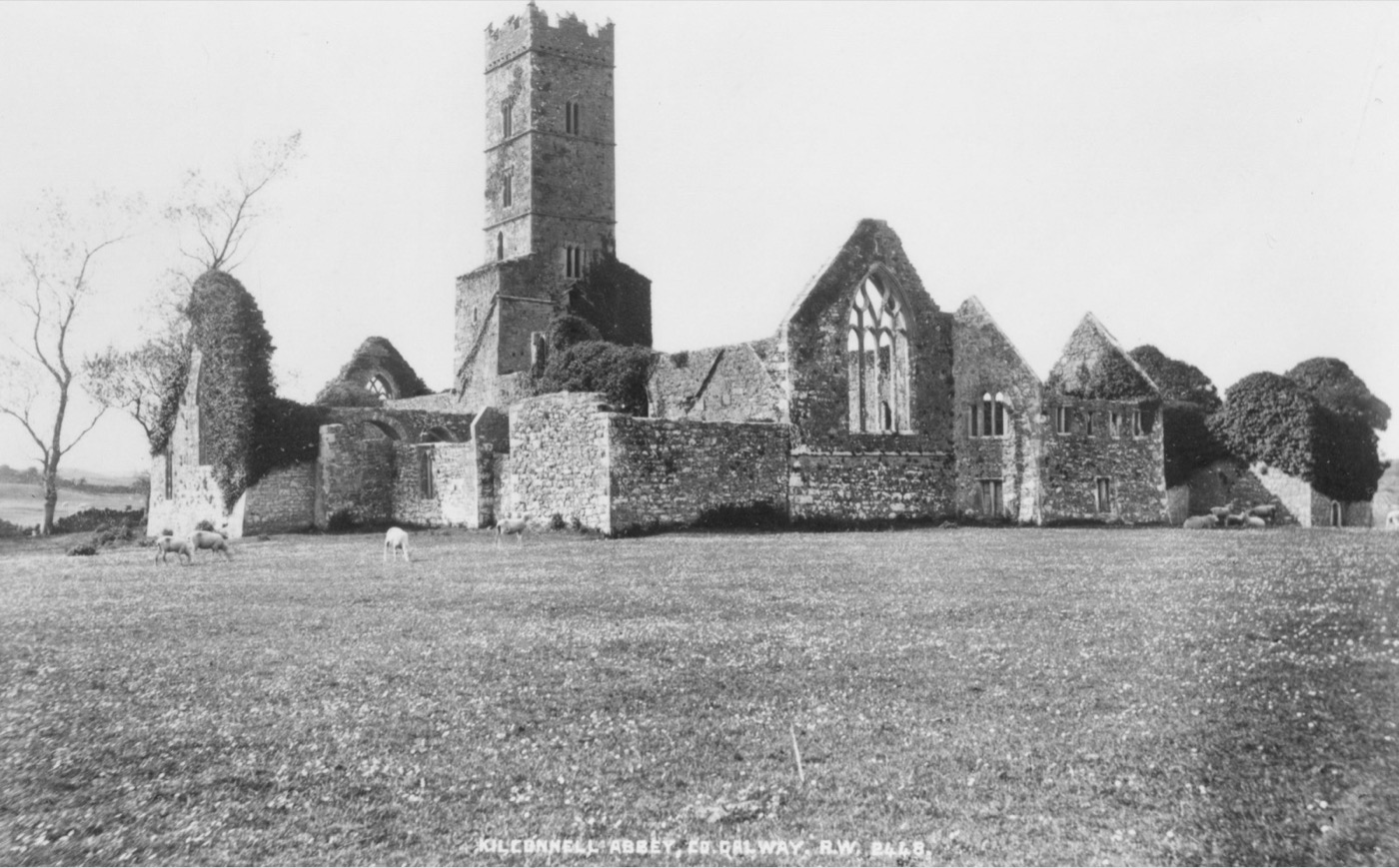
Aughrim and Kilconnell, both in east County Galway a short distance apart, were the cenn áiteanna, the chief places, of the O'Kelly lords of Uí Maine from the mid-thirteenth century onward, after Anglo-Norman grants from around 1253 had already begun cutting into the wider lordship around them. William Buí Ó Ceallaigh, lord of Uí Maine, founded the Franciscan friary at Kilconnell, a few miles from Aughrim itself, in 1353, and built the bawn at nearby Callow; a once-cited 1414 foundation date is now considered an erroneous identification of a different place named in a papal licence. The friary still stands as a ruin today, its walls and window tracery largely intact, one of the better-preserved medieval Franciscan houses in Ireland.
The same small stretch of country carries a second, much later weight of history that this report keeps carefully separate from the medieval one. On 12 July 1691, the Battle of Aughrim, the decisive and bloodiest battle of the Williamite War in Ireland, was fought on and around the same ground the O'Kellys had held as their own chief place for four centuries; over seven thousand men are recorded killed, and the battle effectively ended Jacobite resistance in Ireland. Burke's General Armory records that James O'Kelly of Aughrim, descended from Feigh O'Kelly, chief of the sept at the invasion of 1172, was himself killed in the battle, leaving a son, Counsellor John O'Kelly of Keenagh, Co. Roscommon, whose arms Ulster King of Arms allowed in 1803. This report states that dated, sourced fact and does not claim more for the family's role in the wider battle than the record actually gives.
The manuscript this family is still named for, the Book of Uí Maine, left Galway long ago: it remained in O'Kelly ownership into the later eighteenth century, reached the antiquarian Sir William Betham's hands before 1820, passed from him to the Duke of Buckingham, and was bought for the nation in 1883, entering the Royal Irish Academy in Dublin, where it remains today, catalogued as manuscript D ii 1. Ten scribes worked on it for Archbishop Muircheartach Ó Ceallaigh beginning no earlier than 1392 and continuing after 1394; it holds Dindsenchas poetry, the Banshenchas, fragments of the Lebor Gabála, and the genealogies that first fixed this family's own pedigree on parchment.
That was one chapter. The report carries the rest: where the name comes from, the clan and its chiefs, heraldry, the stories, a timeline, migration, the name today, notable bearers, and a page on tracing your own line. Every claim sourced the same way as the chapter above.
Get the Kelly report$14.99 · instant download, yours to keep and print
Not your name? Search yours, or read how we work, with another full chapter.
This history is written by AI from public-domain sources and the family's own published records, every one of them listed above. Where tradition and record disagree the text says so rather than choosing quietly. No image on this page is AI-generated.
First edition · last revised