The Old Country
Cover of the Elliott Surname Report
Free to read · Clan Eliott of Liddesdale and the Scottish Middle March

ElliottSurname meaning, origin and history

This is the history of a name that a government wrote down. In 1583 an English officer called Thomas Musgrave sat down to explain the Scottish frontier to Lord Burghley, who did not know it, and when he came to the Liddel Water he wrote that the river was "planted with Ellotes" from its head almost to Whithaugh tower. Then he listed them: thirty-four men of the name, in the chief's own following and three branches, each one with the byname his neighbours actually used him by. Curst Hobbe. Fyre the brayes. Halfe loges. Gray Wille. Scotes Hobbe. That page is in the Calendar of Border Papers, and this report has read it.

The Elliott name at a glance

Meaning
From the older Border forms Elwald and Elwold, which the state papers use interchangeably with Ellot for the same men; behind them, usually, the Old English Aelfwald
Language of origin
Older Scots and the northern English of the frontier, on both sides of it. Spelled Ellot through the sixteenth century; Elliot and Eliott settle in from about the middle of the seventeenth
Clan and territory
Clan Eliott of Liddesdale, in the Scottish Middle March, the chiefs at Redheugh on the Hermitage Water; branches at Stobs, Minto, Wolfelee, Larriston and Arkleton
Earliest record read here
Thomas Musgrave's survey of the Border riders for Lord Burghley, endorsed to the end of 1583, naming thirty-four Ellots of Liddesdale under Robin Ellot of Redheugh
Homeland
Liddesdale, in the Scottish Borders, between Hermitage Castle and Whithaugh tower, with Teviotdale and Ewesdale over the hills
Crest and motto
A dexter hand in armour holding a cutlass, within a strap and buckle; Fortiter et recte, boldly and rightly. Fairbairn in 1905 gives the same crest under a second motto, Peradventure
Chief today
Madam Margaret Eliott of Redheugh, 29th Chief of the Name and Arms of Eliott by the clan's own count, daughter of the 11th baronet of Stobs
Recorded surname ranks
131,897 Elliotts at the 2020 United States census, 216th of all surnames; 93 Elliott and 45 Elliot on Scotland's 2024 registers; 3,752 Elliotts in Ireland in 1901
Chapter four, free to read in full

Liddesdale, and the country next door

Liddesdale is a single valley about twenty miles long, running south-west from the bare shoulder of hill under Hermitage Castle down to where the Liddel Water becomes the border itself. It is not fertile and it never was. What it had was position: a way through the hills that an army could use and a raiding party could use better, with England on one side of the water and Scotland on the other and neither government able to reach it in a hurry.

The Elliot places are still on the map, and they are the same places as the documents.

The Elliot places are still on the map, and they are the same places as the documents. Gorrenberry sits on the Hermitage Water above the castle. Braidley, which the sixteenth century spelled Bradley, is a mile below it, as Old Braidley and New Braidley. Hartsgarth, which Musgrave wrote Harskarth, is over the ridge to the south. Larriston is on the Liddel below Newcastleton, and Whithaugh, the tower Musgrave used as the eastern limit of Elliot country, is on the same reach of river. Copshaw, the byname of one of Martyn Ellot's men, is the old name of Newcastleton itself, laid out on a grid in 1793 by the Duke of Buccleuch.

Teviotdale, the next valley north, is where the name went when it could afford to. Stobs and Wolfelee lie south of Hawick; Minto sits under its craigs on the Teviot east of the town. That move, from a defensible tower on a raiding road to a house on good arable, is the whole seventeenth century of this surname in one sentence.
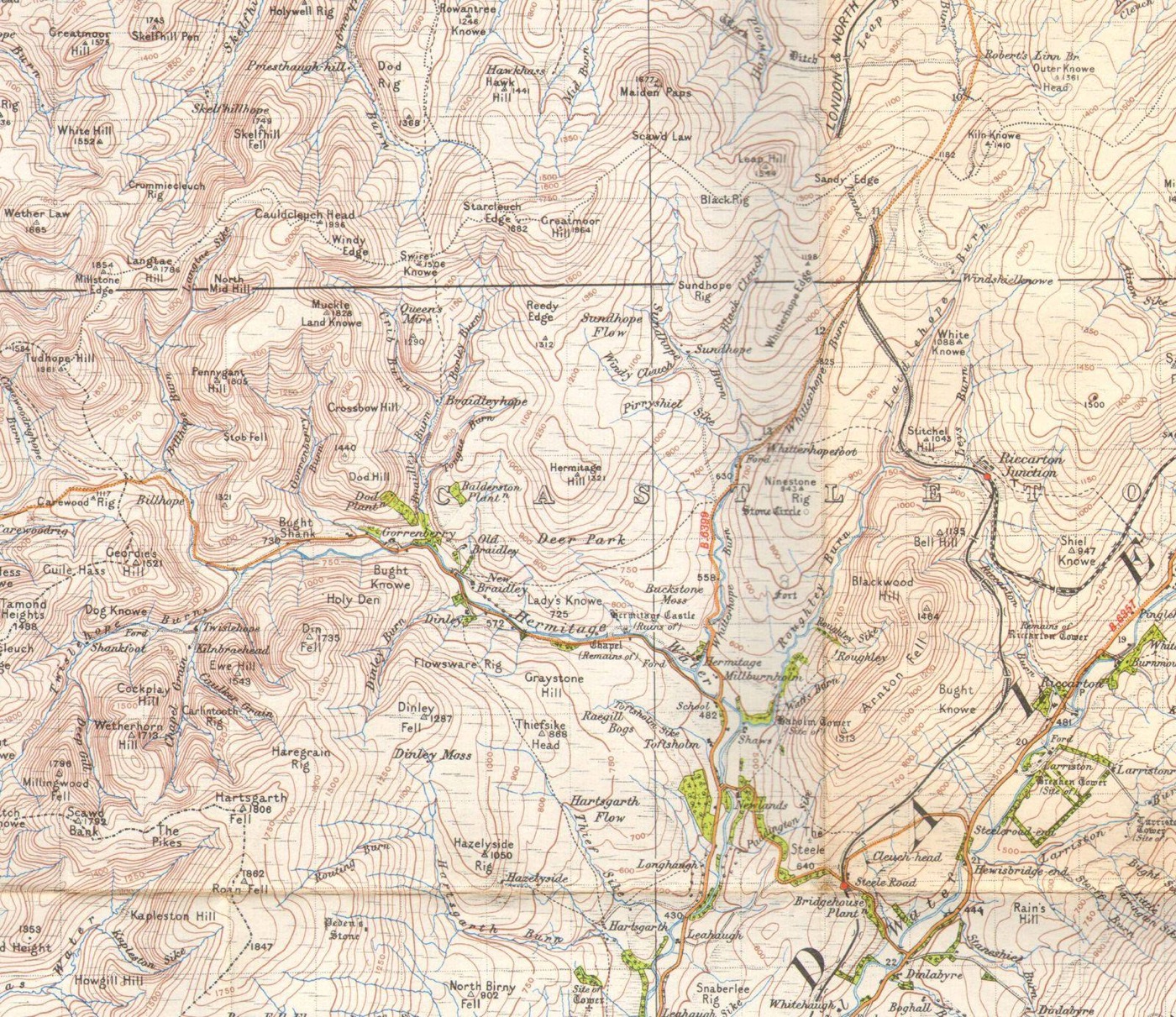
The head of Liddesdale on an Ordnance Survey one-inch sheet: Gorrenberry, Old and New Braidley, Hartsgarth, Larriston, Whithaugh and Hermitage Castle, every one
The head of Liddesdale on an Ordnance Survey one-inch sheet: Gorrenberry, Old and New Braidley, Hartsgarth, Larriston, Whithaugh and Hermitage Castle, every one of them a place named in the Elliot documents of 1583 and 1584. Ordnance Survey; public domain.
Clan Eliott of Liddesdale and the Scottish Middle March · 36 pages

The full Elliott surname report

That was one chapter. The report carries the rest: where the name comes from, the clan and its chiefs, heraldry, the stories, a timeline, migration, the name today, notable bearers, and a page on tracing your own line. Every claim sourced the same way as the chapter above.

Get the Elliott report

$14.99 · instant download, yours to keep and print

Not your name? Search yours, or read how we work, with another full chapter.

The sources page, in full

Where every claim on this page comes from.

Where the record is uncertainWhere a claim in this report is tradition rather than record it is labelled as such on the page where it appears, and the six that failed checking are set out under Checked, and cut. Two primary works could not be opened this session and no words are put in their mouths: George F. Black's Surnames of Scotland, which is on loan-restricted deposit, and the Oxford Dictionary of National Biography entry for Jean Elliot, which is behind a subscription.

This history is written by AI from public-domain sources and the family's own published records, every one of them listed above. Where tradition and record disagree the text says so rather than choosing quietly. No image on this page is AI-generated.

First edition · last revised

More surname histories, free to read

Every surname we have written →