The Old Country
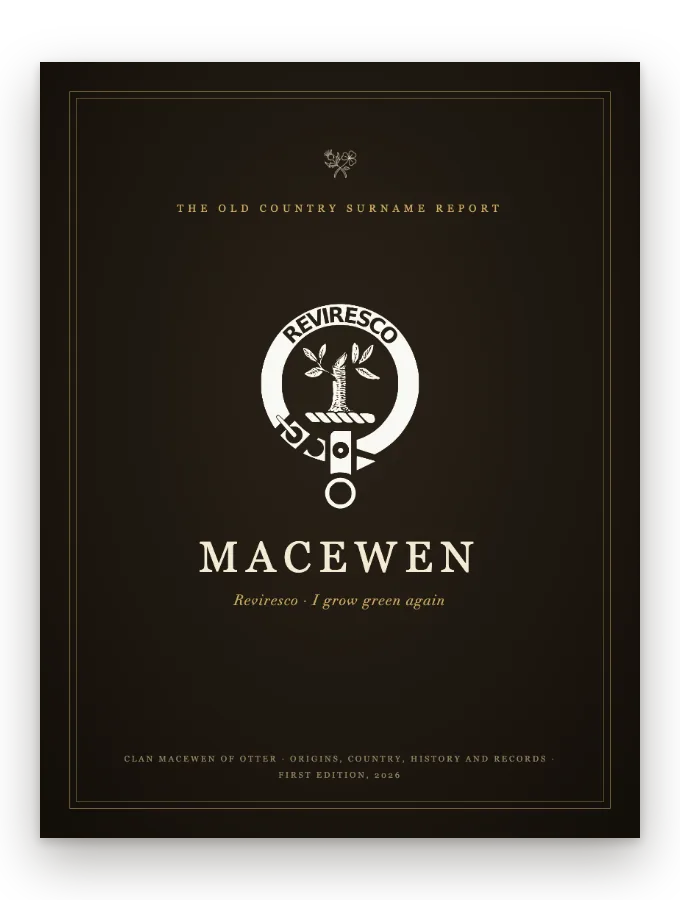
Cover of the MacEwen Surname Report
Free to read · Clan MacEwen of Otter

MacEwenSurname meaning, origin and history

This report tells the story of MacEwen, and of McEwen, McEwan and the smaller family of spellings that carry one Gaelic name into English: Mac Eoghain, son of Eoghan. The clan's record begins on the shore of Loch Fyne, in the Cowal district of Argyll, where a clan the old genealogies call Clann Eoghain na h-Oitrich, the MacEwens of Otter, held a small barony. In 1432 their chief, Swene MacEwen, resigned it to King James I and took it back with a clause naming a Campbell heir. By the end of that century Otter was Campbell land, and the name went on for more than five hundred years without a chief the Lord Lyon would recognise.

Get my report · $14.99

38 pages, 17 named sources, in your inbox within a minute.

Read it. If it is not the best account of your name you have seen, reply to your receipt within 14 days and we refund you.

“I have been tracing my family tree for some time, but there were certain stories that even our closest relatives never knew about. This surname report is a true deep dive. Thank you.”Susan D., reader

Not today? Read the MacEwen chapter free. We will email it to you.Rather read it later? We will email you the MacEwen chapter.

One email: the link to this page and the free Clan Finder, eighteen clans and every surname recorded as belonging to them, on two printable pages. Nothing else unless you tick the box.

The MacEwen name at a glance

Meaning
Scottish Gaelic Mac Eoghain, son of Eoghan, the first name English writes Ewen or Ewan; Harrison enters MacEwan and MacEwen together as son of Ewan or Ewen
The old clan
Clann Eoghain na h-Oitrich, the children of Eoghan of the Otter, whose pedigree is entered in the Gaelic manuscript of 1467
Recorded heartland
The Barony of Otter in Kilfinan parish, Cowal, on the eastern shore of Loch Fyne; later Lorn, the Lennox and Galloway
Earliest dated record
Malcolm mac Ewen, a witness before 1174, and Gilpatrik mac Ewen in 1219 (Black); of the Otter clan, 1432, when Swene MacEwen resigns the barony to James I
Crest badge and motto
An oak stump putting out new branches, Reviresco, I grow green again: the crest Burke records for M'Ewan of Glasgow, granted arms in 1847
Chief
None recognised from the fifteenth century until 20 March 2025: Sir John Roderick Hugh McEwen of Marchmont and Bardrochat, 5th Baronet
Scotland today
Mcewan 144 in the 2024 register, ranking 167th, down from 253 in 1975; Mcewen 19
United States today
McEwen 7,610 at the 2010 census, ranking 4,659th; Mcewan 2,652; MacEwen, as spelled here, 532
Chapter four, free to read in full

Otter, Cowal, and the shore the MacEwens lost

Cowal is the peninsula between Loch Fyne and the Firth of Clyde, hill country cut by narrow sea lochs, and the Barony of Otter lay on its western edge, on Loch Fyne's own shore, in the parish of Kilfinan. The place-name is Gaelic, oitir, a sandbank or spit, and the village of Otter Ferry is An Oitir in Gaelic. A ferry ran from there across Loch Fyne to West Otter Ferry near Lochgilphead until the late 1940s. There is no ferry now, only the pier, the shore and the loch the barony looked across.

Oitir, a sandbank or spit. The family took its old name from this shore, and in 2024 the convention came back to it.

Castle MacEwen, Caisteal Mhic Eoghainn, lies on the coast about two kilometres north-west of Kilfinan. It is a promontory site rather than a tower. When the Cowal Archaeological Society excavated it in 1968 and 1969, the earliest structure it found was a palisaded enclosure of medieval date, later replaced by a fort and then by a homestead; postholes gave dates in the fifteenth and sixteenth centuries, and the finds included a twelfth-century crucifix, a fifteenth-century groat and pottery of the thirteenth and eighteenth centuries. The excavators also found passages to the sea on the north and south, and the finds went to the Glasgow Art Gallery and Museum. The fifteenth-century dates put people on the point in Swene's own century, and the 1904 clan history quotes an older parish account: on a rocky point on Loch Fyne there stood in 1700 the ruins of Castle MacEwen, the stronghold of the earlier lords of the Otter.

Kilfinan's church of St Finan dates from the thirteenth century, and the earliest mentions of it are grants made between 1231 and 1241 to the Cluniac monks of Paisley Abbey. It also holds the Lamont north aisle, added in 1633 by Sir Coll Lamont, whose initials are carved on its gable. The MacEwens came back to both places within living memory: on 1 June 2019 the clan society held a family gathering at Kilfinan to confirm its choice of chief, and on 8 June 2024 the family convention met at Otter Ferry. The chief's own style, of Marchmont and Bardrochat, comes from the baronetcy created in 1953, not from Cowal.
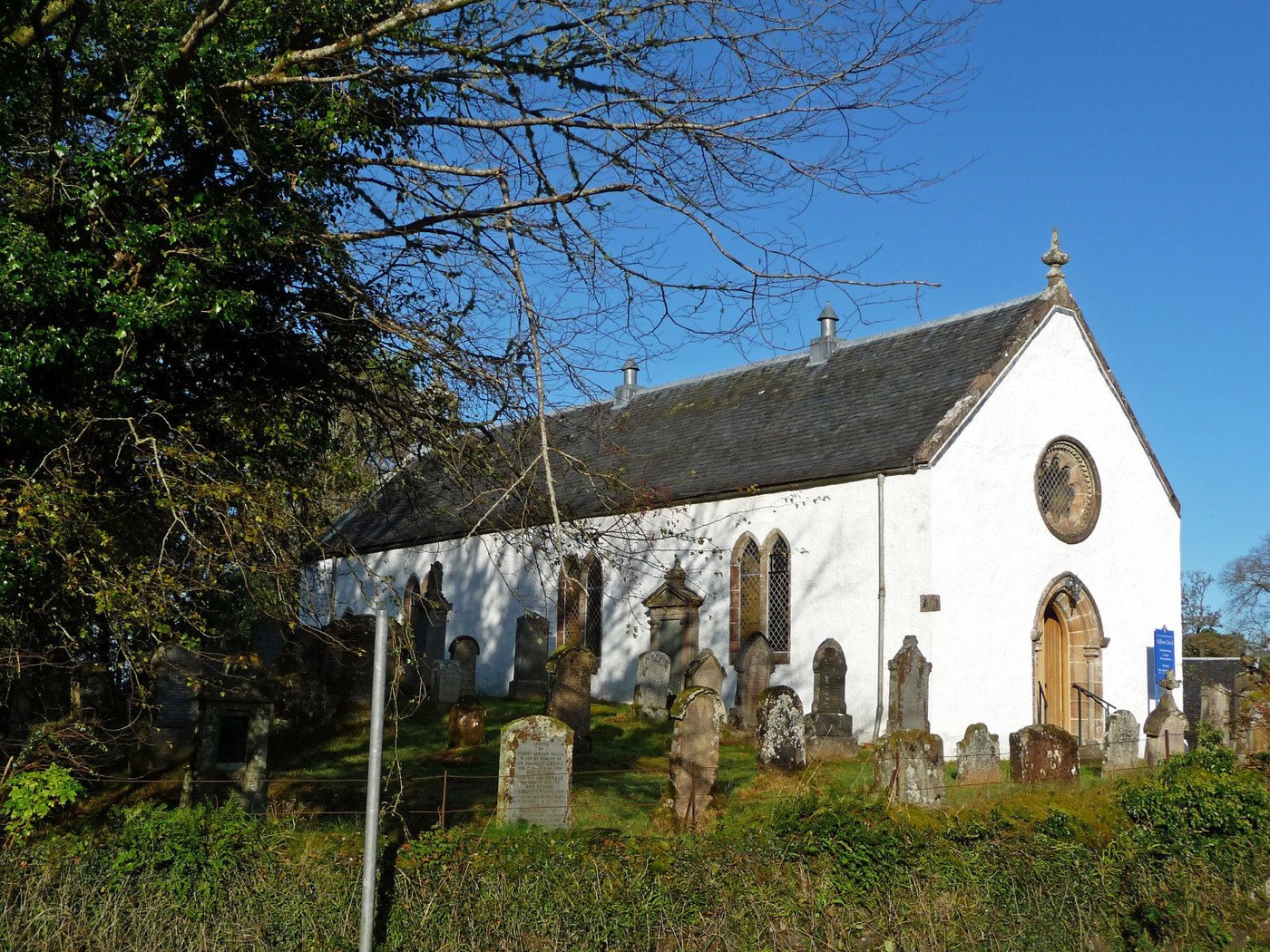
Kilfinan Parish Church, the church of the parish in which the MacEwens of Otter held their barony, with Castle MacEwen about two kilometres to the north-west. P
Kilfinan Parish Church, the church of the parish in which the MacEwens of Otter held their barony, with Castle MacEwen about two kilometres to the north-west. Photograph by Phil Champion, CC BY-SA 2.0.
Clan MacEwen of Otter · 38 pages

The full MacEwen surname report

That was one chapter. The report carries the rest: where the name comes from, the clan and its chiefs, heraldry, the stories, a timeline, migration, the name today, notable bearers, and a page on tracing your own line. Every claim sourced the same way as the chapter above.

Get my report · $14.99

Instant download, yours to keep and print

Read it. If it is not the best account of your name you have seen, reply to your receipt within 14 days and we refund you.

Not your name? Search yours, or read another name's free chapter.

The editions

Read it, watch it, or keep it on the shelf.

One piece of research, three more ways to have it. Every edition includes the MacEwen report itself.

Watch itin five days$39.99

The MacEwen report and a five and a half minute film of the name, your spelling on the title.

Get the film · $39.99
Keep itin two weeks$79

The MacEwen report as a hardback, posted free to your door.

Get the book · $79
All three Best valuesaves $19.99$99

The report, the film and the hardback. Bought apart they are $118.99.

Get all three · $99

For the wall. The MacEwen record on one framed sheet, 16 by 12 inches, $89 posted free. See the framed plate.

A gift? Send the MacEwen report on a day you choose, with a card.

The sources page, in fullWhere every claim on this page comes from.
Where the record is uncertainWhere two accounts of one fact disagree, as over the year Swene MacEwen died and so over how long the name went without a chief, both are printed with the name of whoever gives each.
  • R. S. T. MacEwen, Clan Ewen: Some Records of its History (Glasgow, 1904), the preface and pp. 6 to 38: the nine chiefs of Otter in the clan's own count, the charters of 1431 to 1432, the confirmations of 1493, 1513 and 1526, the proof of 1602, the Lennox, Glenboig, Galloway and Lochaber families, the oak-and-Reviresco seals, the 1847 Glasgow grant and the MacEwen tartan, Skye and the 1745 list, and its quotations of MacNicol and of the parish account of Castle MacEwen.
  • The Scots Peerage, ed. Sir James Balfour Paul, vol. I (Edinburgh, 1904), Campbell, Duke of Argyll, pp. 327 to 332: the forms Gillespic, Archibald and Celestin, the writ of 12 March 1439-40 naming the soul of Celestin, lately his son and heir, and the younger Archibald styled Celestin in 1452, ancestor of the old family of Otter.
  • Donald MacNicol, Remarks on Dr Samuel Johnson's Journey to the Hebrides (1779), pp. 245 to 246: the MacEwens' free lands in Lorn as bards to Argyll, Breadalbane and MacDougall of Dunollie in 1572, Airne and his son Neil, and Neil's elegy of 1630.
  • S. Innes and S. Reid, Expressions of faith: religious writing, in N. Royan (ed.), The International Companion to Scottish Literature 1400 to 1650 (Glasgow, 2018), pp. 60 to 78: Niall MacEoghain and the Gaelic catechism of about 1631, and Athairne's poems in the Book of the O'Conor Don.
  • Sir Bernard Burke, The General Armory of England, Scotland, Ireland and Wales (1884): the M'Ewan arms of Muckly, of Glenboig (1796) and of Glasgow (1847), and Reviresco in the motto index.
  • Fairbairn's Book of Crests of the Families of Great Britain and Ireland (1905), vol. I: William McEwan, M.P. for Central Edinburgh, and M'Ewan of Glasgow, the oak trunk and Reviresco, plate 145, crest 2; M'Ewan of Glenboig, Pervicax recte; and Euen, Ewan and Ewing listed with Buchanan under the motto Audaciter.
  • Henry Harrison, Surnames of the United Kingdom (1912 to 1918), under MacEwan, MacEwen, MacOwen and Owen; Patrick Woulfe, Irish Names and Surnames (1923), under Eoghan, Mac Eoghain and Mac Eoin.
  • George F. Black, The Surnames of Scotland (New York, 1946), s.v. MacEwan (archive.org scan, leaf 567, read 18 October 2026), for the Gaelic MacEoghainn and the MacEwens of 1174 and 1219.
  • Clan MacEwen Society, Progress of Chiefship (clanmacewen.com): the Lord Lyon's notices of February and October 2012, the 2014 commission, the gathering of 1 June 2019, the convention of 8 June 2024, the warrant of 20 March 2025, Swene's dates as 1429 to about 1460 and the figure of approximately 575 years; and the Society's history page, The Clan (clanmacewen.org), for Anrothan, Gillespie Campbell, 1493 and 1510.
  • Council of Scottish Clans and Associations, Lord Lyon Recognizes New Chief of the Name and Arms of MacEwen (cosca.scot, 24 March 2025), for the 2014 commission, the 2019 ratification, the 161 at the 2024 convention and the 575-year headline; and the Clan Carruthers Society (International), 26 March 2025, for the same headline.
  • Wikipedia, Clan Ewen of Otter and Clan MacEwen, citing Iain Moncreiffe of that Ilk, The Highland Clans (1967), pp. 99 to 100, for 1493 as the year of Swene's death and the badge as not derived from a chief's arms; Wikipedia, MS 1467, for the manuscript's shelfmark; Wikipedia, Duncan Campbell, 1st Lord Campbell, for Colin's earldom of 1457.
  • Wikipedia, Castle MacEwen, citing Dorothy N. Marshall, Excavations at Macewen's Castle, Argyll, in 1968-69, Glasgow Archaeological Journal 10 (1983); Wikipedia, Kilfinan and Otter Ferry, for the church, the Lamont aisle of 1633, the distances and the Gaelic oitir; Wikipedia, Marchmont House and McEwen baronets (citing Debrett's, 1990), for the creation of 1953 and the succession of 1983.
  • Wikipedia, William Macewen (for 1876, Erskine and Kingarth too), and Archives Hub, Papers of Sir William Macewen; Wikipedia, William McEwan and McEwan Hall, drawing on Ian Donnachie's entry in the Oxford Dictionary of National Biography (2004).
  • Wikipedia, George McEwen, citing the Parliament of Canada biography and the Canadian Parliamentary Guide (1903); Wikipedia, Grant MacEwan, for his Stirling grandfather and the spelling he chose; Wikipedia, John A. McEwen, citing the Republican Banner of 7 December 1858; C. J. Lloyd, McEwen, Sir John (1900-1980), Australian Dictionary of Biography, vol. 15 (2000).
  • National Records of Scotland, Most Common Surnames 2024 workbook; United States Census Bureau, surname files for the 2010 and 2020 censuses; National Archives of Ireland, Census of Ireland 1901 and 1911, surname search (exact match), for McEwen, McEwan, MacEwen, MacEwan and McKeown by county.
  • OpenStreetMap contributors (openstreetmap.org), Open Database Licence, for the coastline of the Cowal map.
  • Clan member crest badge illustration by the Wikimedia Commons contributor Celtus, used under CC BY-SA 3.0. Plate credits and licences are set out in assets_macewen/MANIFEST.md.

This history is written from public-domain sources and the family's own published records, every one of them listed. Where tradition and record disagree the text says so rather than choosing quietly. No image on this page is AI-generated.

First edition · last revised

More surname histories, free to read

Every surname we have written →