The Old Country
Cover of the Grant Surname Report
Free to read · Big or tall, from Norman French: Strathspey and Castle Grant, the glens by Loch Ness, the prisoners of 1746, Barbados, Grantown and Mathew Grant's New England line

GrantSurname meaning, origin and history

This report tells the story of the name Grant. It covers what the name means, when it was first written down, the families who carried it, and how it crossed the ocean.

Get my report · $14.99

43 pages, 22 named sources, in your inbox within a minute.

Read it. If it is not the best account of your name you have seen, reply to your receipt within 14 days and we refund you.

“I have been tracing my family tree for some time, but there were certain stories that even our closest relatives never knew about. This surname report is a true deep dive. Thank you.”Susan D., reader

Not today? Read the Grant chapter free. We will email it to you.Rather read it later? We will email you the Grant chapter.

One email: the link to this page and the free Clan Finder, eighteen clans and every surname recorded as belonging to them, on two printable pages. Nothing else unless you tick the box.

The Grant name at a glance

Meaning
Big or tall, from the Norman French graund
Kind of name
A nickname, for a big man or the elder of two
First written in Scotland
Laurence and Robert, "called Grant", witnesses to a deed of 1258
Homeland
Strathspey, with Glen Urquhart and Glenmoriston by Loch Ness
The chief's crest and motto
A burning hill, with the motto Stand fast
Main families
Freuchie, Glenmoriston, Corrimony, Rothiemurchus, Ballindalloch and Monymusk
United States today
139,862 people at the 2020 Census (196th)
Scotland today
406 register entries in 2025 (39th)
Chapter four, free to read in full

Strathspey and the glens by Loch Ness

The Grant country comes in two parts. The first is Strathspey, the broad valley of the River Spey in the north-east Highlands. The chiefs lived there, at Castle Grant, near the town of Grantown-on-Spey that their family built.

Up the valley stands a rocky hill called Craigellachie, by Aviemore. Fraser says there were two hills of that name, and that when the chief wanted the clan to gather, fires were lit on both. Hence the name he gives it, the "Rock of alarm".

Two countries: the River Spey for the chiefs, and the glens by Loch Ness for the men of 1746.

The second part lies to the west, on Loch Ness, south-west of Inverness. Glen Urquhart runs inland from Urquhart Castle on the loch shore. Glen Moriston meets the loch further south, at Invermoriston. Both came to the Grants in 1509.

These glens had Grants of their own: the Grants of Glenmoriston, and in Glen Urquhart the Grants of Corrimony and Sheuglie. They carry most of the story that follows. On the prisoners' roll of 1746, the homes printed for Grants are 46 Glenmoriston and 9 Glen Urquhart, out of 82 entries. Strathspey gives two.
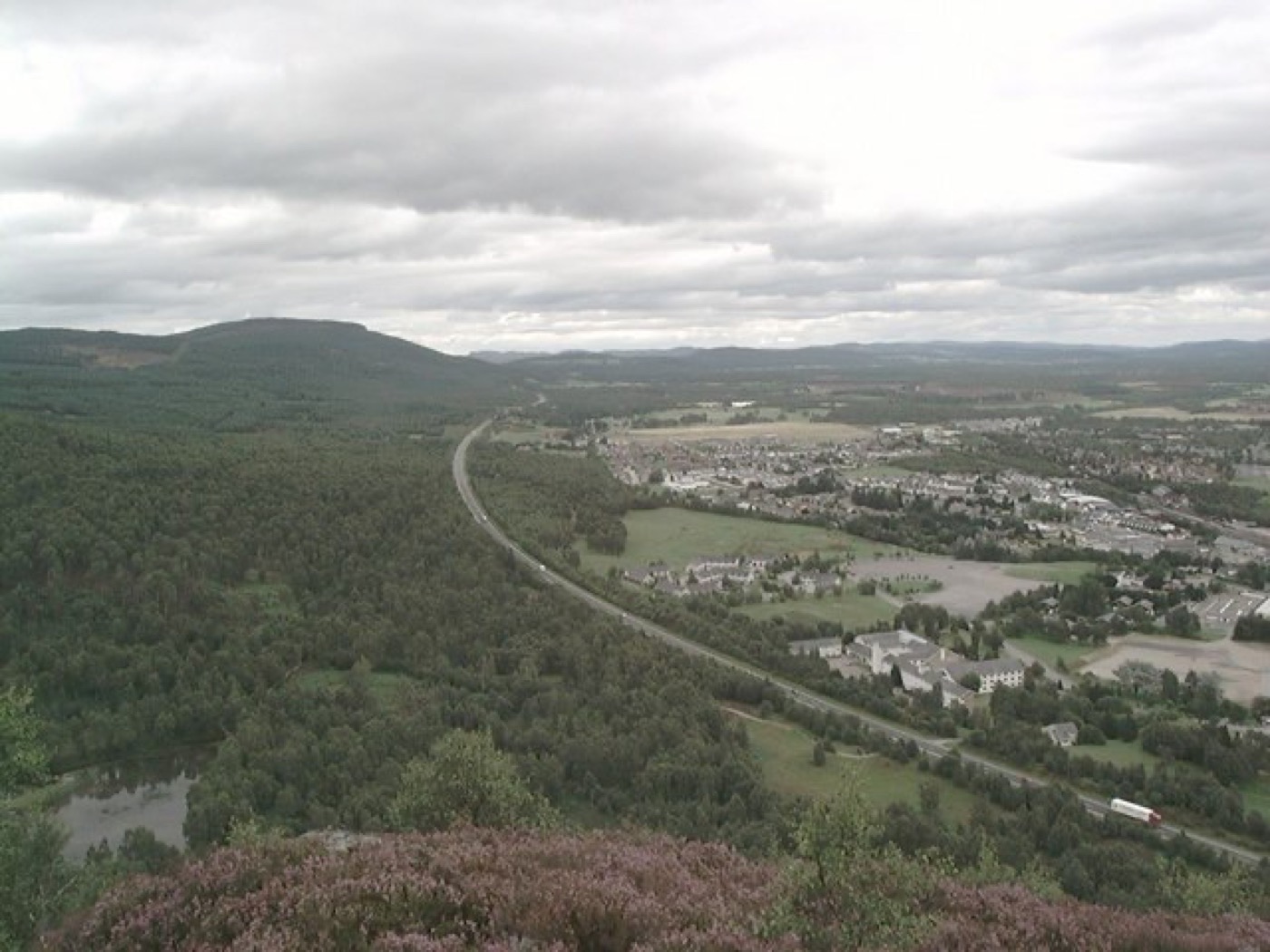
Aviemore seen from the hill of Craigellachie. Fraser writes of two Craigellachies, where fires were lit to gather the Grants, and calls the name "Rock of alarm"
Aviemore seen from the hill of Craigellachie. Fraser writes of two Craigellachies, where fires were lit to gather the Grants, and calls the name "Rock of alarm". Photograph by John G Burns, 2001, geograph.org.uk, used under CC BY-SA 2.0.
Big or tall, from Norman French: Strathspey and Castle Grant, the glens by Loch Ness, the prisoners of 1746, Barbados, Grantown and Mathew Grant's New England line · 43 pages

The full Grant surname report

That was one chapter. The report carries the rest: where the name comes from, the clan and its chiefs, heraldry, the stories, a timeline, migration, the name today, notable bearers, and a page on tracing your own line. Every claim sourced the same way as the chapter above.

Get my report · $14.99

Instant download, yours to keep and print

Read it. If it is not the best account of your name you have seen, reply to your receipt within 14 days and we refund you.

Not your name? Search yours, or read another name's free chapter.

The editions

Read it, watch it, or keep it on the shelf.

One piece of research, three more ways to have it. Every edition includes the Grant report itself.

Watch itin five days$39.99

The Grant report and a five and a half minute film of the name, your spelling on the title.

Get the film · $39.99
Keep itin two weeks$79

The Grant report as a hardback, posted free to your door.

Get the book · $79
All three Best valuesaves $19.99$99

The report, the film and the hardback. Bought apart they are $118.99.

Get all three · $99

For the wall. The Grant record on one framed sheet, 16 by 12 inches, $89 posted free. See the framed plate.

A gift? Send the Grant report on a day you choose, with a card.

The sources page, in fullWhere every claim on this page comes from.
Where the record is uncertainWhere tradition and record disagree in these pages, we have said so in the text rather than choosing quietly. Where one writer is the only authority for a statement, the report says whose it is. No commercial surname site was used.
  • The Oxford Dictionary of Family Names in Britain and Ireland, ed. Patrick Hanks and others (Oxford, 2016), s.v. Grant.
  • Dictionary of American Family Names, 2nd edition (Oxford, 2022), s.v. Grant.
  • Charles Wareing Bardsley, A Dictionary of English and Welsh Surnames (London, 1901), s.v. Grant.
  • George Fraser Black, The Surnames of Scotland (New York, 1946), pp. 324 and 325, and s.v. Bowie, Chiaran and Grantham.
  • Sir William Fraser, The Chiefs of Grant (Edinburgh, 1883), vol. 1, pp. 1 to 14, xxi, xc and xci, 447 to 449; vol. 2, pp. 266 and 267.
  • Registrum Episcopatus Moraviensis (Bannatyne Club, Edinburgh, 1837), pp. 134 and 135, for the deed of 1258.
  • Frank Adam, The Clans, Septs and Regiments of the Scottish Highlands (Edinburgh, 1908), pp. 53 to 55, 135 and 136.
  • Sir Bruce Gordon Seton and Jean Gordon Arnot, The Prisoners of the '45, Scottish History Society, 3 vols (Edinburgh, 1928 and 1929), vol. 1, pp. 25 to 27, 45, 263 to 266, 313; vol. 2, pp. 248 to 265.
  • Robert Forbes, The Lyon in Mourning, ed. Henry Paton, Scottish History Society, 3 vols (Edinburgh, 1895 and 1896), vol. 1, pp. 343 and 344; vol. 3, pp. 6, 7, 103 to 111, 152, 202.
  • William Mackay, Urquhart and Glenmoriston, Olden Times in a Highland Parish (Inverness, 1893), pp. 280 to 290.
  • Personal Memoirs of U. S. Grant, vol. 1 (New York, 1885), chapter 1.
  • Dictionary of National Biography, vol. 22 (London, 1890), and its 1901 supplement; Oxford Dictionary of National Biography; Dictionary of Canadian Biography, vols 8 and 13.
  • Miller Center, University of Virginia, and the National Park Service, on Ulysses S. Grant.
  • Sir Bernard Burke, The General Armory (London, 1884), pp. 419 to 421 and 750.
  • James Fairbairn, Fairbairn's Book of Crests, 4th edition (Edinburgh, 1905), pp. 237 and 238, plate 179.
  • Sir James Balfour Paul, An Ordinary of Arms (Edinburgh, 1903), pp. 116 and 117.
  • Scottish Register of Tartans; Standing Council of Scottish Chiefs, list of chiefs, October 2026.
  • United States Census Bureau, surname files for 2000, 2010 and 2020; Heads of Families at the First Census of the United States, 1790 (Washington, 1907 and 1908).
  • National Archives of Ireland, Census of Ireland 1901 and 1911.
  • Patrick Woulfe, Irish Names and Surnames (Sloinnte Gaedheal is Gall, Dublin, 1923), pp. 58 and 84.
  • National Records of Scotland, Most Common Surnames, 1975 to 2025.
  • Clan member crest badge illustration by the Wikimedia Commons contributor Celtus, used under CC BY-SA 3.0.

This history is written from public-domain sources and the family's own published records, every one of them listed. Where tradition and record disagree the text says so rather than choosing quietly. No image on this page is AI-generated.

First edition · last revised

More surname histories, free to read

Every surname we have written →