The Old Country
Cover of the Hay Surname Report
Free to read · The hedge in three countries: the cupbearer's house of Erroll and its cadets, the English local name, and the two Irish names in one sound

HaySurname meaning, origin and history

This report is about one short surname that three different kinds of family carried at once, and that is easy to take for one. Hay is the Norman-French and English word for a hedge or an enclosure, and Bardsley, whose dictionary of English and Welsh surnames appeared in 1901, files Hay, Heys and Hayes together as a local name, at the hay. In Scotland that word became the name of a great house: William de Haya, the cupbearer of King Malcolm IV, is the first of the surname in Scottish record after 1160, and from him came the Hays of Erroll, Constables of Scotland by a charter of 1314 and Earls of Erroll from 1452, with cadet lines at Yester, Leys and Megginch, Kinnoull, Delgatie and elsewhere. In England the same word was taken up wherever there was a hedge, and the Hundred Rolls of 1273 and the poll tax of 1379 hold Hays in Norfolk, Lincolnshire and Yorkshire who had nothing to do with Erroll. In Ireland two names sit inside one sound: the Norman-Irish de Hae and the Gaelic O hAodha, which became Hayes in the south and O'Hea in Cork.

Get my report · $14.99

41 pages, 23 named sources, in your inbox within a minute.

Read it. If it is not the best account of your name you have seen, reply to your receipt within 14 days and we refund you.

“I have been tracing my family tree for some time, but there were certain stories that even our closest relatives never knew about. This surname report is a true deep dive. Thank you.”Susan D., reader

Not today? Read the Hay chapter free. We will email it to you.Rather read it later? We will email you the Hay chapter.

One email: the link to this page and the free Clan Finder, eighteen clans and every surname recorded as belonging to them, on two printable pages. Nothing else unless you tick the box.

The Hay name at a glance

Meaning
The hedge or enclosure: Bardsley's local name at the hay; in Scotland the French de la Haye and the Latin de Haya of the charters.
Earliest records
After 1160: William de Haya witnesses charters of Malcolm IV, styled pincerna, cupbearer; he had Erroll by charter between 1178 and 1182. In England, Everard de la Heye in Norfolk, 1273.
The Constable
12 November 1314: Robert I confers the office of Constable of Scotland on Gilbert de Haya and his heirs at Cambuskenneth; Gilbert seals the Arbroath letter of 6 April 1320.
The earldom
1452: William Hay of Erroll is made Earl of Erroll. The chief of the name on the Standing Council's list is The Earl of Erroll.
Three streams
The Scottish house and its cadets; the English local name of the hedge; in Ireland the Norman de Hae and the Gaelic O hAodha. No authority printed here makes them one.
Spellings
Hay, Haye, de la Haye and de Haya are one name; Hays is routed with a caveat; Hayes is mostly another name and is not routed; Hey, Haigh, Hague, Haig and O'Hea are different names.
Scotland today
204 register entries in 2025, joint 97th; 342 in 1975, 88th.
United States today
Hay 17,186 at the 2020 Census, ranking 2,055th; Hays 33,013; Hayes 186,445, ranking 133rd.
Chapter four, free to read in full

The Carse of Gowrie, Slains and Yester

The Hay country begins on the north bank of the Tay. Erroll is in the Carse of Gowrie, the flat land between Perth and Dundee, and the charter of 1178 to 1182 made it a barony; the roll of 1296 still finds a Hay parson in the church of Erroll and Hays holding of the king in the county of Perth. The Peerage puts Leys and Megginch in the same Carse, Hay lands by 1251 and 1491, and Kinnoull, the hill across the river from Perth, gave its name to George Hay's earldom in 1633. Pitmilly, which Eva brought to the cupbearer, is in Fife, and the roll of 1296 holds three Hays of Fife and one of Forfar. The family's own tale puts the beginning further up the Tay, at Luncarty north of Perth, where Boece set the battle, and runs the falcon's flight down the Carse to a stone four miles from Dundee that Bellenden says was still called the Falcon Stane.

Erroll in the Carse, Slains on the Buchan cliffs, Yester under the Lammermuirs: three countries of one house, and none of them the hedges of Norfolk.

The second country is the Buchan coast. The Constable's charter of 1314 carried the lands of Slains in Aberdeenshire with the office, and a charter of 1376-77 recites that Robert I had given the late Gilbert de Haya three hundred pounds of land there. Old Slains stood on its cliff south of Cruden Bay until October 1594, when the king came to Aberdeen and, in the court clerk Moysie's words, the houses of Strathbogie and Slains were destroyed and demolished, the King riding there to that effect in proper person. The earls built again at Bowness, and the ninth Earl died at Slains in 1631. Delgatie, the tower house of the Hays of Delgatie, stands at Turriff in the same county.

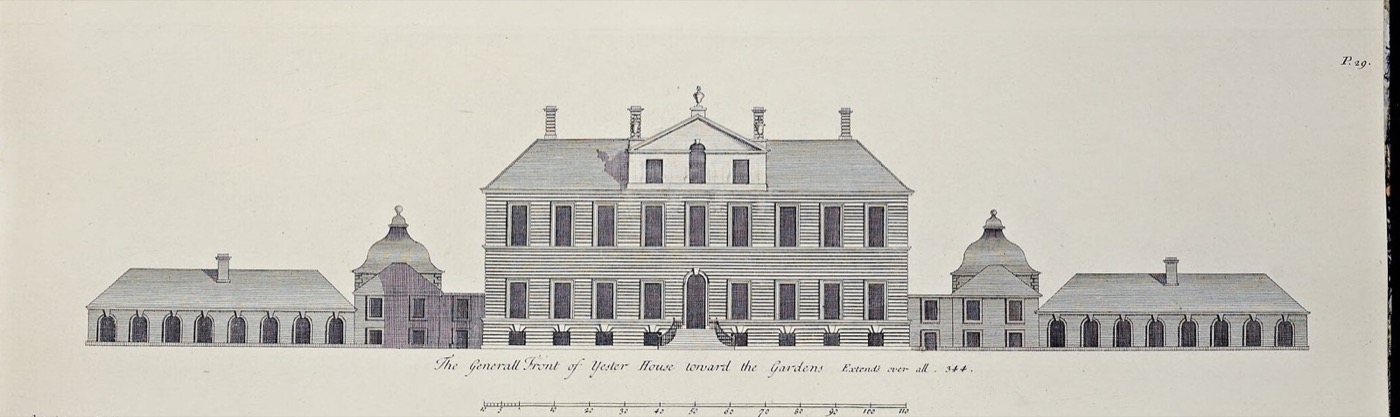
The third country is Lothian. The Hays of Yester held Locherworth, now Borthwick, in Midlothian from 1263, and Yester near Gifford in East Lothian from the marriage of 1399; Yester House, drawn by William Adam for Vitruvius Scoticus, is the seat the Marquesses of Tweeddale built there. Linplum, where Bishop George Hay's forebears sat, is in the same county. Outside Scotland the name's places are the hedges of Bardsley's record, Norfolk, Lincolnshire and the West Riding, and Hay-on-Wye in Wales, which is the Latin haia, a hedge, with its own Welsh name Y Gelli Gandryll, and is named for no Hay.
The garden front of Yester House in East Lothian, the seat of the Hays of Yester and Marquesses of Tweeddale, drawn by William Adam and engraved for Vitruvius S
The garden front of Yester House in East Lothian, the seat of the Hays of Yester and Marquesses of Tweeddale, drawn by William Adam and engraved for Vitruvius Scoticus. Getty Research Institute scan, via Wikimedia Commons; public domain.
The hedge in three countries: the cupbearer's house of Erroll and its cadets, the English local name, and the two Irish names in one sound · 41 pages

The full Hay surname report

That was one chapter. The report carries the rest: where the name comes from, the clan and its chiefs, heraldry, the stories, a timeline, migration, the name today, notable bearers, and a page on tracing your own line. Every claim sourced the same way as the chapter above.

Get my report · $14.99

Instant download, yours to keep and print

Read it. If it is not the best account of your name you have seen, reply to your receipt within 14 days and we refund you.

Not your name? Search yours, or read another name's free chapter.

The editions

Read it, watch it, or keep it on the shelf.

One piece of research, three more ways to have it. Every edition includes the Hay report itself.

Watch itin five days$39.99

The Hay report and a five and a half minute film of the name, your spelling on the title.

Get the film · $39.99
Keep itin two weeks$79

The Hay report as a hardback, posted free to your door.

Get the book · $79
All three Best valuesaves $19.99$99

The report, the film and the hardback. Bought apart they are $118.99.

Get all three · $99

For the wall. The Hay record on one framed sheet, 16 by 12 inches, $89 posted free. See the framed plate.

A gift? Send the Hay report on a day you choose, with a card.

The sources page, in fullWhere every claim on this page comes from.
Where the record is uncertainWhere this report cites an early record it cites the edition that prints it: the cupbearer's charters through the Scone and Dunfermline registers and the Scots Peerage, the roll of 1296 through the Bannatyne Club's Instrumenta Publica, the Constable's charter through the Spalding Miscellany, the sentence of 1650 through Balfour and Nicoll. Where one writer is the only authority for a statement, the report says whose it is. No commercial surname site was used as corroboration.
  • C. W. Bardsley, A Dictionary of English and Welsh Surnames (1901), s.v. Hay and Hey; H. Harrison, Surnames of the United Kingdom (1912-18), the root of Hay; G. F. Black, The Surnames of Scotland (1946); P. H. Reaney and R. M. Wilson, A Dictionary of English Surnames (1995)
  • Sir James Balfour Paul (ed.), The Scots Peerage, vol. 3 (Edinburgh, 1906), Hay, Earl of Erroll, pp. 555-587; vol. 5 (1908), Hay, Earl of Kinnoull, pp. 217-223; vol. 8 (1911), Hay, Marquess of Tweeddale, pp. 416-430
  • Patrick Woulfe, Irish Names and Surnames (1923), s.v. de Hae and O hAodha; E. MacLysaght, The Surnames of Ireland (1985)
  • Liber Ecclesie de Scon (Bannatyne Club, 1843), no. 15; Registrum de Dunfermelyn (Bannatyne Club, 1842); Archibald Lawrie, Early Scottish Charters prior to A.D. 1153 (1905)
  • Instrumenta Publica sive Processus super Fidelitatibus et Homagiis Scotorum (Bannatyne Club, 1834), the roll of 1296, pp. 119-164 and index; Joseph Bain (ed.), Calendar of Documents relating to Scotland, vol. 2 (1884), nos. 781, 832, 1738, 1787
  • The Miscellany of the Spalding Club, vol. 2 (Aberdeen, 1842), the Erroll charters, no. I, p. 211; National Records of Scotland, transcription and translation of the Declaration of Arbroath, SP13/7
  • Hector Boece, The History and Chronicles of Scotland, translated by John Bellenden (1536), reprint (Edinburgh, 1821), vol. 2, pp. 216-220; Alexander Nisbet, A System of Heraldry (1722), vol. 1, pp. 181-182
  • John of Fordun, Chronicle of the Scottish Nation, ed. W. F. Skene (1872), pp. 165-168 and 335; Andrew of Wyntoun, The Orygynale Cronykil of Scotland, ed. Laing, vol. 2 (1872), pp. 93-94; Walter Bower, Scotichronicon, ed. Goodall (1759), vol. 2, pp. 99-100
  • David Moysie, Memoirs of the Affairs of Scotland 1577-1603 (Bannatyne Club, 1830), pp. 76, 119-120
  • Sir James Balfour, Historical Works, vol. 4, Annales (Edinburgh, 1824), pp. 36-37, 44; John Nicoll, A Diary of Public Transactions 1650-1667 (Bannatyne Club, 1836), pp. 15, 331-332
  • W. R. Macdonald, Scottish Armorial Seals (1904), nos. 1266-1279; Burke, The General Armory (1884), pp. 470-472; Fairbairn's Book of Crests (1905), vol. 1, pp. 188, 265-266, 321, 561
  • Standing Council of Scottish Chiefs, members; Scottish Register of Tartans, refs 1631, 1635 and 6021; Clan Hay Society, Septs; Frank Adam, The Clans, Septs and Regiments of the Scottish Highlands (1908)
  • Dictionary of National Biography, vol. 25 (1891), the Hay entries, pp. 250-278; Oxford DNB (2004), Hay family; PoMS no. 12057; Dictionary of Canadian Biography; Australian Dictionary of Biography, vols 1 and 4; Handbook of Texas Online; G. H. Scholefield (ed.), A Dictionary of New Zealand Biography (1940), vol. 1, p. 202
  • William Roscoe Thayer, The Life and Letters of John Hay (Boston, 1915), vol. 1, pp. 2-5, vol. 2, p. 408; Encyclopaedia Britannica, 11th edition (1911), vol. 13, p. 105
  • Charles Richard Williams, The Life of Rutherford Birchard Hayes (1914), vol. 1, pp. 1-3; The Life, Public Services and Select Speeches of Rutherford B. Hayes (1876); Will H. Hays, The Memoirs of Will H. Hays (1955), pp. 7-8; New York Times, 8 March 1954
  • Voltaire, Precis du siecle de Louis XV, chapter 15; Dictionary of Canadian Biography, Hay, Lord Charles, citing Hay to the Marquess of Tweeddale, 20 May 1745
  • John Camden Hotten, The Original Lists of Persons of Quality, 1600-1700 (London, 1874), pp. 160, 296-297; George Hill, An Historical Account of the Plantation in Ulster (1877); C. K. Bolton, Scotch Irish Pioneers in Ulster and America (1910), pp. 272, 324-330, 335; George Patterson, A History of the County of Pictou (1877), Appendices A and C
  • Hay Shire Council, Where we came from; Kansas Historical Society, Kansapedia, Fort Hays; Handbook of Texas Online, Hays County; Royal Commission on the Ancient and Historical Monuments of Wales, List of Historic Place Names, Hay-on-Wye / Y Gelli Gandryll
  • Heads of Families at the First Census of the United States taken in the Year 1790 (Bureau of the Census, 1907-08), the state indexes
  • National Records of Scotland, Most Common Surnames, 2025; United States Census Bureau surname files, 2000, 2010 and 2020; National Archives of Ireland, Census of Ireland 1901 and 1911, exact surname search
  • The arms of Hay, Earl of Erroll, engraved for The Scots Peerage, vol. 3 (1906), public domain.
  • Photograph: August Schwerdfeger (Delgatie Castle), 2017, CC BY 4.0, Wikimedia Commons
  • Map coastlines: Natural Earth, public domain.

This history is written from public-domain sources and the family's own published records, every one of them listed. Where tradition and record disagree the text says so rather than choosing quietly. No image on this page is AI-generated.

First edition · last revised

More surname histories, free to read

Every surname we have written →