The Old Country
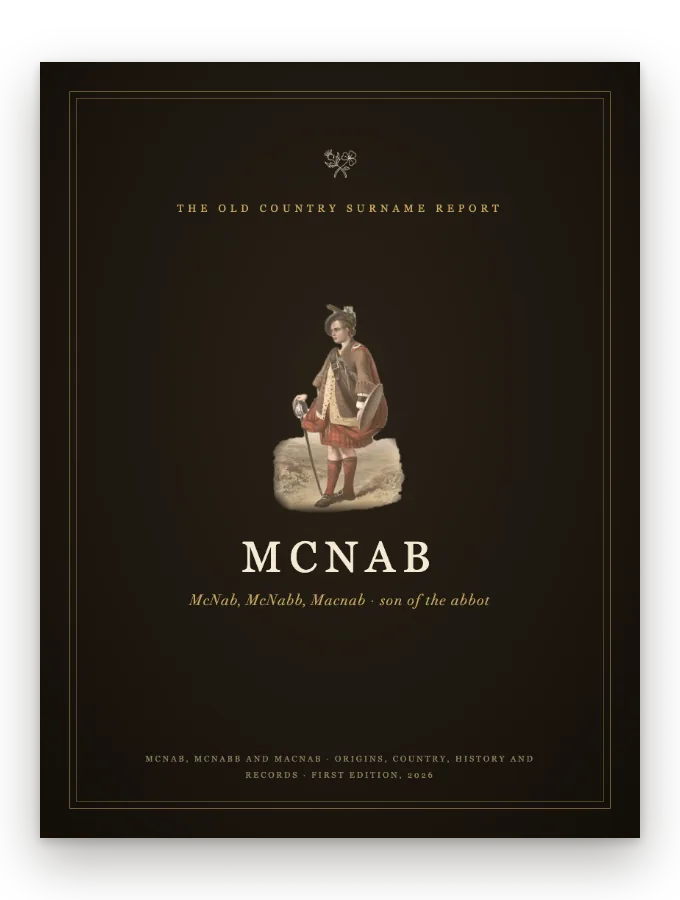
Cover of the McNab Surname Report
Free to read · Mac an Aba, son of the abbot: the Macnabs of Glen Dochart and Killin, McNabb in Ulster and America

McNabSurname meaning, origin and history

McNab and McNabb are one name, and this book covers both. It is the Gaelic Mac an Aba, son of the abbot.

This report tells the story of the name McNab, and of McNabb with two b's: what it means, the glen it came from, the people who carried it, and how it crossed to Ulster, Canada, America and New Zealand.

Get my report · $14.99

40 pages, 20 named sources, in your inbox within a minute.

Read it. If it is not the best account of your name you have seen, reply to your receipt within 14 days and we refund you.

“I have been tracing my family tree for some time, but there were certain stories that even our closest relatives never knew about. This surname report is a true deep dive. Thank you.”Susan D., reader

Not today? Read the McNab chapter free. We will email it to you.Rather read it later? We will email you the McNab chapter.

One email: the link to this page and the free Clan Finder, eighteen clans and every surname recorded as belonging to them, on two printable pages. Nothing else unless you tick the box.

The McNab name at a glance

Meaning
Son of the abbot: Gaelic Mac an Aba
Kind of name
A patronymic: a name made from a forefather's title
Homeland
Glen Dochart and Killin, at the west end of Loch Tay
Oldest deed read
1486, Killin: Patrick Maknab of Bovain to his son Finlay
The abbots
Lay abbots of Glendochart, named in a law of William the Lion
The spelling
One name: Scotland writes McNab, Ireland and America McNabb
Chief
The Standing Council of Scottish Chiefs lists a Chief of Macnab
Ireland, 1901
261 with a double b, 73 with one; 80 per cent in Ulster
United States, 2020
McNabb 9,430 people; McNab 1,662; MacNab 424
Scotland, 2025
Mcnab 43 register entries, Macnab 16; McNabb under 10
Chapter four, free to read in full

Glen Dochart and Killin

Glen Dochart is a long Highland glen in west Perthshire. The River Dochart runs east through it from Loch Dochart, near Crianlarich, to Killin, a village at the west end of Loch Tay. At Killin the river breaks over the Falls of Dochart and runs past Inchbuie, a small island that is the Macnabs' burial ground.

The Macnab lands lay along the glen. The charter of 1486 names Bovain, Ardkelze-Estir and Doinch, in the barony of Glendochart. Bovain survives as the name of a wood by Ardchyle, and Ardkelze is Ardchyle itself, a hamlet about four miles west of Killin. Finlay Maknab added Yhewire and Lerakene in 1502-03, as the register writes the year.

Glen Dochart runs down to Killin, and the Macnabs are buried on an island in its river.

Finlarig Castle stands just north of Killin. It belonged to the Campbells of Glenorchy, the family that took the superiority of the Macnab lands. In 1654 its governor received General Monck's order about the Macnab widow, which is the story told later in this book.

Further west, past Crianlarich and near Tyndrum, is Dalrigh, the king's field, where tradition sets the Macnabs against Robert the Bruce. South over the hills from Loch Tay lies Loch Earn, and on it the small island where the story of the boat ends.
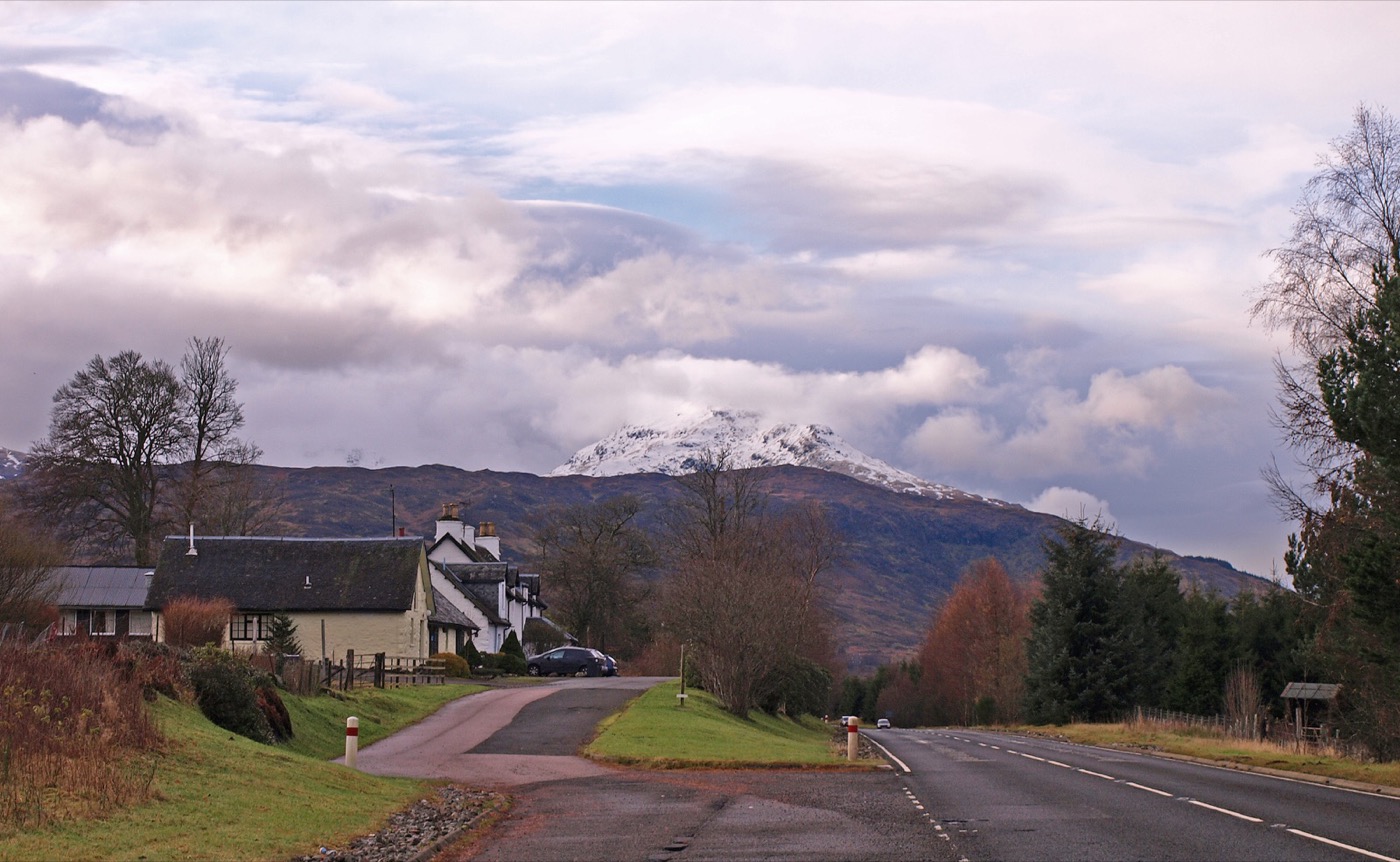
Glen Dochart, the glen of the Macnab lands, looking west in November 2010. Photograph by wfmillar, geograph.org.uk, via Wikimedia Commons; CC BY-SA 2.0.
Mac an Aba, son of the abbot: the Macnabs of Glen Dochart and Killin, McNabb in Ulster and America · 40 pages

The full McNab surname report

That was one chapter. The report carries the rest: where the name comes from, the clan and its chiefs, heraldry, the stories, a timeline, migration, the name today, notable bearers, and a page on tracing your own line. Every claim sourced the same way as the chapter above.

Get my report · $14.99

Instant download, yours to keep and print

Read it. If it is not the best account of your name you have seen, reply to your receipt within 14 days and we refund you.

Not your name? Search yours, or read another name's free chapter.

The editions

Read it, watch it, or keep it on the shelf.

One piece of research, three more ways to have it. Every edition includes the McNab report itself.

Watch itin five days$39.99

The McNab report and a five and a half minute film of the name, your spelling on the title.

Get the film · $39.99
Keep itin two weeks$79

The McNab report as a hardback, posted free to your door.

Get the book · $79
All three Best valuesaves $19.99$99

The report, the film and the hardback. Bought apart they are $118.99.

Get all three · $99

For the wall. The McNab record on one framed sheet, 16 by 12 inches, $89 posted free. See the framed plate.

A gift? Send the McNab report on a day you choose, with a card.

The sources page, in fullWhere every claim on this page comes from.
Where the record is uncertainWhere tradition and record disagree, the text says so. Where one writer is the only authority, the report names them. No commercial surname site was used.
  • Henry Harrison, Surnames of the United Kingdom (London, 1912 to 1918), s.v. Mac Nab and Nabb.
  • Patrick Woulfe, Irish Names and Surnames (Dublin, 1923), the Irish-to-English list, p. 61.
  • William Forbes Skene, Celtic Scotland (Edinburgh, 1877), vol. 2, pp. 406 to 407, for the law of William the Lion (as printed in the Acts of the Parliaments of Scotland, vol. 1, p. 50), the lay abbots of Glendochart, the men of 1296 and the keepers of St Fillan's relics.
  • The Highlanders of Scotland, by William F. Skene (London, 1837), vol. 2, pp. 260 to 262, for the bond of 1606, the Bruce tradition and the line of the chiefs.
  • The Register of the Great Seal of Scotland (Registrum Magni Sigilli Regum Scotorum), vol. 2, nos. 1668, 2683 and 3646.
  • The New Statistical Account of Scotland, vol. 10, Perth (Edinburgh, 1845): Killin, by the Rev. Alexander Stewart, pp. 1085 to 1089, with the family manuscript, General Monck's order of 1654 and the Black Book of Taymouth as he quotes them; and Comrie, by the Rev. William Mackenzie.
  • Dictionary of Canadian Biography (Toronto), McNab, Archibald, by Alan Cameron and Julian Gwyn (vol. 8, 1985); MacNab, Sir Allan Napier; McNabb, Colin; McNabb, James; Braden, Mary Ellen (Macnab).
  • Dictionary of National Biography, vol. 35 (London, 1893), entries for Allan Napier MacNab, Henry Gray MacNab and William Ramsay McNab.
  • An Encyclopaedia of New Zealand (Wellington, 1966), entries for Alexander McNab and Robert McNab.
  • Sir Bernard Burke, The General Armory of England, Scotland, Ireland, and Wales (London, 1884), s.v. M'Nab.
  • Fairbairn's Book of Crests of the Families of Great Britain and Ireland (4th edition, London, 1905), vol. 1, s.v. M'Nab.
  • Frank Adam, The Clans, Septs and Regiments of the Scottish Highlands (Edinburgh, 1908), the Macnab septs.
  • James Logan, The Clans of the Scottish Highlands (London, 1845), with plates by R. R. McIan, for the Macnab arms.
  • The Standing Council of Scottish Chiefs, list of members (clanchiefs.org.uk), read 7 November 2026.
  • US Census Bureau, Frequently Occurring Surnames from the 2010 Census, and the 2020 Census surname file.
  • National Records of Scotland, Most Common Surnames, 2025, time series 1975 to 2025; Open Government Licence.
  • National Archives of Ireland, Census of Ireland 1901 and 1911, counts by surname and county.
  • Map: positions of places, rivers, roads and council boundaries from OpenStreetMap (OpenStreetMap contributors, Open Database Licence), read 7 and 16 November 2026; land from Natural Earth (public domain); hill shading from SRTM elevation, in Terrarium tiles (AWS Open Data).
  • Pictures: each plate names its painter or photographer, its collection and its licence in its own caption. Raeburn's portrait and the paintings by Percy and Cranstoun are public domain; the photographs are Creative Commons or public domain, as each caption says.
  • Cover: "MacNab", a clansman painted by R. R. McIan for James Logan's The Clans of the Scottish Highlands (London, 1845); public domain. It is a picture of a clansman of the name, not a coat of arms.

This history is written from public-domain sources and the family's own published records, every one of them listed. Where tradition and record disagree the text says so rather than choosing quietly. No image on this page is AI-generated.

First edition · last revised

More surname histories, free to read

Every surname we have written →