 The Old Country
The Old Country
The Old Country
This report tells the story of a name that belongs to a trade and to every corner of the German-speaking world at once, and it begins by saying plainly what most books about the name will not. Miller in America is two names wearing one spelling. One of them is the native English and Scots name for the man who ran the mill, and it came over with English and Ulster families. The other is Müller, the same word in German, the commonest surname in Germany, carried across the Atlantic by families from the Palatinate, from Württemberg, from Hesse, from Bavaria, from Baden, from Switzerland and from the Low German coast, and written Miller by an English-speaking clerk or by the family itself once the children were at an American school. This report is about the second of those two names, and it shows you how the record tells them apart.
Before it was a surname the word was a job, and the job was the most important machine a German village owned. A mill was capital: a weir, a race, a wheel, a pair of stones and a building, more than any one household could raise on its own, so the mill usually belonged to the lord or the town and the miller held it. He was not a peasant and he was not a burgher. He handled everybody's grain, took his share of it in kind, and was therefore watched: the measure he used, the fee he kept, the hours he ground. Out of that ordinary suspicion came centuries of jokes about millers, and out of the job itself came the name that a million Americans now carry.
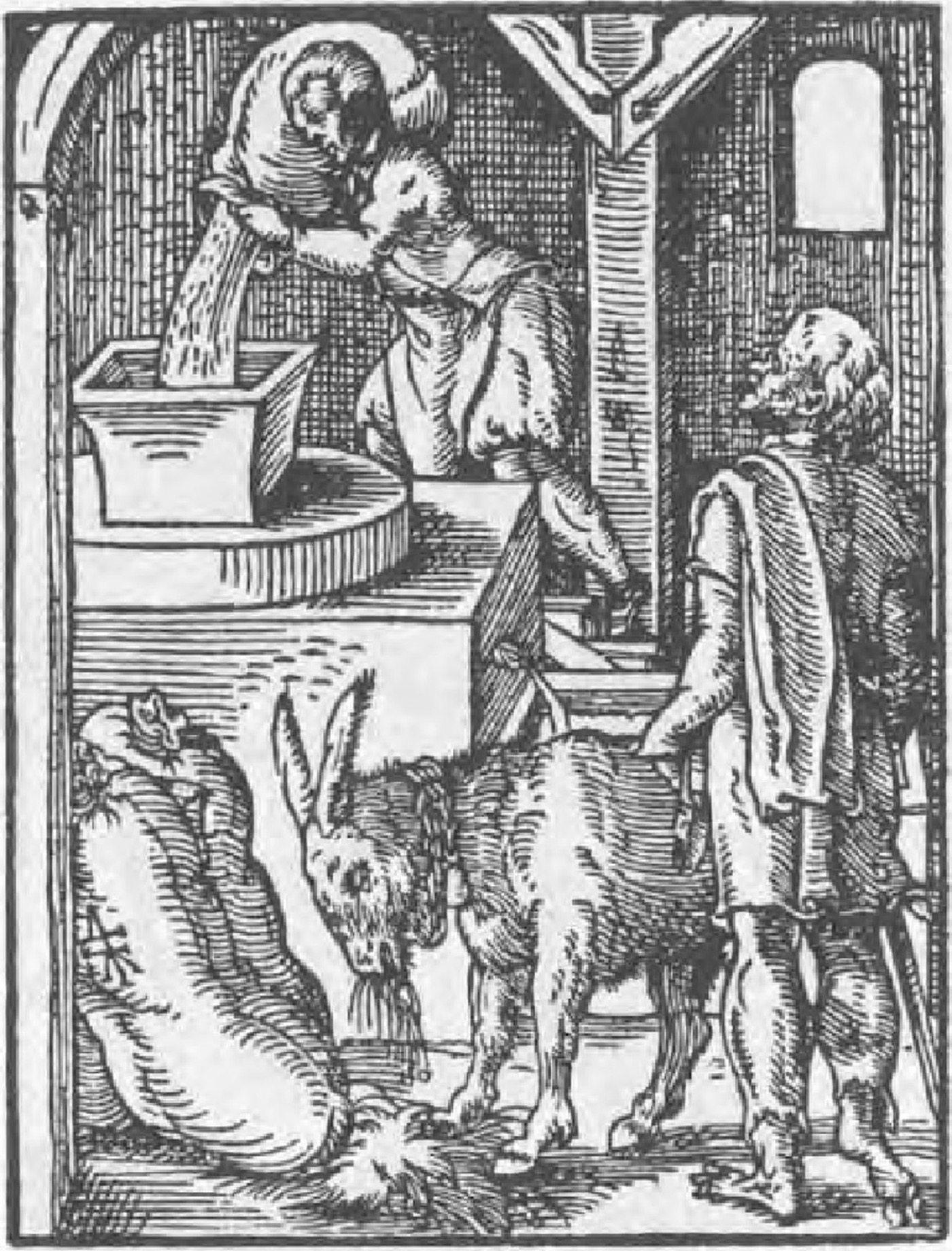
The picture on the facing page is the one the sixteenth century drew of him. In 1568 the Frankfurt printer Sigmund Feyerabend published a book of trades with woodcuts by Jost Amman and verses by Hans Sachs, and the plate for the miller, headed Molitor, Der Müller, is six centimetres by eight. It shows the whole business at once: the miller at the top emptying a sack into the hopper, the stones and their casing below him, a customer at the door with his own sack across his shoulder, and the donkey that carried the grain in and the meal out. Nothing in it is grand. Everything in it is the reason the name exists.
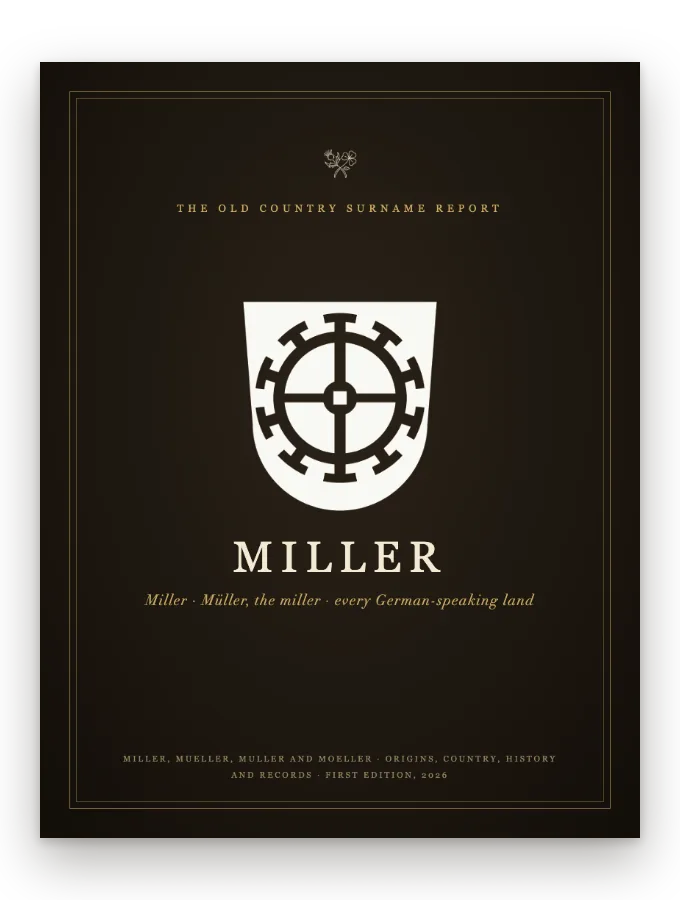
The mill also gave the village its shape and often its name, and both are still on the map. Mühlheim an der Donau, in the Tuttlingen country of Swabia, took its name from the mills that stood at its karst springs, and put a four-spoked mill wheel on its seal by 1266; that wheel is still the town's arms and it is the device on this report's cover. Hundreds of German places carry the same syllable, Mühlhausen, Mühlacker, Mühlheim, Mühlberg, and behind each of them stood a building with a wheel in the water and a man inside called, by everybody who brought him grain, the Müller.
That was one chapter. The report carries the rest: where the name comes from, the region and its records, arms, seals and marks, the stories, a timeline, migration, the name today, notable bearers, and a page on tracing your own line. Every claim sourced the same way as the chapter above.
Get the Miller report$14.99 · instant download, yours to keep and print
Not your name? Search yours, or read how we work, with another full chapter.
Also as a film, $39.99, a printed book, $59, or all three, $79, with Miller on the title.
Buying it for someone? Send it on a day you choose, with a card.
This history is written by AI from public-domain sources and the family's own published records, every one of them listed above. Where tradition and record disagree the text says so rather than choosing quietly. No image on this page is AI-generated.
First edition · last revised