 The Old Country
The Old Country
The Old Country
This report tells the story of a surname that began as a job with horses. Keith is taken from the lands of Keith in the parish of Humbie in East Lothian, and the family who took the name from those lands held, with them, the office of marischal to the kings of Scots. The Scots Peerage, the standard printed authority on the Scottish nobility, glosses that office in four blunt words when it opens its Keith article: marischal, or farrier. The word is the same as the English marshal, and it began as a name for the man who looked after the king's horses. It ended as one of the great hereditary offices of the kingdom, and the family rose with it.
The name has two countries and the record is clear about which came first. East Lothian is low, dry, farmed ground on the south shore of the Forth, and the barony of Keith sits inland from it in the parish of Humbie, where the land begins to rise toward the Lammermuirs. Keith Water runs down off those hills into the Tyne. Keith Marischal, the house, stands about a mile north north west of Humbie village: an L-shaped tower that was already old when it was enlarged into a courtyard house before 1589, and that was filled in and given its present face in the nineteenth century. It is the ground the surname is made of, and after 1324 the family scarcely lived on it.
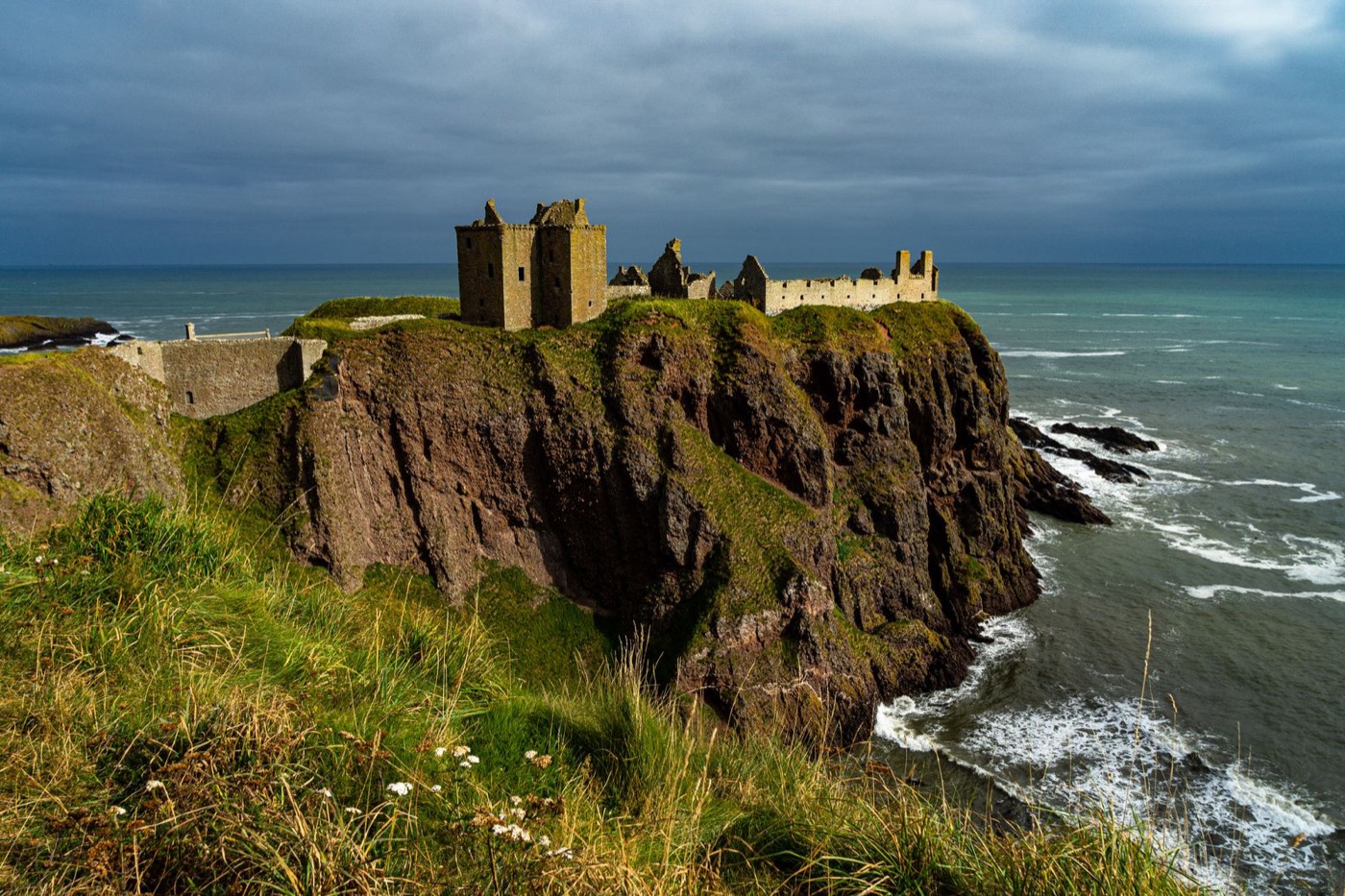
The country they moved to is harder. Kincardineshire, the Mearns, is a coastal shelf of red cliff and thin field between the Grampians and the North Sea, and Dunnottar Castle sits on a stack of it south of Stonehaven, cut off from the land on three sides and reached by a path down and up again. North of that, in Buchan, the Keiths held Inverugie on the river Ugie near Peterhead, Ravenscraig, Ludquharn and Ackergill away north in Caithness. Aberdeen is the city of the name: George Keith founded a college there in 1593 and it still carries the office in its title.
A branch of the name went further north still and got into a feud that ran for three centuries. Caithness Keiths fought the Gunns at Tannach about 1464 and again at the Battle of Champions about 1478, and Keith of Ackergill was killed by the Gunns in the reprisal. The peace was not signed until 1978, when the chief of Clan Keith and the commander of Clan Gunn met at the site of the chapel of St Tayrs to end it. That is a clan society's account rather than a document, and it is printed here as such, but the feud itself is in the sixteenth and seventeenth century histories.
That was one chapter. The report carries the rest: where the name comes from, the clan and its chiefs, heraldry, the stories, a timeline, migration, the name today, notable bearers, and a page on tracing your own line. Every claim sourced the same way as the chapter above.
Get the Keith report$14.99 · instant download, yours to keep and print
Not your name? Search yours, or read how we work, with another full chapter.
This history is written by AI from public-domain sources and the family's own published records, every one of them listed above. Where tradition and record disagree the text says so rather than choosing quietly. No image on this page is AI-generated.
First edition · last revised