 The Old Country
The Old Country
The Old Country
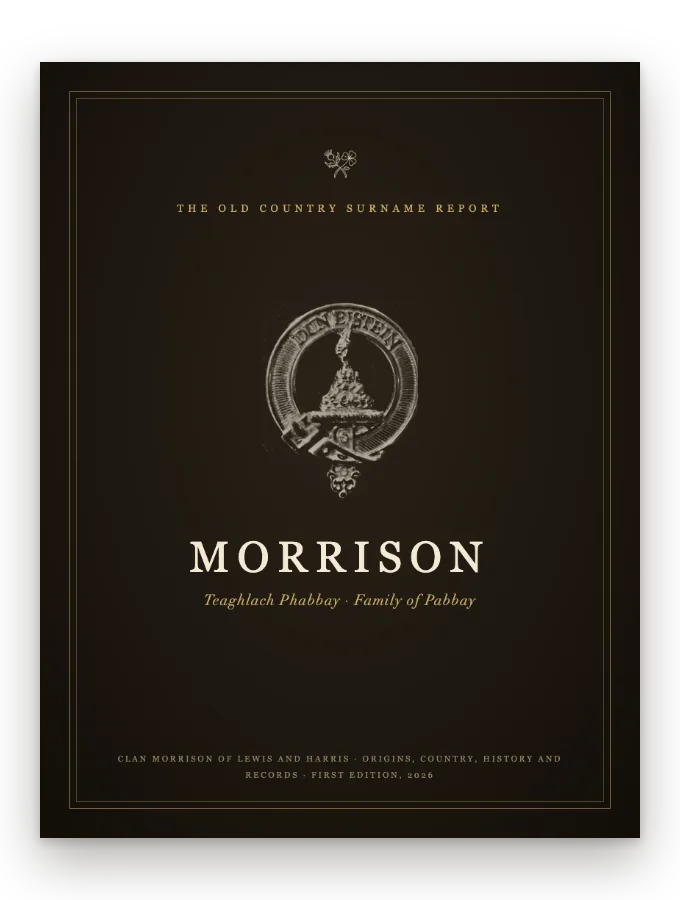
This report tells the story of the name Morrison, and of Morison, Gilmour, Gilmore, and the half-dozen other spellings that share its Gaelic root, plus one or two that only sound like it does. It is not, whatever the popular story says, one family's story. At least three or four separate naming events, on the Isle of Lewis, in Ireland, and across Lowland Scotland and England, converged on the same spelling by accident of language rather than blood. On Lewis, one Morrison family held something no ordinary clan possessed: a hereditary seat on the judge's bench, administering the island's own law for generations, before a wine-cask betrayal and a change of overlord ended it within a single lifetime.
The country of this name is a headland, not a glen. Ness sits at the northern tip of the Isle of Lewis, where croft land runs out to meet the open Atlantic with nothing between it and Canada. It is flat, treeless, wind-scoured ground, and it produced a family whose entire authority rested on the sea around it: driftwood as the founding legend, a stronghold reachable only across a ravine, and a wine ship as the instrument of the office's own undoing. The brieve's seat was at Habost, remembered locally as An Taigh Mòr, the Big House, though nothing of the building itself survives above ground today.
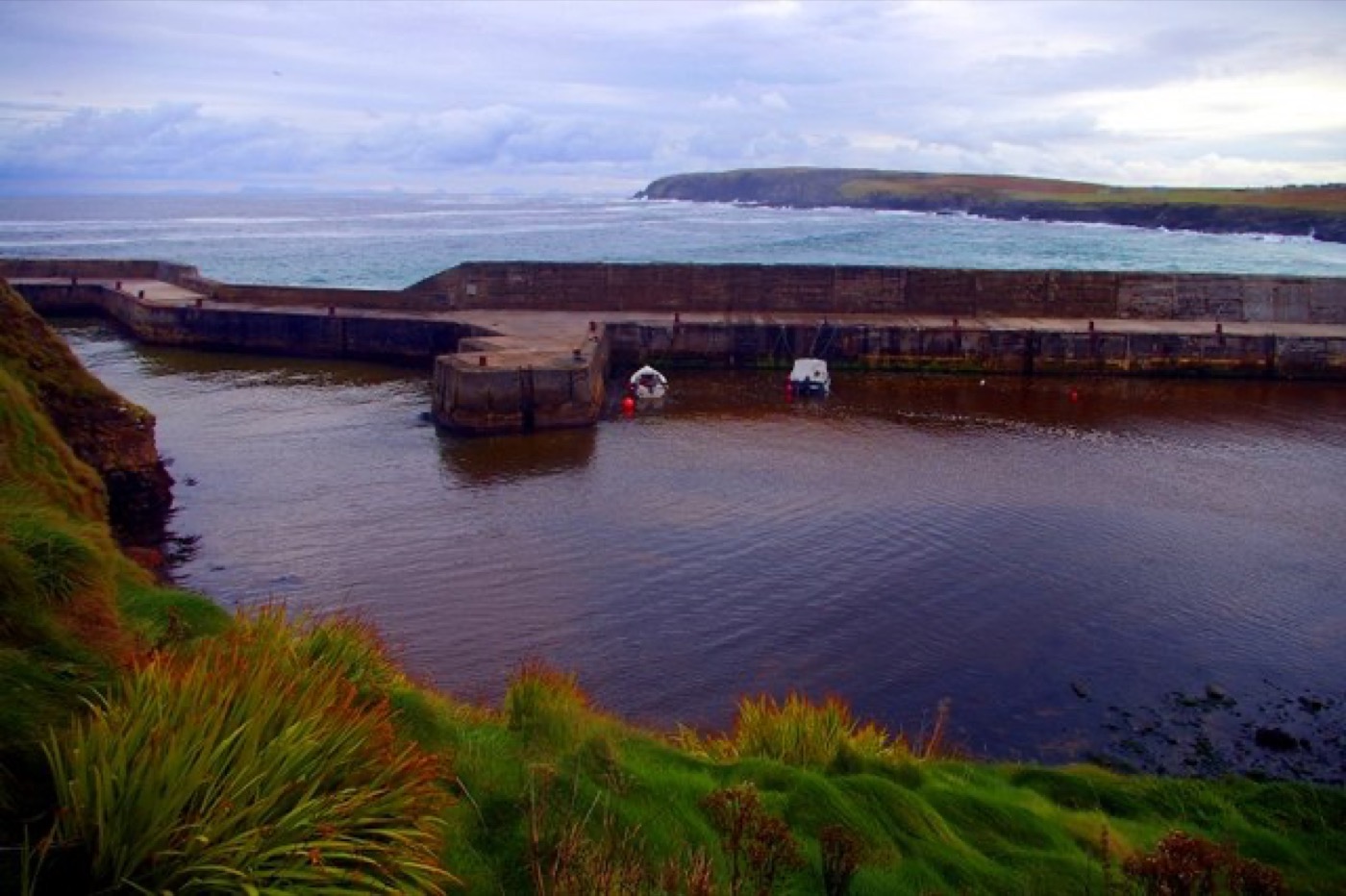
A few miles from Habost, on the north-east coast, a spur of rock called Dùn Èistean sits cut off from the mainland by a ravine some ten to fifteen metres across, crossed today by a footbridge. Tradition, already written down by the nineteenth century, held this was the Morrisons' island of refuge during the worst of the island's feuding. A short walk south is Teampall Mholuaidh at Eoropie, a restored thirteenth-century church that stood in the parish the Morrisons governed, even though no surviving record ties a specific Morrison gift or burial to the building itself.
Two more places belong to the story, both outside Lewis. On the mainland, at Inverkirkaig in Assynt, the brieve John Morrison was killed in the family's last stand against the MacLeods; a small island nearby still carries the name Eilean a' Bhrithimh, the Brieve's Island. And in Sutherland, the parish of Durness took in the family's survivors after the Mackenzie conquest. Writing in 1878, Thomas stated that in 1793 the natives of Durness and Eddrachillis were, with few exceptions, of the three surnames Mac Leay, Morrison or Macleod.
That was one chapter. The report carries the rest: where the name comes from, the clan and its chiefs, heraldry, the stories, a timeline, migration, the name today, notable bearers, and a page on tracing your own line. Every claim sourced the same way as the chapter above.
Get the Morrison report$14.99 · instant download, yours to keep and print
Not your name? Search yours, or read how we work, with another full chapter.
This history is written by AI from public-domain sources and the family's own published records, every one of them listed above. Where tradition and record disagree the text says so rather than choosing quietly. No image on this page is AI-generated.
First edition · last revised