 The Old Country
The Old Country
The Old Country
This report tells the story of a midland Irish name built, like so many, from a personal name nobody now remembers as a person: Ó Maoiléidigh, descendant of Maoléidigh, a name Rev. Patrick Woulfe's dictionary of Irish surnames glosses as armoured chief, built from maol, a devotee or a bald or shorn man, and éidigh, from éide, armour or war-gear. Whatever Maoléidigh himself did to earn that description, the family that carried his name forward settled the wooded, boggy midland country of Westmeath and Offaly, and by the sixteenth century Woulfe could call them, in his own words, a highly respectable family there, with an older, separate branch recorded in Corcumroe, in the north of County Clare.
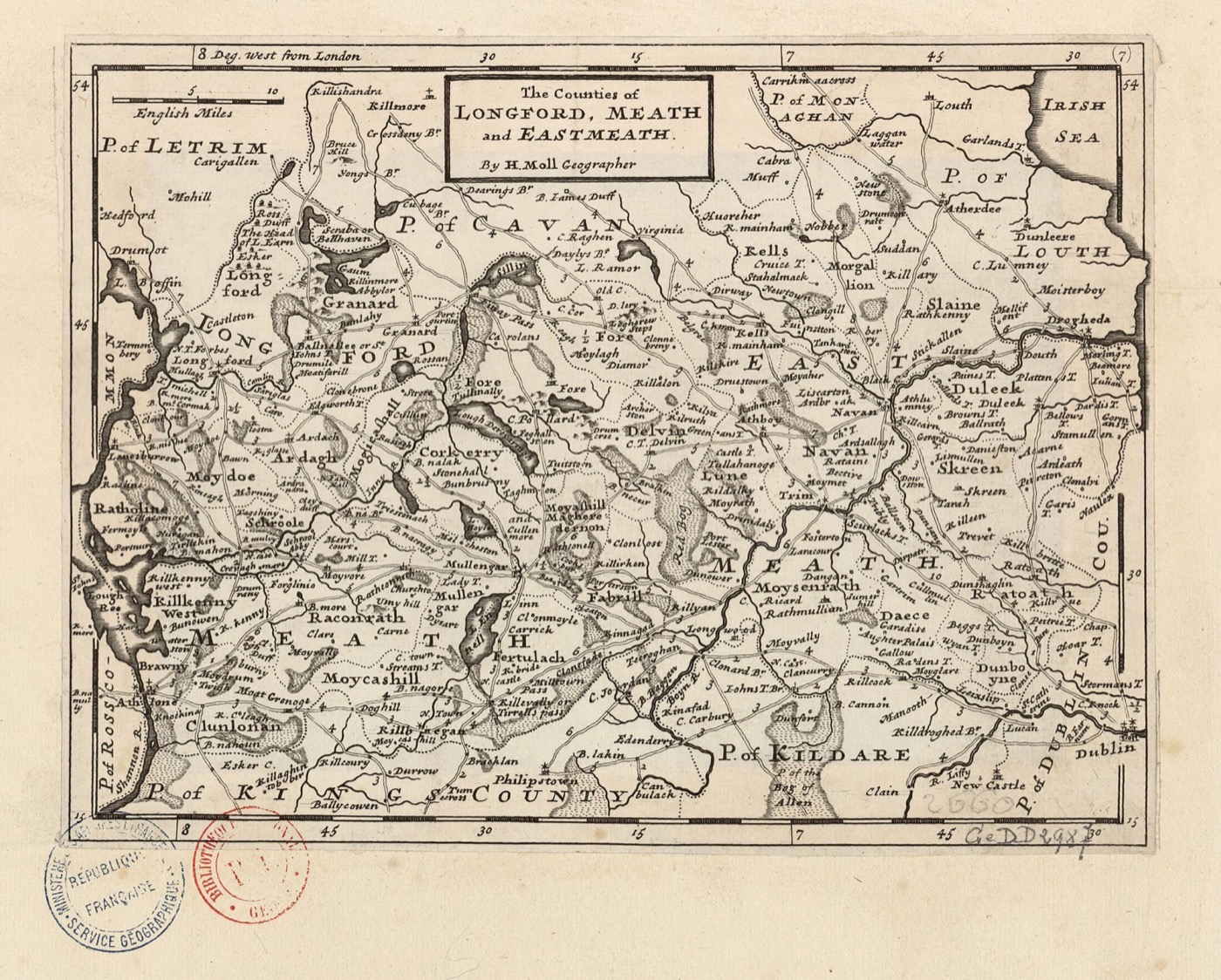
Westmeath and Offaly sit at the flat centre of Ireland, a country of bog, callow meadow and slow rivers rather than mountain fastness, the kind of ground that rewards a family's staying power more than its swordsmanship. This is the country Woulfe names plainly as Ó Maoiléidigh's own, a family he calls established and highly respectable there by the sixteenth century, without naming a single fortified seat or chieftaincy the way a Munster or Ulster armorial entry so often does. Mullingar, Westmeath's county town, and Ballymahon, just across the county line in Longford, sit at the working heart of this ground, and the Poor Law Union that shared both counties' names in the nineteenth-century administrative record is itself a small, honest sign of how little the modern county boundary meant to the people who actually lived and farmed there.
The same country was swept up, at its edge, in the last act of the 1798 Rising. General Humbert's French landing force, having beaten a British army at Castlebar in August, marched east through the disaffected districts of Longford and Westmeath before its final surrender at Ballinamuck, County Longford, on 8 September 1798, a few miles across the county line from the ground this report calls Ó Maoiléidigh's own. No source found and checked this session names a Mulready, Mulleady or Mulledy among the rebels, the French, or the Crown forces at Ballinamuck, and this report will not invent one; what it can say honestly is that the campaign's last battle was fought within a short march of this name's own recorded homeland, on the same flat midland ground, in the same season Woulfe's sixteenth-century record already places the family there.
A separate branch of the name, recorded by Woulfe in Corcumroe, a barony in the north of County Clare, sits on a wholly different landscape, limestone and Atlantic coast rather than midland bog. William Mulready RA, a documented bearer of the disputed Mulready spelling, was born in Ennis, the Clare county town, not far south of Corcumroe; a coincidence of county this report states plainly, since no proven line back to the Corcumroe branch itself was found.
That was one chapter. The report carries the rest: where the name comes from, the clan and its chiefs, heraldry, the stories, a timeline, migration, the name today, notable bearers, and a page on tracing your own line. Every claim sourced the same way as the chapter above.
Get the Mulleady report$14.99 · instant download, yours to keep and print
Not your name? Search yours, or read how we work, with another full chapter.
This history is written by AI from public-domain sources and the family's own published records, every one of them listed above. Where tradition and record disagree the text says so rather than choosing quietly. No image on this page is AI-generated.
First edition · last revised