 The Old Country
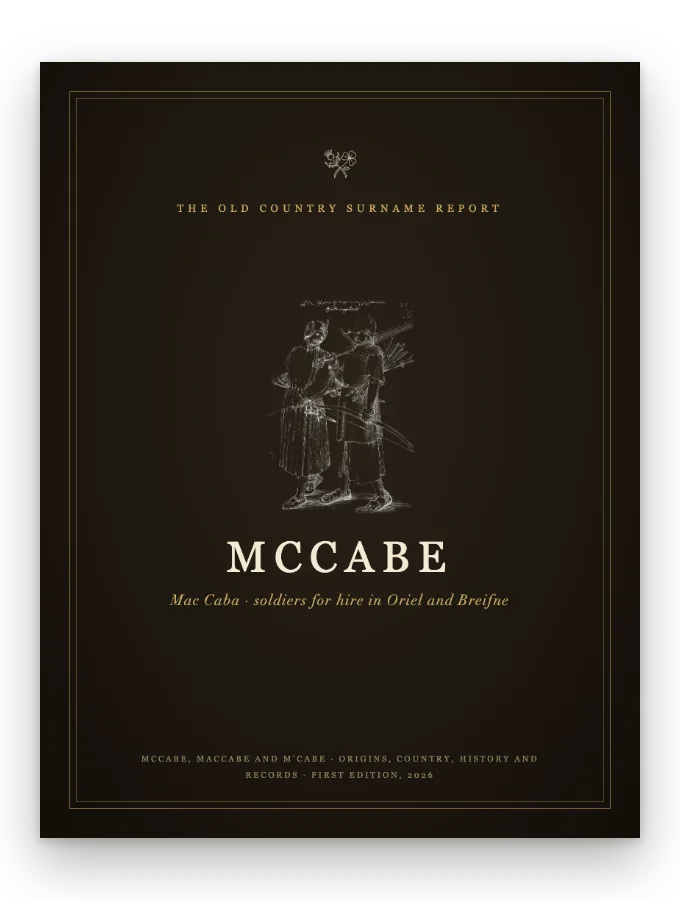
This report tells the story of the name McCabe: what it means, what the family did, the people who carried it, and how it crossed the ocean.
No email needed. It starts just below.
47 pages, 27 named sources, in your inbox within a minute.
The next page asks where to post it.
The hardback could not be added just now. Get your report here, and the hardback is offered on the next page for the same $79 in all.
Read it. If it is not the best account of your name you have seen, reply to your receipt within 14 days and we refund you.
“I have been tracing my family tree for some time, but there were certain stories that even our closest relatives never knew about. This surname report is a true deep dive. Thank you.”Susan D., reader
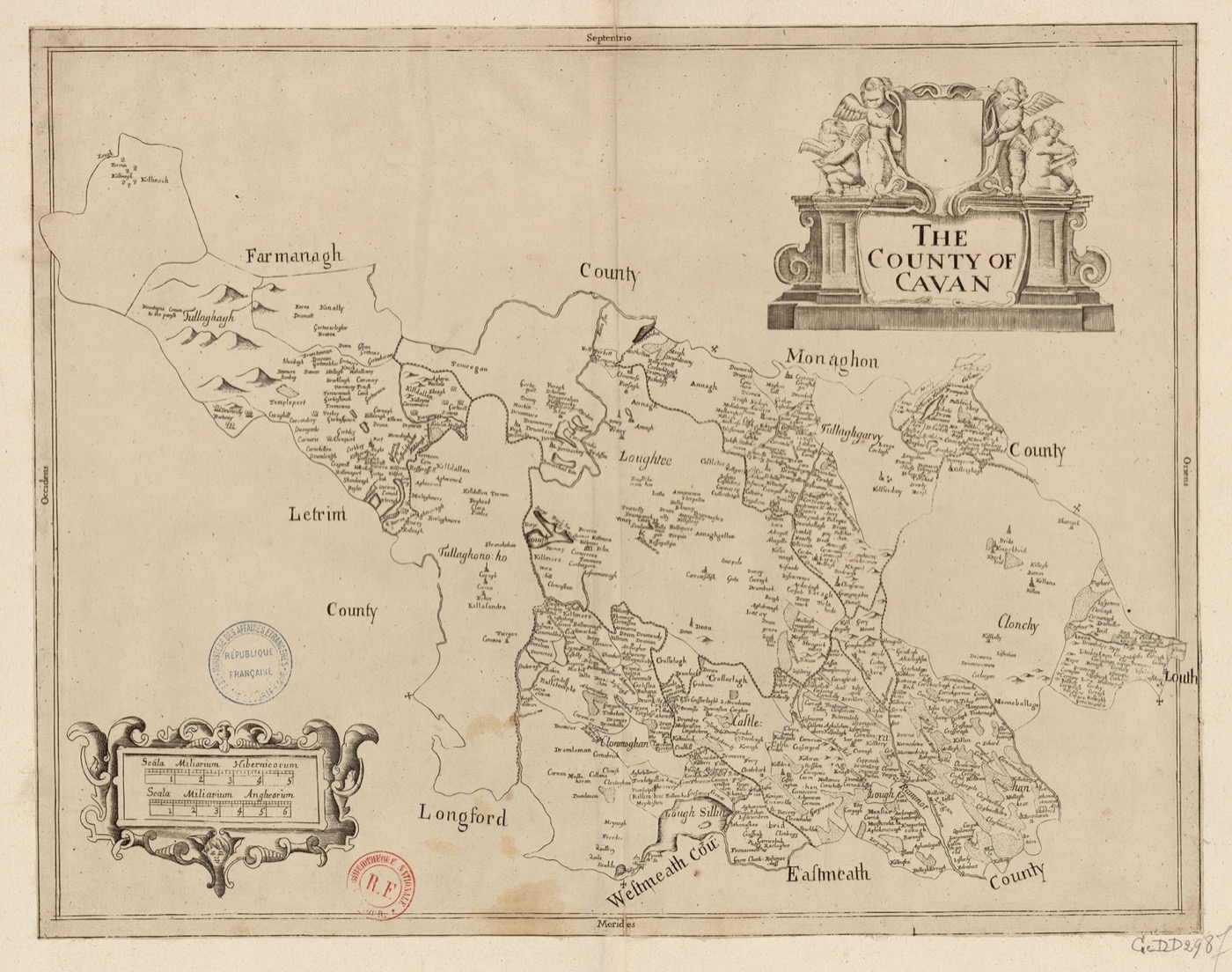
The McCabe country is the meeting of two Irish counties, Cavan and Monaghan, in Ulster, the northern province. The old names are Breifne and Oriel. Do not look for a great castle at its centre. Hired men lived where the work was. What the record gives you instead is names on land.
The land comes in the 1590s. The state's own papers, called the Fiants, show McCabes becoming named landholders in the Monaghan settlement of 17 November 1591. "Grant to Breine M'Cabe fitz Alexander; five tates", says one. A tate was a local measure of land. A pardon of about 1590 lists some ten McCabes in Leitrim beside Donnell O Rourke, and a pardon of 1601 lists more in Farney, in Monaghan.
Cavan has them too. Redmund M'Cabe "of Keishill" is there in 1593. In 1601 James and Brian M'Cabe appear as "yeomen", which meant small farmers, with "Katherine ny Cabe" beside them. G. A. Hayes-McCoy, in his book Scots Mercenary Forces in Ireland (1937), thought the family was still numerous in that country 150 years after Melaghlin died in 1424.
The counties kept the name. Robert Matheson, in his Special Report on Surnames in Ireland (1894), wrote that the MacCabes were "originally from County Monaghan, but subsequently settled in County Cavan". He gives no source, so that sentence is his alone. His births of 1890 put the name mainly in Cavan, Monaghan and Dublin.
The census of 1901 agrees. Cavan holds 1,343 McCabe records and Monaghan 1,119. That is 2,462 of the 6,157 placed in a county, or 40.0 per cent. Dublin comes third with 797, and Leitrim fourth with 399. By 1911 Monaghan had fallen to 927, while Cavan stood at 1,291. The table does not say why.
That was one chapter. The report carries the rest: where the name comes from, the family and its chiefs, heraldry, the stories, a timeline, migration, the name today, notable bearers, and a page on tracing your own line. Every claim sourced the same way as the chapter above.
Get my report · $14.99Instant download, yours to keep and print
Read it. If it is not the best account of your name you have seen, reply to your receipt within 14 days and we refund you.
Not your name? Search yours, or read another name's free chapter.
One piece of research, three more ways to have it. Every edition includes the McCabe report itself.
The McCabe report and a five and a half minute film of the name, your spelling on the title.
Get the film · $39.99The McCabe report as a hardback, posted free to your door.
Get the book · $79The report, the film and the hardback. Bought apart they are $118.99.
Get all three · $99For the wall. The McCabe record on one framed sheet, 16 by 12 inches, $89 posted free. See the framed plate.
A gift? Send the McCabe report on a day you choose, with a card.
This history is written from public-domain sources and the family's own published records, every one of them listed. Where tradition and record disagree the text says so rather than choosing quietly. No image on this page is AI-generated.
First edition · last revised