 The Old Country
The Old Country
The Old Country
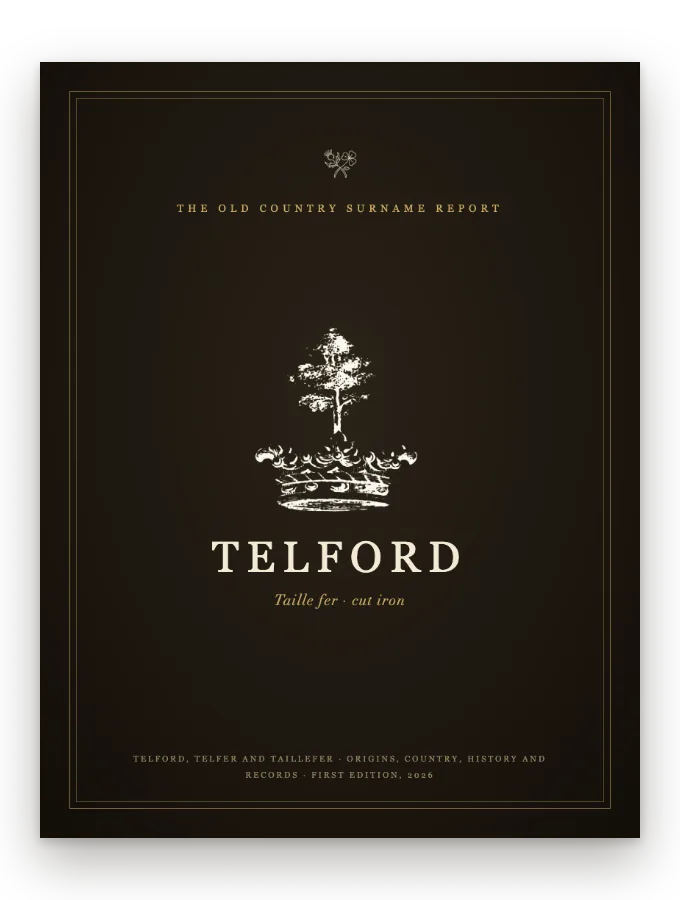
This report tells the story of the name Telford, and it begins by taking the name apart. Telford looks like a place name, a shallow crossing on some northern river, and nearly every cheap surname chart sells it that way. The scholarly dictionaries are unanimous that it is nothing of the kind. Telford is a fighting nickname in disguise: Old French taille fer, cut iron, the man whose blow went through chainmail. The ending drifted toward -ford in northern England centuries later, reshaped by habit to look like the place names around it. There is no ford in it at all, and the modern town of Telford in Shropshire took its name from a man of this surname in 1968, not the other way round.
The country of the record is upper Clydesdale: the treeless sheep hills where the Clyde begins, around Crawford, Crawfordjohn, Abington and Leadhills, some of the highest worked land in southern Scotland. This is where Haircleuch sits, where the 1369 charter ran, where the testaments of Telfer farmers were proved at Lanark from 1595, and where James Taillifeir raided the King's own gold diggings in 1607. It is lead and gold country as well as sheep country, and the family names of its record, in Liscleuch, Normangill, Whitegill and Shortcleuch, are a map of narrow glens that still carry those names today.
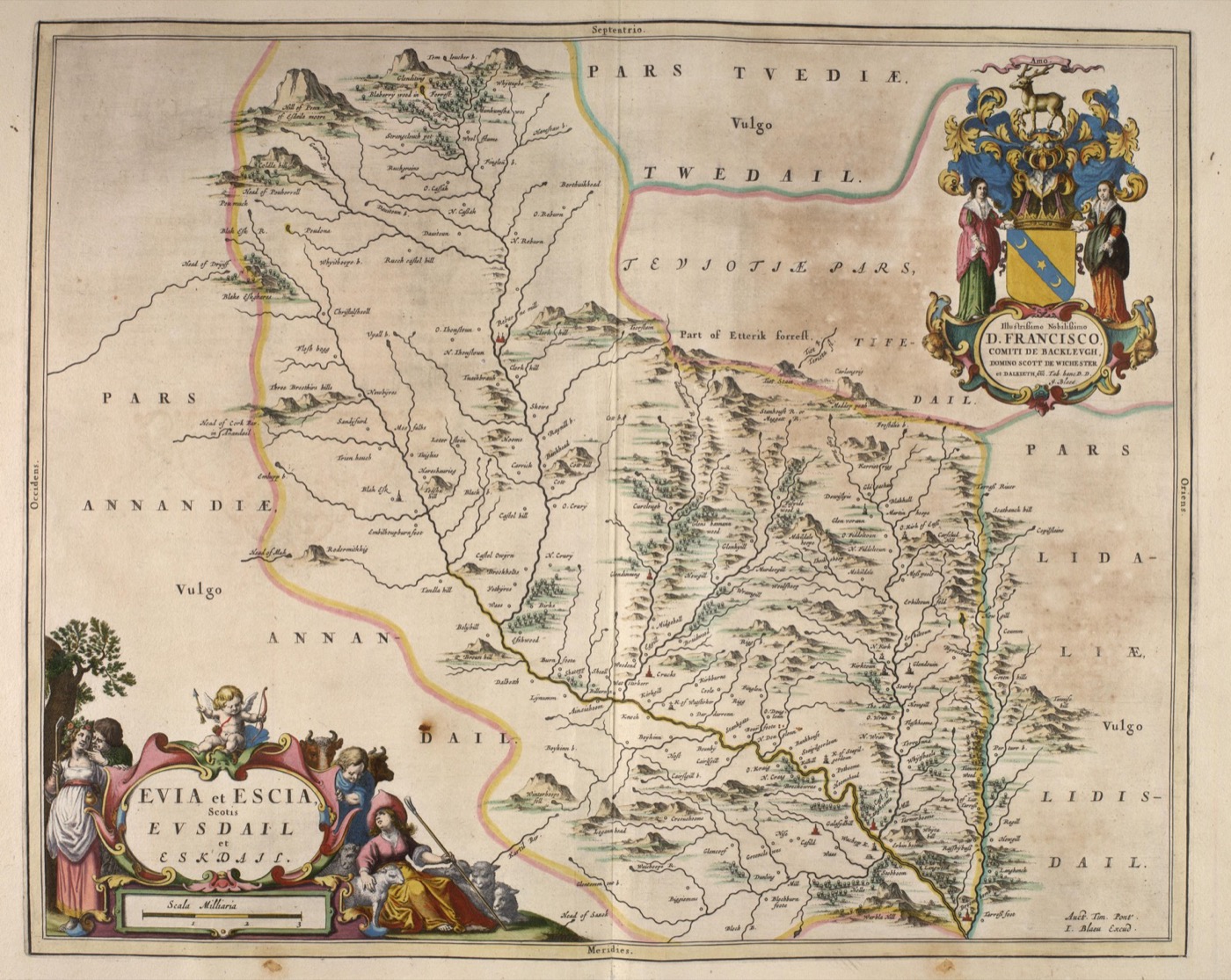
The country of the legend lies one watershed south: the Border dales. Down Annandale and into Eskdale and Ewesdale the name thickened through the seventeenth century, at Canonbie by 1696 and at Westerkirk by the eighteenth, with Langholm as its market town. Across the line in England it was at home in the North Tyne at Falstone. This is the landscape Joan Blaeu engraved in 1654 on the map reproduced in these pages, and it is the landscape of the ballad: Teviotdale, Liddesdale and the mosses between, where a man's cattle could be gone by morning and his nearest law was his neighbours.
Honesty requires one more sentence about those two heartlands. The ballad places Telfers at the Fair Dodhead in the raiding age itself, but the tower's very location is disputed, Scott putting it near Singlee in Ettrick while others argue for the Dod burn near Skelfhill, and Andrew Lang, who went through the estate records, could place no Telfer at either. The documented Border presence of the name begins later, with a drowned man's gravestone at Canonbie and a shepherd's family at Glendinning. The high Clyde holds the charters; the Border holds the story. Both are truly this name's country, but they are true in different ways.
That was one chapter. The report carries the rest: where the name comes from, the clan and its chiefs, heraldry, the stories, a timeline, migration, the name today, notable bearers, and a page on tracing your own line. Every claim sourced the same way as the chapter above.
Get the Telford report$14.99 · instant download, yours to keep and print
Not your name? Search yours, or read how we work, with another full chapter.
This history is written by AI from public-domain sources and the family's own published records, every one of them listed above. Where tradition and record disagree the text says so rather than choosing quietly. No image on this page is AI-generated.
First edition · last revised