 The Old Country
The Old Country
The Old Country
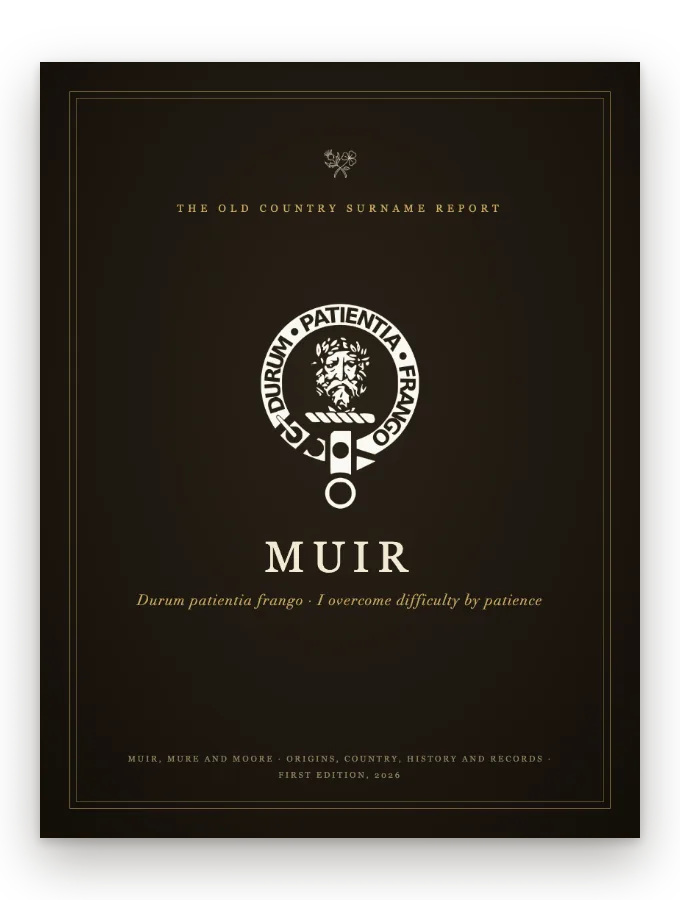
This report tells the story of the name Muir, and it begins by putting the name back on the ground. The word is Scots, not Gaelic. George Black's Surnames of Scotland, still the standard dictionary of Scottish names, gives Muir, Mure, Moor, Moore and More a single entry on page 617 and a single origin: from residence beside a moor or heath. The Dictionary of the Older Scottish Tongue carries the same word, mure, from 1375, meaning barren open country, moorland, heath. Somewhere in the south-west of Scotland, more than once and in more than one family, a man was known by the ground he lived beside, and it stuck to his children.
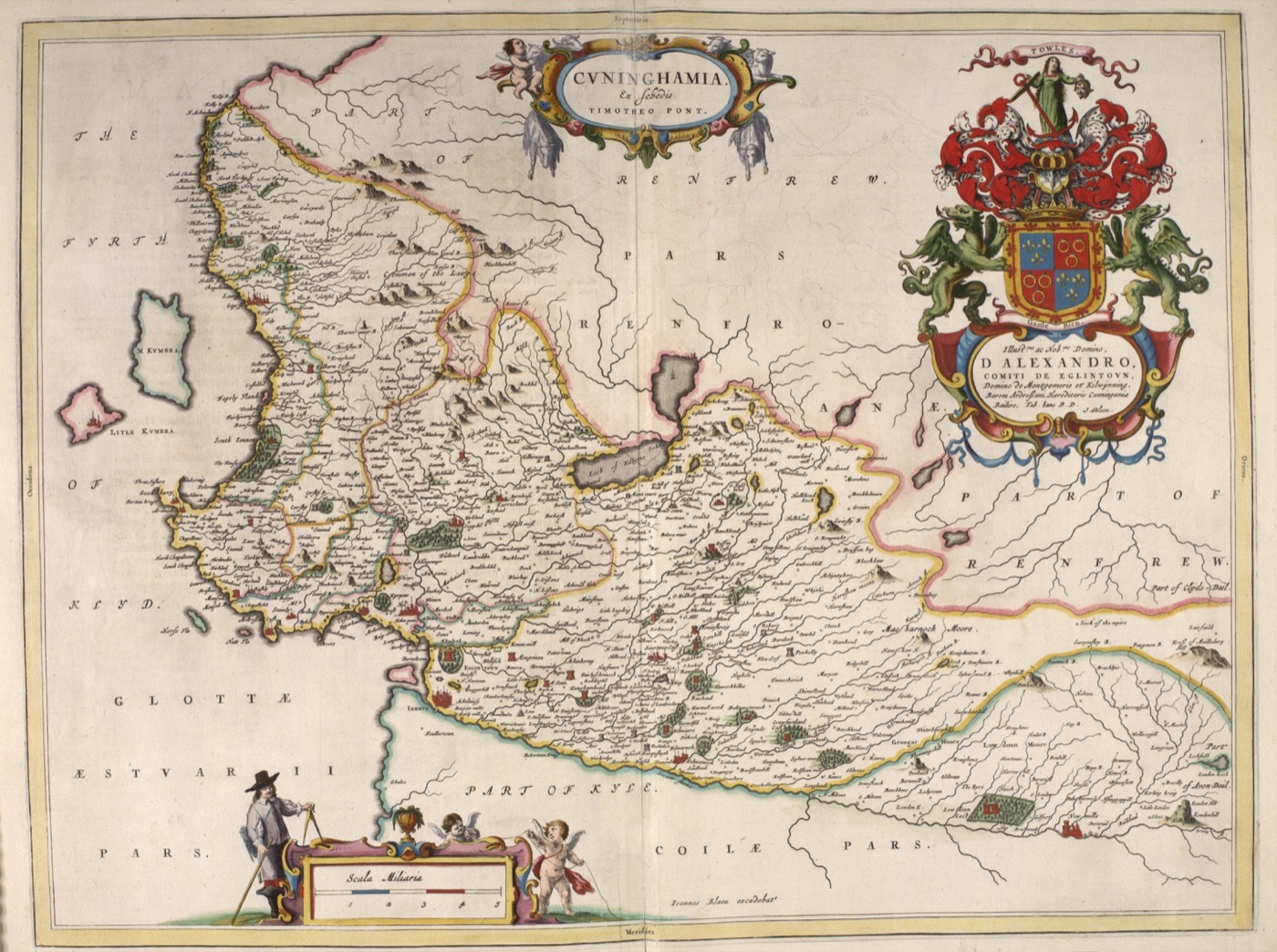
Ayrshire is not one country but three, and this name is in all of them. Cunninghame is the northern district, and it holds Rowallan in Kilmaurs parish, the Blaeu sheet of 1654 reproduced in these pages, and the lands in Conyngham where Adam and William de la More sat as jurors in 1296. Kyle is the middle district, the ground around Ayr itself, where Robert Mure kept the burgh school and Sir Thomas Kennedy was shot down on the road in 1602. Carrick is the south, running toward Galloway, and it holds Auchendrane on the Doon, Cloncaird near Kirkmichael, and the Bailliary of Carrick that John Mure of Auchendrane held from the Earl of Cassilis and then, as Pitcairn's record of the trial notes, lost through Culzean's influence.
The second heartland is Lanarkshire, and it is working country rather than a lairds' country. Symon de la More of Thankerton did homage there in 1296. Old Monkland, east of Glasgow, carries ground named Coatsmuir and Muiryhall and had peat moss in abundance toward the north, although the parish itself was fertile and heavily cultivated, called an immense garden in the Old Statistical Account: the moor is in the place names there, not across the whole landscape. Alexander Muir was born at Lesmahagow in 1830, and Daniel Muir, John Muir's father, was raised for a time at Crawfordjohn in the same county. Which of the two counties is the older home depends on how you count. Guppy's survey of 1890 put Muir in Ayrshire and Dumfriesshire, but he counted only farmers listed in post office directories, a method that cannot see an industrial county at all. In the later nineteenth century Lanarkshire held more Muirs by simple count; Ayrshire held them more densely, and had held them for six hundred years.
Almost all of the country in this chapter can still be stood in front of. Rowallan Castle at Kilmaurs keeps the 1562 marriage stone of John Mure and Marion Cuninghame on its south front, beside Robert Lorimer's Rowallan House of 1903. Caldwell, near Beith, was rebuilt by Robert Adam for William Mure between 1771 and 1773. Nothing of Auchendrane's tower survives: Paterson, writing in 1852, found a yew tree and nothing else, and the present house on the site dates from 1856. Culzean and Dundonald are open to visitors, and Huntershill House, Thomas Muir's home, still stands at Bishopbriggs. On the east coast, John Muir's birthplace at 126 High Street, Dunbar is a museum, and the Political Martyrs' Monument on Calton Hill carries Thomas Muir's own words.
That was one chapter. The report carries the rest: where the name comes from, the clan and its chiefs, heraldry, the stories, a timeline, migration, the name today, notable bearers, and a page on tracing your own line. Every claim sourced the same way as the chapter above.
Get the Muir report$14.99 · instant download, yours to keep and print
Not your name? Search yours, or read how we work, with another full chapter.
This history is written by AI from public-domain sources and the family's own published records, every one of them listed above. Where tradition and record disagree the text says so rather than choosing quietly. No image on this page is AI-generated.
First edition · last revised