The Old Country
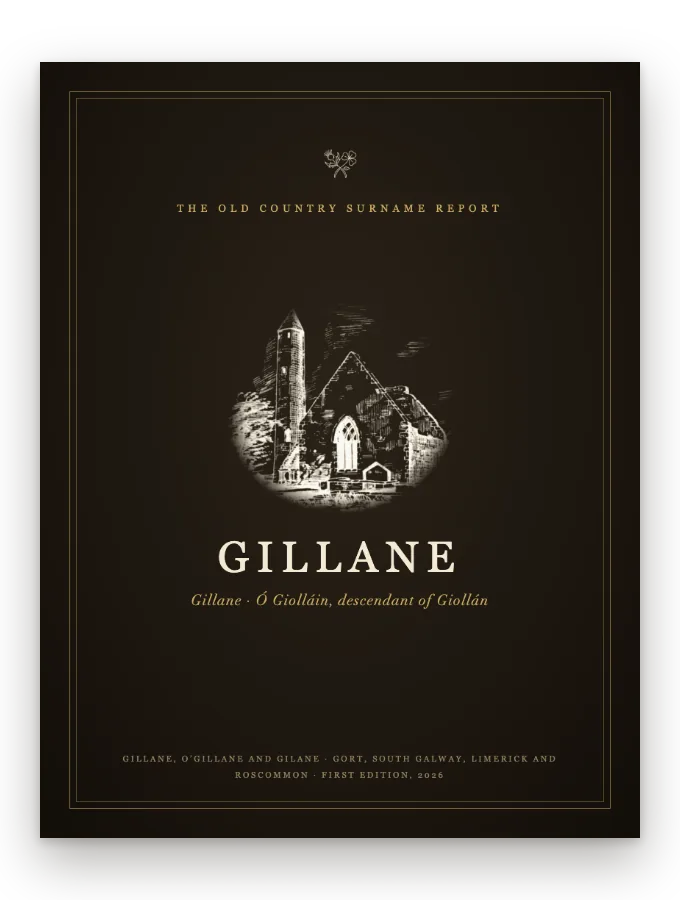
Cover of the Gillane Surname Report
Free to read · Ó Giolláin, round Gort in south Galway, with the Limerick and Roscommon families

GillaneSurname meaning, origin and history

This report is about a small Irish surname and the country where the record puts it. Gillane is an English form of the Irish Ó Giolláin, descendant of Giollán, and Giollán is a diminutive of giolla, which Patrick Woulfe, in his Irish Names and Surnames of 1923, translates as servant or youth. Woulfe lists Gillane first among the English forms of the name. The census of 1901 counted 61 people called Gillane in Ireland, and 40 of them lived within a few miles of Gort, in south Galway, in the districts of Kiltartan, Gort, Ardrahan, Cahermore and Kilbecanty.

Get my report · $14.99

42 pages, 24 named sources, in your inbox within a minute.

Read it. If it is not the best account of your name you have seen, reply to your receipt within 14 days and we refund you.

“I have been tracing my family tree for some time, but there were certain stories that even our closest relatives never knew about. This surname report is a true deep dive. Thank you.”Susan D., reader

Not today? Read the Gillane chapter free. We will email it to you.Rather read it later? We will email you the Gillane chapter.

One email: the link to this page and the free Sept Sheet, every Irish name on the shelf, its spellings and its families, county by county, on two printable pages. Nothing else unless you tick the box.

The Gillane name at a glance

Meaning
Ó Giolláin, descendant of Giollán, from giolla: servant or youth in Woulfe, lad in MacLysaght.
Earliest records
Donell roe O Gilan, County Sligo, 1590; Teige O Gillain, King's County, 1602: the earliest found in the Elizabethan fiants read.
Where
Round Gort, in south Galway: 40 of Ireland's 61 Gillanes in 1901, and 41 of 63 in 1911.
Griffith's, 1855
13 Gillane occupier entries in Galway, every one in the barony of Kiltartan and the union of Gort.
Which Gillane?
The Gort family; smaller families in Limerick and Roscommon; and other names that share Gillan and Gillen.
Spellings
Gillane, O'Gillane and Gilane are one name. Gillan and Gillen each stand for several names.
The play
The family of Cathleen ni Houlihan, first played in Dublin on 2 April 1902, is the Gillanes.
Civil registers
246 Gillane index entries, 113 of them in the Gort registration district.
Chapter four, free to read in full

Kiltartan and the country round Gort

The Gillane country is a small one, the barony of Kiltartan in south Galway, and three independent records draw it the same way. Griffith's Valuation, printed for this barony in 1855, has 13 entries for a Gillane occupier in County Galway, and every one is in the barony of Kiltartan and the Poor Law union of Gort: six in the parish of Kilbeacanty, at Gortnaclassagh, Knockaunawadda and Rakerin; five in Kiltartan parish, at Carrowbaun West, Newtown, Rinrush, Glenbrack and the town of Gort; and two in Kinvarradoorus, at Funshinmore and Caherawoneen North. Seven of the 13 were held from William H. Gregory, the name as the valuation prints it, and the rest from Robert D'Arcy, James Lahiff, Anne Hynes, Patrick M. Lynch and the Rev. Thomas Kelly. Twice a Gillane is the lessor: Martin Gillane let to John Cahill at Rakerin, and John Gillane to Thomas Naughton at Funshinmore.

Every one of the 13 Galway Gillane holdings in Griffith's of 1855 lies in the barony of Kiltartan.

The censuses find the family on the same ground. On the night of 31 March 1901, 40 of the 61 Gillanes in Ireland were in five neighbouring census districts: Kiltartan 16, Ardrahan 8, Cahermore 8, Gort 7 and Kilbecanty 1. In 1911 it was 41 of 63: Kiltartan 22, Ardrahan 9, Cahermore 7 and Gort 3. Six townlands are in both the valuation and the censuses: Carrowbaun West, Knockaunawadda, Rakerin, Rinrush, Glenbrack and Caherawoneen North, the last spelt Caheravoneen in 1901. Parish and census district do not match, so Griffith's puts Knockaunawadda and Rakerin in Kilbeacanty parish and the census puts them in the Kiltartan division. Ardrahan is about ten kilometres north of Gort, Kiltartan about seven. The households were farming families, with a baker in Gort and a railway man at Ballylara. In 1901, 25 of the 61 Gillanes were entered as speaking Irish and English, and 60 as Roman Catholic.

The civil registers say the same in their own way. The index on irishgenealogy.ie holds 246 entries for Gillane, and 113 of them, 45.9 per cent, are in the Gort registration district; Croom 23, Roscommon 22, Tipperary 19 and Galway 14 come next. The two smaller families sit in County Limerick, round Croom and Crecora, and in County Roscommon, at Athleague on the River Suck. What none of these records shows is how or when the family came to be round Gort. Griffith's is the earliest of the three, and it already finds Gillanes holding land in three parishes of the barony in 1855. No authority printed here says they came from the north, and this report does not say it either.
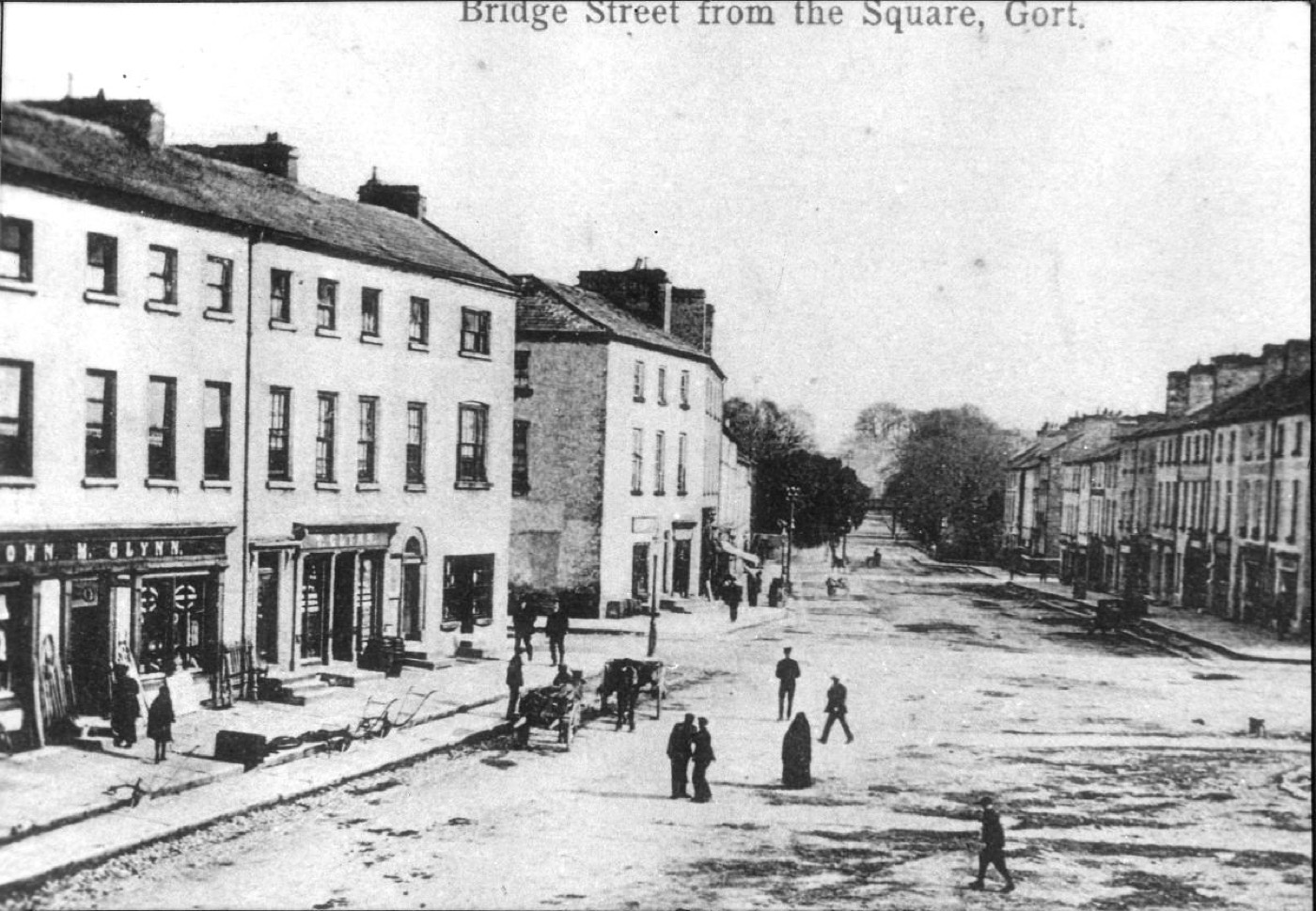
Bridge Street from the Square, Gort, in a print of about 1900 from Galway County Libraries. In 1901 William Gillane, 80, a baker, lived at No. 9, The Square, an
Bridge Street from the Square, Gort, in a print of about 1900 from Galway County Libraries. In 1901 William Gillane, 80, a baker, lived at No. 9, The Square, and the Gort district holds 113 of the 246 Gillane entries in the civil index. Galway County Libraries, via Wikimedia Commons; public domain.
Ó Giolláin, round Gort in south Galway, with the Limerick and Roscommon families · 42 pages

The full Gillane surname report

That was one chapter. The report carries the rest: where the name comes from, the family and its chiefs, heraldry, the stories, a timeline, migration, the name today, notable bearers, and a page on tracing your own line. Every claim sourced the same way as the chapter above.

Get my report · $14.99

Instant download, yours to keep and print

Read it. If it is not the best account of your name you have seen, reply to your receipt within 14 days and we refund you.

Not your name? Search yours, or read another name's free chapter.

The editions

Read it, watch it, or keep it on the shelf.

One piece of research, three more ways to have it. Every edition includes the Gillane report itself.

Watch itin five days$39.99

The Gillane report and a five and a half minute film of the name, your spelling on the title.

Get the film · $39.99
Keep itin two weeks$79

The Gillane report as a hardback, posted free to your door.

Get the book · $79
All three Best valuesaves $19.99$99

The report, the film and the hardback. Bought apart they are $118.99.

Get all three · $99

For the wall. The Gillane record on one framed sheet, 16 by 12 inches, $89 posted free. See the framed plate.

A gift? Send the Gillane report on a day you choose, with a card.

The sources page, in fullWhere every claim on this page comes from.
Where the record is uncertainWhere this report cites an early record it cites the edition that prints it: the pardons through the Deputy Keeper's calendar of the Fiants, the valuation through Griffith's as indexed, the censuses through the National Archives' returns, the play and the essay through their first printings. Where one writer is the only authority for a statement, the report says whose it is. No commercial surname site was used as corroboration.
  • Patrick Woulfe, Sloinnte Gaedheal is Gall: Irish Names and Surnames (Dublin, 1923), s.v. Ó Giolláin, Ó Giollagáin, Ó Gilín, Ó Gealáin, Ó Giollaráin, Mac Gileáin, Mac Gealáin, Mac Giolla Fhaoláin and Mac Giollagáin
  • Edward MacLysaght, The Surnames of Ireland (Irish Academic Press, 1985), s.v. Gillan, Gillen, Gilleen, Gilligan, Gilgan, Gilliland, Gilleran, Killeen, Galligan and Gillanders
  • Dictionary of American Family Names, 2nd ed. (Oxford, 2022), s.v. Gillan, Gillen, Gillon, Gilland and Gillin
  • G. F. Black, The Surnames of Scotland (New York Public Library, 1946), s.v. Gillan, Gilliland and Gullan
  • R. E. Matheson, Special Report on Surnames in Ireland (Dublin, 1894), p. 46; R. E. Matheson, Varieties and Synonymes of Surnames and Christian Names in Ireland (Dublin, 1901)
  • Calendar of Fiants, Elizabeth, in the 16th and 18th Reports of the Deputy Keeper of the Public Records in Ireland, fiants 5475, 6515 and 6618
  • Annals of the Kingdom of Ireland by the Four Masters, ed. John O'Donovan, via CELT
  • Griffith's Valuation, General Valuation of Rateable Property in Ireland (1850-1857), the Gillane entries for Galway, Limerick, Roscommon and Tipperary, as indexed on askaboutireland.ie
  • National Archives of Ireland, Census of Ireland 1901 and 1911, surname search (exact match), and the household returns
  • Civil registration index, irishgenealogy.ie, the Gillane entries; National Library of Ireland, Catholic parish registers, registers.nli.ie
  • W. B. Yeats and Lady Gregory, Cathleen ni Houlihan, in The Hour-Glass; Cathleen ni Houlihan; The Pot of Broth (Dublin and London, 1905), p. 35
  • Lady Gregory, Our Irish Theatre: A Chapter of Autobiography (New York and London, 1913), pp. 82-83 and the list of performances
  • W. B. Yeats, The Celtic Twilight (London, 1902), "Dust Hath Closed Helen's Eye", pp. 46-47; The Dome, October 1899
  • Lady Gregory's Journals 1916-1930, ed. Lennox Robinson (London, 1946), the entry for 24 April 1929
  • Dictionary of Irish Biography: Gregory, Sir William Henry; Gregory, (Isabella) Augusta; Dirrane, Bridget (nee Gillan), www.dib.ie/biography/dirrane-bridget-nee-gillan-a9481
  • National Archives of Ireland, Ireland-Australia Transportation Records, TR 12, p. 56; FreeCEN, the 1851 and 1891 census transcriptions; Irish Famine Memorial, Orphan Database
  • Political Graveyard, Gillen, Charles P.; Biographical Directory of the United States Congress 1774-2005 (2005), p. 1120; Portrait and Biographical Record of Sheboygan County, Wisconsin (1894), pp. 583-584
  • Arthur J. Hope, Notre Dame: One Hundred Years; Australian National Herbarium, Gillen, Francis James, from Short, In Pursuit of Plants (2003); Olympedia, James Angus Gillan; GAA.ie, 5 April 2026
  • Sir Bernard Burke, The General Armory (1884), p. 400, the Gilland and Gillon entries; Fairbairn's Book of Crests, 4th ed., vol. 1, p. 226; Clans of Ireland, Register of Clans 2026
  • United States Census Bureau surname files, 2010 and 2020; National Records of Scotland, Most Common Surnames, 1975 to 2025
  • Cover device: "Kilmacduagh Cathedral, from the north east", engraving, The Reliquary and Illustrated Archaeologist, new series vol. 6 (April 1892), p. 92, public domain.
  • Lady Gregory's Journals, ed. Daniel J. Murphy, vol. 1 (Gerrards Cross, 1978), pp. 402 and 405, and the note on the cover photograph
  • Cornelius Weygandt, Irish Plays and Playwrights (Boston, 1913), the plate of Cathleen ni Houlihan; the Abbey Theatre opening week poster, December 1904, National Library of Ireland
  • Photographs: Jerzy Strzelecki (Thoor Ballylee), 2007, CC BY-SA 3.0, Wikimedia Commons; scan by Chetham's Library (Athenry station), CC BY-SA 4.0, Wikimedia Commons

This history is written from public-domain sources and the family's own published records, every one of them listed. Where tradition and record disagree the text says so rather than choosing quietly. No image on this page is AI-generated.

First edition · last revised

More surname histories, free to read

Every surname we have written →