 The Old Country
The Old Country
The Old Country
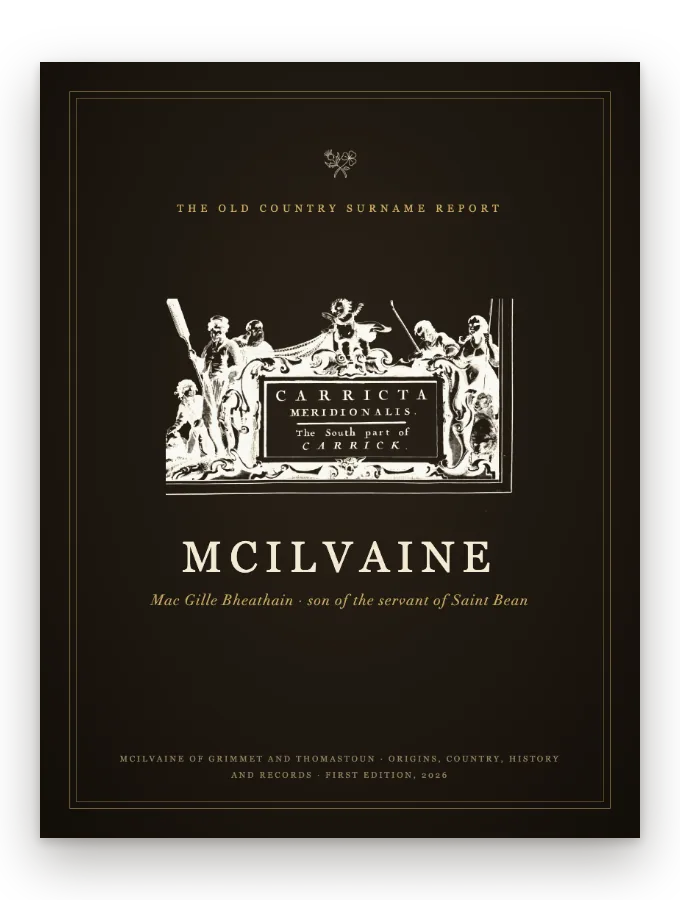
This report tells the story of a name built from an old habit of Gaelic naming: not a description of the man himself, but of his devotion. McIlvaine, in its oldest form Mac Gille Bheathain, means son of the servant of Saint Beathan (Bean); gille marks service, not blood, the same pattern that gives Gillespie, servant of the bishop, and Gilchrist, servant of Christ. Whoever the first Gille Bheathain was, service is what his own name records, not descent. The family this surname settles on first is a small Carrick lairdship in south Ayrshire: the McIlvaines of Grimmet, holders of Grimmet and Attiquin from a royal charter of 1529, later lairds of Thomastoun Castle on the coast road between Culzean and Maidens. George F. Black's Surnames of Scotland gives the earliest record as Gilbert Macilmeyn of Grimmet, entered in the Register of the Privy Seal in 1503.
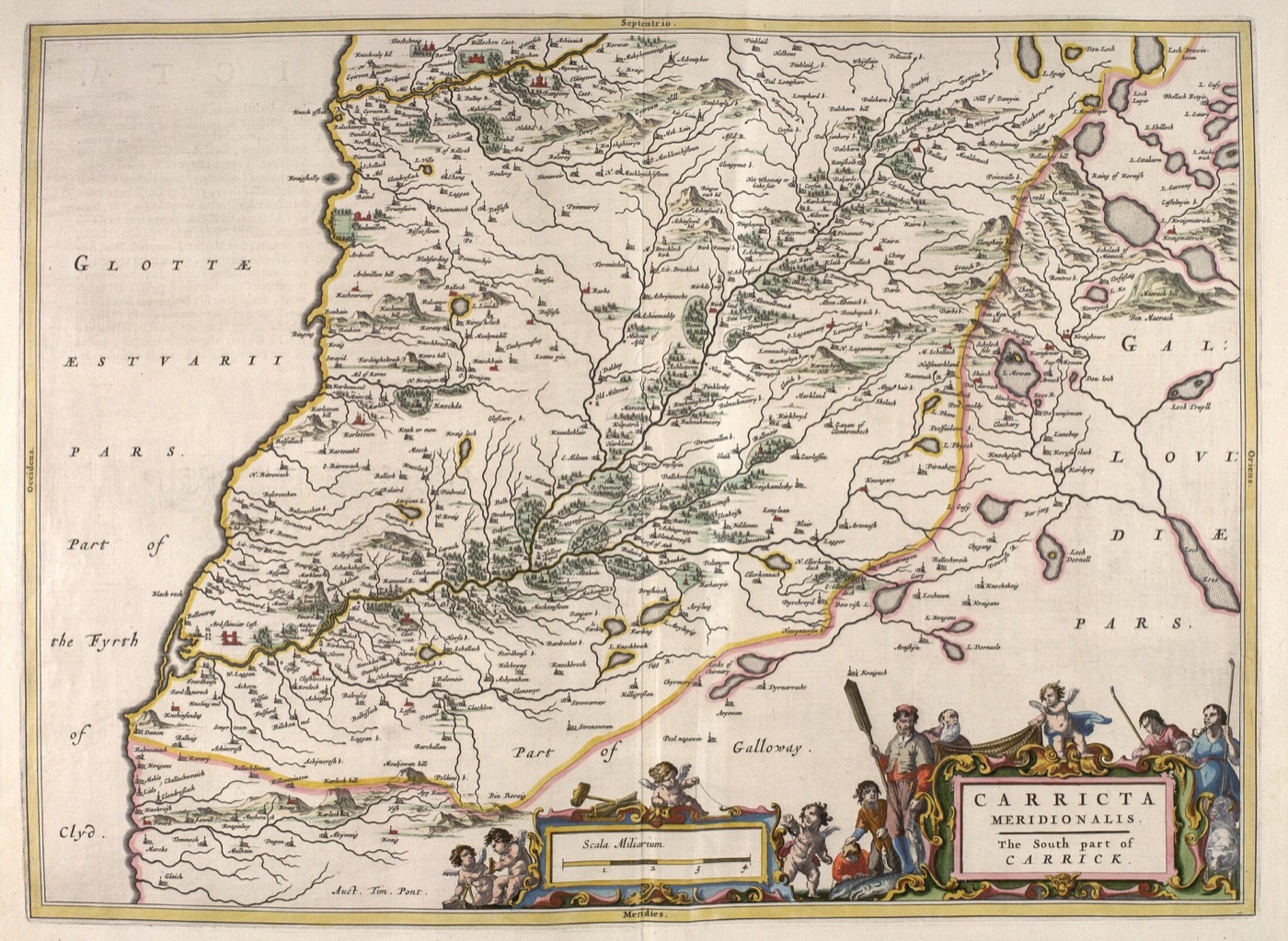
Carrick is the southern third of Ayrshire, hill and pasture country running from the Firth of Clyde inland toward Galloway, harder ground than the rich lowlands of Kyle further north. Grimmet and Attiquin, the McIlvaine family's own lands under the 1529 charter, sit within it, a few miles east of Maybole, the small town that served as Carrick's own capital under the Kennedy Earls of Cassillis. Maybole's Collegiate Kirk, founded by the Kennedys in the fourteenth century, is where, in 1632, John McIlvaine joined five fellow Carrick lairds in a contract to repair and maintain the building as a shared family burial place, perpetuating a pre-Reformation function the new Kirk of Scotland had otherwise abandoned there.
A few miles further west, on the coast road toward Maidens, stands Thomastoun Castle, the McIlvaine family's second seat, and closer still to Maybole itself, Crossraguel Abbey, the Cluniac house whose Abbot held the Regality, the right to administer justice across Carrick, and whose Bailie, from 1529, was Alano McIlvaine himself. Culzean, the Kennedy Earls' own great house on the coast nearby, replaced an older tower called Coiff in 1777; before that rebuilding, the McIlvaines' own merchant trade out of Thomastoun is said, in the family's own account, to have used the sea caves beneath the cliffs there.
None of this ground was ever the McIlvaine family's alone to hold. Carrick belonged, in practice, to the Kennedys, and the McIlvaines held their two seats as tenants and allies of that greater family, drawn into its feuds as readily as into its favour, until debt, not conquest, finally ended their tenure of both Grimmet and Thomastoun in the 1740s.
That was one chapter. The report carries the rest: where the name comes from, the clan and its chiefs, heraldry, the stories, a timeline, migration, the name today, notable bearers, and a page on tracing your own line. Every claim sourced the same way as the chapter above.
Get the McIlvaine report$14.99 · instant download, yours to keep and print
Not your name? Search yours, or read how we work, with another full chapter.
This history is written by AI from public-domain sources and the family's own published records, every one of them listed above. Where tradition and record disagree the text says so rather than choosing quietly. No image on this page is AI-generated.
First edition · last revised