 The Old Country
The Old Country
The Old Country
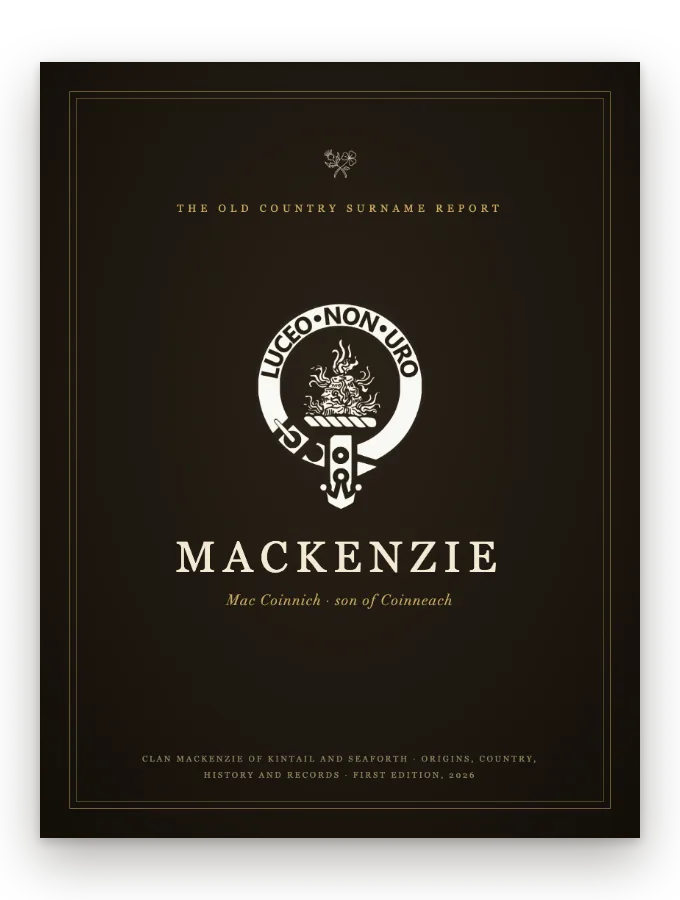
This report tells the story of the name Mackenzie: Gaelic Mac Coinnich, son of Coinneach, a personal name usually glossed comely or handsome and rendered in English as Kenneth. One requester wrote the clan's name in Gaelic as Clann MacCoinneach, moran taing, thank you very much, and this report carries that spelling prominently alongside the more standard modern form, Mac Coinnich, Clann MhicCoinnich. The clan's own homeland is Kintail, a stretch of hill and sea loch country in Wester Ross where Eilean Donan Castle stands at the meeting of three lochs; its greater story runs on from there to Brahan Castle near Dingwall, to Castle Leod at Strathpeffer, and to the Isle of Lewis, held by the family from 1610 until 1844, for much of that time as Earls of Seaforth, a title itself interrupted by forfeiture and re-creation along the way.
Kintail, the head of the kyle, is hill and sea loch country in Wester Ross, where Loch Duich, Loch Long and Loch Alsh meet at a tidal island the Mackenzies fortified as Eilean Donan. It is dramatic ground rather than rich farmland, the kind of country a family could hold against rival neighbours for centuries without ever ruling a whole province, and it is the ground the family's reported 1362 charter, unlocated today, and the surviving 1509 Eilean Donan grant both name as its own.
The clan's story did not stay in Kintail. Colin Mackenzie became Earl of Seaforth in 1623 and built Brahan Castle, three and a half miles from Dingwall in Easter Ross, as the family's grander seat; rebuilt and enlarged through the nineteenth century, it stood until the early 1950s, when the postwar building was demolished, leaving only a garden wall and the surviving stable block, now known as Brahan House. A separate branch, descended from a younger son of the first Earl of Seaforth, built Castle Leod at Strathpeffer around 1616; it became the seat of the Earls of Cromartie and remains the home of the clan's chief today.
The family's reach went further again. In 1672 the Mackenzies captured Ardvreck Castle from the MacLeods of Assynt, carrying the name north into Sutherland; from 1610 until its sale in 1844 they held the Isle of Lewis itself, the estate that gave the Seaforth earldom its name, though the earldom itself was interrupted, forfeited in 1716 and re-created only in 1771, as a new Irish peerage rather than the old Scottish title restored. Sir Alexander Mackenzie, whose story runs through this report's chapter on the diaspora, was born near Stornoway on that same island.
That was one chapter. The report carries the rest: where the name comes from, the clan and its chiefs, heraldry, the stories, a timeline, migration, the name today, notable bearers, and a page on tracing your own line. Every claim sourced the same way as the chapter above.
Get the MacKenzie report$14.99 · instant download, yours to keep and print
Not your name? Search yours, or read how we work, with another full chapter.
This history is written by AI from public-domain sources and the family's own published records, every one of them listed above. Where tradition and record disagree the text says so rather than choosing quietly. No image on this page is AI-generated.
First edition · last revised