 The Old Country
The Old Country
The Old Country
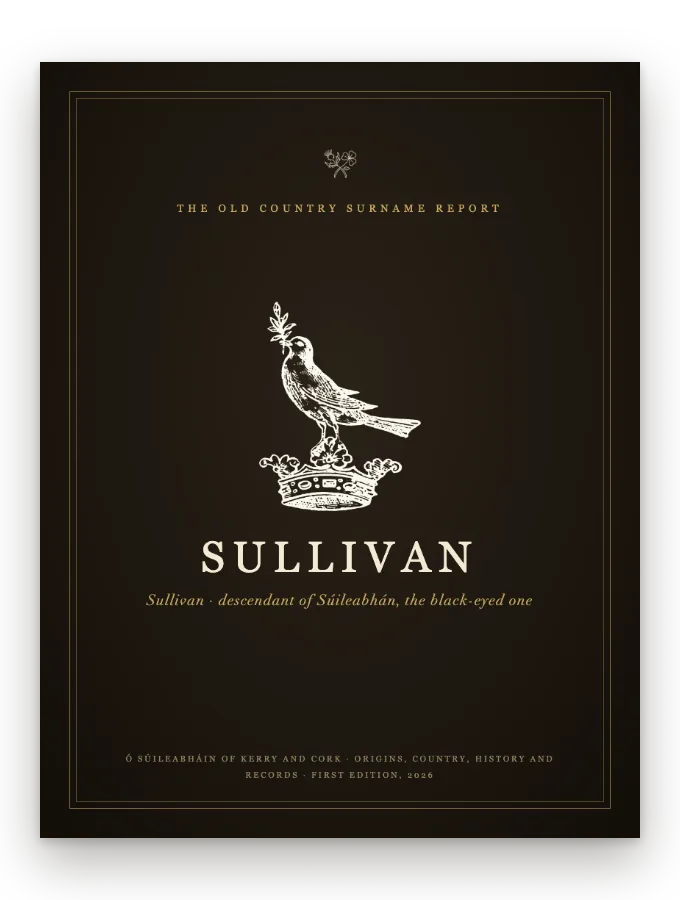
This report is about a surname built from a description of one man's eyes. Ó Súileabháin joins súil, the Irish word for eye, to a diminutive ending, and Woulfe's own dictionary of 1923 reads the whole of it as súil-dubhán, black-eyed. Other glosses circulate, one-eyed here, hawk-eyed there, but none of them carries a named source, so this report keeps Woulfe's own reading and says plainly that the rest is repetition, not evidence.
Cork and Kerry are not a general Irish backdrop for this name; they are, in the census of Ireland and in Matheson's report alike, the country that actually holds it. In the 1911 census of Ireland, 11,669 people were indexed as Sullivan in Cork and 9,543 in Kerry, out of 26,969 counted across the whole island under that spelling: together the two counties held more than three in every four. O'Sullivan, counted as its own spelling, has the same shape: 7,312 people, 2,968 of them in Cork and 2,554 in Kerry. The 1901 census gives the same picture: Cork at 13,255 and Kerry at 10,927 out of 30,259 Sullivans, and 2,871 in Cork and 2,205 in Kerry out of 6,647 O'Sullivans. Matheson's 1894 report on the 1890 birth registers independently calls Sullivan the predominant name in exactly these two counties. Three different counts, two decades apart, agree.
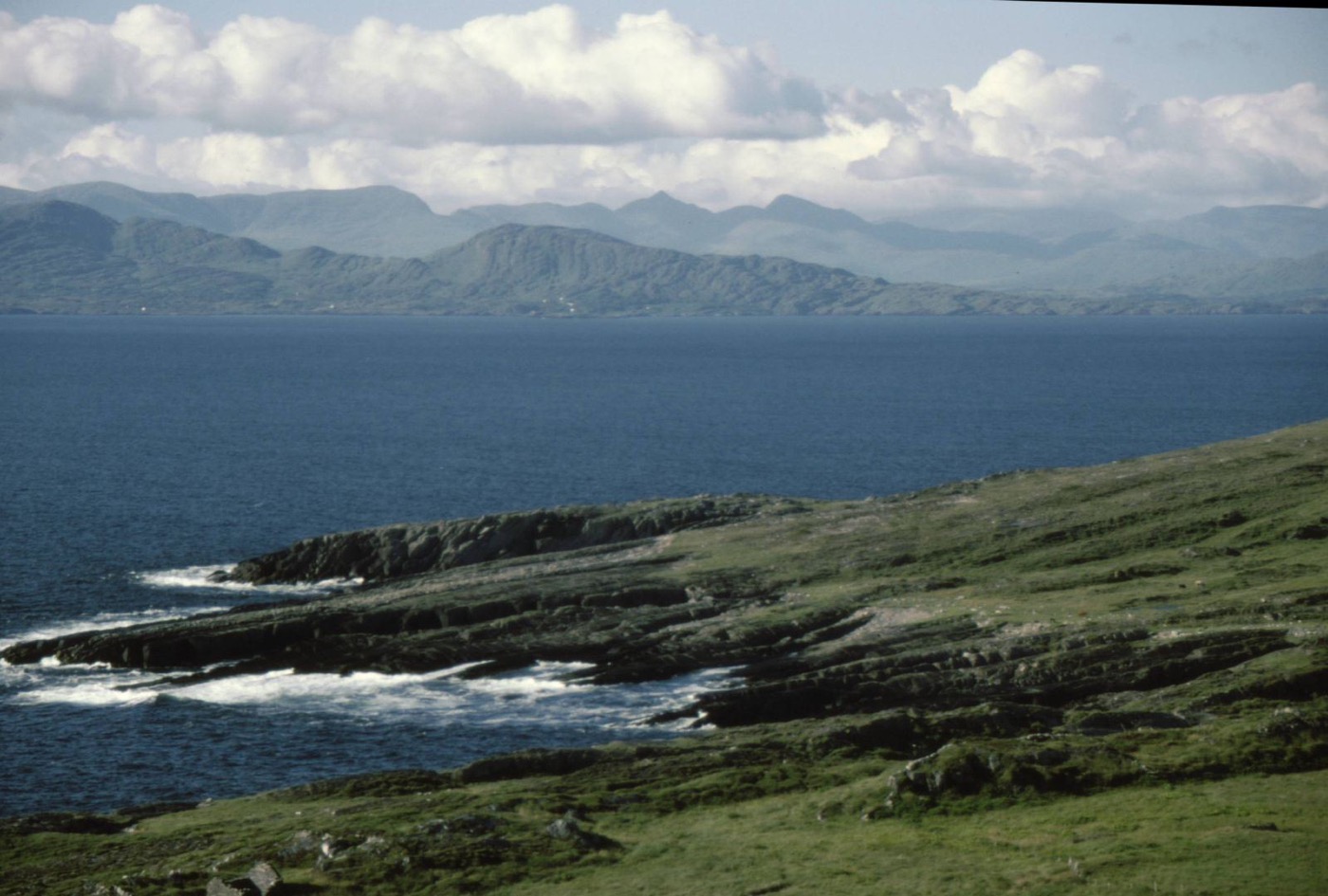
The ground itself explains some of that concentration. South Kerry and west Cork are mountain and coastal country, the Beara and Iveragh peninsulas running out into the Atlantic between deep sea inlets, harder land to farm than the wheat country further east and, for exactly that reason, land an Anglo-Norman advance found less worth the taking. Dunkerron's castle stands on the Kenmare river; Dunboy stood on Bantry Bay at the mouth of the Beara peninsula.
The Beare house held more than Dunboy. Carriganass, near Kealkill north-east of Bantry, was probably built about 1540 by a Dermot O'Sullivan of the same sept, and passed into Carew's hands during the Dunboy campaign. Ardea, in the parish of Tuosist on the Kerry side of the Beara peninsula, was another stronghold of Donal Cam O'Sullivan Beare. The country the family left behind is marked too: Heritage Ireland dates the Norman motte at Knockgraffon, five kilometres north of Cahir, to 1192, the same year Woulfe gives for the O'Sullivans' forced move out of Tipperary, from a principal seat he places at Knockgraffon itself.
What the numbers cannot do is sort one Sullivan household from another. The two counties held tens of thousands of people of this name in 1911; a shared county is a lead worth following in a parish register, never proof of which house, Mór or Beare, a particular family belonged to.
That was one chapter. The report carries the rest: where the name comes from, the clan and its chiefs, heraldry, the stories, a timeline, migration, the name today, notable bearers, and a page on tracing your own line. Every claim sourced the same way as the chapter above.
Get the Sullivan report$14.99 · instant download, yours to keep and print
Not your name? Search yours, or read how we work, with another full chapter.
This history is written by AI from public-domain sources and the family's own published records, every one of them listed above. Where tradition and record disagree the text says so rather than choosing quietly. No image on this page is AI-generated.
First edition · last revised